Mar 26, 2011

Richard Russell: Gold. Out in the Open

Out in the Open

Clipping from Richard Russell's "Dow Theory Letters"

March 24, 2011 -- "There is only one certainty regarding paper money -- the longer you hold it, the less it will buy in terms of real goods or real money -- gold." Richard Russell.
Yesterday was a banner day for the precious metals. Gold closed at an all-time high in terms of dollars. Silver moved into the 37 dollar zone for the first time since the precious metal bull market of the 1970s (today it's above 38 dollars an ounce!).
But there's a big difference between the current precious metals bull market and the bull market of the 1970s. The 1970 bull market drew tremendous interest (I was there). Everybody I knew (even the gold haters) were watching that bull market with keen interest, particularly during the wild "blow off" days of the late 1970s, when silver was rocketing higher -- rising every day by "limit up."
In comparison, today's huge precious metal bull market is greeted with yawns, that is, if it is greeted at all. I've been calling the current gold/silver market the "great stealth bull market." Ask the average man or woman on the street what's happening to precious metals, and they'll give you a blank stare and maybe a "Duh." Ask them if they own any gold or silver, and they'll give you a sheepish "Nah."
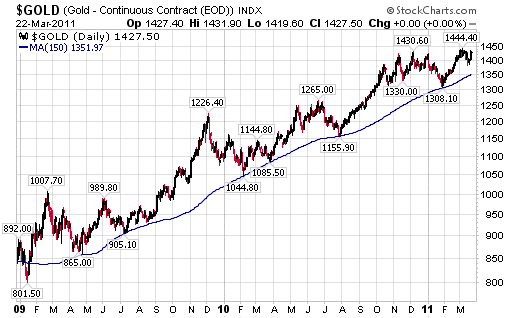
Gold (April) closed on March 2 at 1437.40, a record high. On March 9 silver closed at 36.04, highest since 1981. Yesterday both marks were bettered. Where's the excitement, where's the interest, where are the articles in the newspapers?
Time to study the chart below. As I've been saying, gold in its advance has periodically tested its 150-day moving average over the past few years (150-day MA is shown as the blue line on the chart). Note that on the most recent "correction," gold didn't even test its 150-day MA. When I saw this, I realized how powerful the forces under gold were.


Gold is now "out in the open" with no overhead resistance and no overhead supply. So far the bull market advance since 1999 has been steady, quiet, and orderly. Except for its spectacular slow and relentless climb, there's been no excitement in the gold bull market.
I don't think this is going to continue. Somewhere ahead the precious metals bull market is going to turn wild and speculative. Only one phenomenon will serve to create this excitement. That phenomenon is HIGHER PRICES. The public can resist anything in markets except steadily rising prices.
As for steady higher prices and excitement, I suspect that silver is about there. As for gold, maybe not yet. But somewhere ahead gold is going to catch fire. That will be the time when the great American public will decide that they have to have some gold, maybe just a coin or two, or maybe just a few shares of GLD -- but that time is coming.

Question -- As a new subscriber what should I do?
Answer -- Buy a position in GLD or SGOL or SLV. Assume a conservative position, one that you can sit with.

Question -- "What about older subscribers? What should we do?"
Answer -- Never mind timing this bull market. It can't be done, even by Goldman. You can add to your gold position. If possible, buy some one-ounce gold coins. One advantage of coins is that you're probably not going to trade them in and out. Sit tight with your coins, Put them in a place that's difficult to get at; in that way it will be a nuisance to sell them, even if you're tempted to.

***
Richard Russell

Labels: , , ,

Sep 26, 2010

Rob McEwen expects gold to reach $5,000

Rob McEwen, CEO of U.S. Gold and creator of Goldcorp, may be too soft-spoken and cautious ever to be caught wearing a tin-foil hat, but in a brief interview broadcast yesterday with TheStreet.com's Alix Steel he forecast a gold price of $5,000 per ounce....

Labels: ,

Sep 7, 2010

Egon Von Greyerz: Gold Entering a Virtuous Circle

GOLD ENTERING A VIRTUOUS CIRCLE

By Egon von Greyerz
September 7, 2010

Fundamental and technical factors for gold are now in total harmony and gold is entering a virtuous circle that will drive the price up at its fastest pace since this bull market started in 1999.

  • It is a fact that gold in US dollars (and many other currencies) has gone up 400% in eleven years or 16% per annum annualised.
  • It is a fact that the US dollar has declined 80% in value against gold since 1999.
  • It is a fact that the dollar and most other currencies have gone down 98-99% against gold since 1913 when the Federal Reserve Bank of New York was created.
  • It is also a fact that the Dow Jones (and many world stock markets) has declined over 80% against gold since 1999.
  • It is a fact that gold has made a new all time monthly closing high in dollars in August 2010.

Gold trend

We expect gold to start a substantial rise now which will continue for 5-10 months before any major correction. Gold’s technical picture is extremely strong with a continuous rising pattern of higher highs and higher lows with the steepness of the curve increasing. From much higher levels we are likely to see a correction that could last up to a year before the next rise which will last several years before we see a significant peak. Once gold has topped we do not expect the same kind of decline as after the 1980 peak since gold is likely to become part of a future reserve currency. At that point gold will be a solid but unexciting investment with very little upside potential. But that is likely to be a few years away.
For the full article please click the following link: GoldSwitzerland Market Update

September 2010
Egon von Greyerz

Labels: , , ,

Jul 22, 2008

Time is running out to buy junior exploration stocks

Peter J. Cooper, a Dubai based economic journalist, has recently posted an excellent analysis of why and how to make the best of the coming (and rather overdue) junior mining shares price explosion.

Here's some appetising excerpts.

"The big gold and silver producers are preparing to unleash a round of bidding for junior exploration companies that will bid up the value of the whole sector, and stocks that are good, bad and indifferent will jump in value. You have been warned. Now is the time to buy. It is so obvious with gold and silver prices on the march…"

"Gold and silver equities have been disappointing performers over the past couple of years. Cost inflation has dented profit margins for the big producers, and capacity expansion has been subject to delays. But these fears may have been overdone, and rising precious metal prices will now begin to feed straight through to the bottom line."

"Market anomalies are how investors make big profits. The price of silver is another example of a market anomaly, as this column argued last week. Silver has underperformed every other metal, except gold in this commodity price boom and yet its supply and demand situation is arguably the weakest of all.

So if you want to hedge your position in the junior explorers with a second opportunity to achieve leveraged performance to the rise in price of the underlying metals, then again silver stocks are to be recommended. The smaller companies might well deliver the best performance but unless you want to deeply diversify you could stick to the bigger names."

Please click HERE to read P.J. Cooper's analysis titled "Time is running out to buy junior exploration stocks" while the junior shopping season still lasts...

Labels: , ,

Mar 13, 2008

Jon Nadler: $1000 Falls. Quo Vadis?

$1000 Falls. Quo Vadis?

Good Afternoon,

The countdown to $1,000 gold finally ran out at 10:35 am New York time today as spot bullion reached a historic high of $1,000.25 bid amid the global market conditions that had emerged overnight. The final push to the peak came on the heels of a slump in US retail sales and following a lack of reassuring words or offer of aggressive remedies for the credit black hole by the Mr. Paulson this morning. This was an achievement of a lofty objective, as well as a long-standing one. Very long.

Gold prices appeared to be all primed to finally achieve the $1K mark as early as last night, when background market conditions shifted from bad to worse overnight. Today's spike will likely become known as the "Carlyle/Drake Rally" (or cave-in, depending on your preference). The imminent doom of the Washington-based bond fund and probable demise of the hedge fund sent icy shivers through the financial markets that way overshadowed the (nanosecond-brief) cheer we witnessed following the Fed's term facility plan the other day.

Today, the Treasury's Mr. Paulson offered the President's Working Group on Financial Markets no more than lip service by concluding his remarks with platitudes such as: " We will continue to re-assess conditions, monitor progress, put forward new recommendations and take additional steps as necessary." US President Bush himself managed to say about the current predicament of the greenback only that it was not 'good tidings'(?!)

However, a retreat in the commodity complex emerged shortly after cues from the Dow (previously down 215 points) showed a reversal in sentiment and the index went into positive territory by 60 points. Stocks erased all of their earlier losses after Standard & Poor's suggested that the "bulk of write-downs linked to bad home loans may be behind for banks." As we said earlier, every bit of news counts these days, and has twice the impact it may normally have. Bad news, as well as good news. We have also opined that once the credit vortex is assigned a final dollar figure, the markets will not feed off of uncertainty like pirahnas anymore. They will have to take into account fundamentals as well. Tall order these days...

A quick scan of values recorded at gold futures closing time in New York revealed crude oil prices at $109.76 per barrel and the dollar off of the 72 mark on the dollar index. New York spot gold was up $6.90 per ounce, showing at $990.30 bid per ounce ( a full $10 under the historic high seen earlier) and related metals were still rising in concert, albeit with more moderated gains of their own. Silver was up 29 cents at $20.30, platinum was up $17 at 2088 and palladium rose $7 to $510 per ounce. Commodities markets continued in a state of disarray, with huge sums of fund money being thrown at them, while still trying to absorb the pyramid of long positions which has already been piling skyward in previous weeks.

Keep an eye on the Dow and on gold's closing levels. Dollar-denominated commodities have all benefited from the intense fund attention. It has taken an estimated $600 billion credit debacle and six months to lift gold from $730 to $1,000. The same funds will now become increasingly conflicted on whether to push the envelope further based on potential further billions being added to the problem or whether to scale back from the sector as some corners begin to be turned. At such a juncture, we may expect volatility of a much larger order of magnitude in these markets and every single news item to matter much, much more. Keep very alert and take nothing for granted. Even on a day of such celebration. We already know how we got here. The bigger/better question is: "Whither Goest Thou?"

Happy Trading,

Jon Nadler
Senior Analyst
Kitco Bullion Dealers Montreal

Labels: ,

Dec 9, 2007

Aden Sisters: Soaring Markets...

"..Normally, for instance, you'll see the so-called smart money go into a developing bull market first. This includes investors who understand the markets and the big picture, some professionals and so on.

As prices rise, more gold bugs will move in, usually followed by some early-bird Wall Street types.

This is basically where we are now, in the second phase. But as New Orleans illustrated, this bull market rise is still lacking investor and Wall Street enthusiasm. That's still to come and we think that'll probably happen once gold hits a new record high above $850.

During the third phase of a bull market, the public jumps in. The public is usually late to the party and in their collective excitement, they'll drive prices up to extreme levels. The most recent example of this happened in the late 1990s when tech stocks were all the rage. Everyone was "into high tech" and these stocks were going to keep rising in the "new era," but of course they didn't.

As for gold, the public is barely aware of gold's ongoing rise and they're not in the market. The reason that's good is because the longer gold goes without attracting much attention, the higher it will ultimately go once the public starts moving in.

This suggests that the gold price could literally skyrocket at some point to levels far higher than most people are expecting. And with world tensions increasing on several fronts, it's providing plenty of fuel for the markets..."

To read the article please click HERE

Labels: , , ,

Nov 22, 2007

Will Dow-gold ratio hit one-to-one again?

Newmont vice-chair Pierre Lassonde looks back at where the price of gold was, and how high it might rise, in this interview with business reporter Lisa Wright.


Q. What do you make of this correction of gold prices?

A. Hey, a year ago it was at $600-and-something (U.S.), so it's still pretty good. We're just getting a bit of a pullback, which is healthy. But I do believe that over the next year or two we'll break right through the $850 (barrier). At some point in the next five years you'll see gold with three zeroes after the first number, we just don't know what number that's going to be.

Q. So where is gold headed?

A. I'll bring out my crystal ball (laughs). But everything is pretty well unfolding the way that we had anticipated and gold is responding primarily to the devaluation of the U.S. dollar. That correlation is the most important in terms of the gold price. We had foreseen that we were going to chase the old highs, the $850 (range), and just almost touched it last week.

Q. What's your theory on the price?

A. Something I've been pointing out since 1999 in our Franco-Nevada annual report is the Dow Jones industrial average divided by gold price. It will blow you away. The Dow represents financial assets while gold represents hard assets. And, over a 100-year period from 1920 to today, there are cycles. There are times to own financial assets, when the ratio goes up, and then there are times to own hard assets, when the ratio goes down because it's one against the other.

So from 1920 to 1929, you wanted to be in financial assets. From 1929 to 1935 you really wanted to be in gold. This is a very interesting thing because the financial asset peak was in 1966. And then the hard asset peak was 1980, so this was a 14-year bull market in hard assets. When you think about it gold went from $35 to $850. If I told you in 1966 that gold is going to $800, you'd say `Lassonde you're completely out of your mind. You're wacko.' But oil went from $2.50 to $50 in that same time. And you know what happened to real estate prices in Toronto in the '70s.

Now here's the real kicker. At the top of the hard-asset bull market, (1933), the Dow, which had been 370 at the top, bottomed at 37, and gold peaked at (about) $35. The ratio was essentially one-to-one. In 1980, the Dow was (about) 800 and gold was $800. One-to-one. You know where the Dow is today – (just over) 13,000. Gold is $800. In every bull market in the last 100 years the ratio came down to essentially one-to-one.

Q. Is this Dow versus gold theory picking up steam?

A. When you tell portfolio managers this, it scares the heck out of them. If the Dow was to lose 90 per cent of its value and go down to 1,200 and gold is at $1,200, you have one-to-one. But then they're wiped out. They're kaput. Or is the Dow going to come down to 6,000 or 8,000 and gold is going to go to $6,000 or $8,000? That's what happened in 1980. The Dow only lost 20 per cent of its value but gold just went straight up.

Q. What do you realistically see happening?

A. When people say to me, what's going to propel gold to $2,000 or $3,000? I don't know. How could I have foretold the events of the 1970s, for instance? Here I think we have a multiplicity of events. We have an industry that's shrinking. We have central banks that are going to turn into buyers, not sellers. And the European central banks are going to run out of gold .... So I do think we're going to continue to see good times in this industry for a generation.

Q. People don't think gold has been in as big a bull market as base metals.

A. That's right. Copper went from 65 cents to $4. That's seven times. Gold is up three times. Oil went from $12 to $96. That's eight times. So, in effect, gold has been the lagging commodity in this hard-asset bull market.

Q. Are these exciting times?

A. Well, the 1970s were a lot of fun but they're generational bull markets. You have to wait 20 years in between. You've got to keep yourself busy. I must admit, being a bit older (and) having more money, this is even more fun.

Labels: ,

Nov 18, 2007

Gold: the Big Picture...

...stay focused with this series of superb charts (in pdf) drawn by Trader Dan (Norcini) from J.S. Minest: HERE

Labels: , ,

Nov 15, 2007

Gold Bugs Riding Wave of Rising Prices

Gold Bugs Riding Wave of Rising Prices

By David Nicklaus
St. Louis Post-Dispatch
Wednesday, November 14, 2007


For the last 25 years, people who wanted to own gold have had a slightly kooky reputation. Mostly older males. Survivalists, maybe. Pessimists, certainly.

Now, with gold at $800 an ounce for the first time since 1980, Dennis McCormick is providing a primer on precious metals to a lot of people who don't fit the stereotype. Men and women, young and old, are coming into his Missouri Coin store in Des Peres. They've never owned bullion before, or gold or silver coins, but they want some now.

They're not doom-and-gloomers who want to convert all their savings into gold, McCormick says, but they see the metal as an important diversification tool, a hedge of sorts. After all, they saw credit markets seize up this summer, and they've been watching the dollar decline.

Last month Missouri Coin sold seven times as much gold and silver as it did a few months earlier. And interest is continuing to build.

"A week ago was the first time I saw fear in their eyes," McCormick said. "They were fearful of the dollar's collapse. ... They wanted to diversify their portfolio and have something in hard assets."

The gold buyers coming into McCormick's store are part of a global parade that's rapidly turning into a stampede. The spot price of gold has risen nearly $100 in the last two months and $300 in the last two years.

That puts it within hailing distance of $850 an ounce, the record price reached in January 1980.

Gold traditionally is a safe haven in times of conflict, and the bull market in precious metals started almost simultaneously with the Iraq war in 2003. It's also a hedge against inflation, which erodes the value of paper assets, and inflation fears seem to be driving the recent rise.

Wistar Holt, a partner at Holt & Shapard Capital Management in St. Louis, has had most of his clients' money in gold-mining stocks since 2001. When he last calculated his returns in June of this year, his portfolio had gained an average of 27 percent annually, net of fees.

Holt believes that the dollar will continue to weaken -- and gold to strengthen -- while the Federal Reserve tries to prevent a recession. The Fed has lowered interest rates twice since September, making dollar-denominated bonds less attractive to foreign investors. Many of those foreigners -- including the Chinese, South Koreans and Russians, Holt says -- are buying significant amounts of gold.

For the average American, investing in gold is easier than ever. If you don't want to go to the trouble of buying physical gold, or understanding the finances of mining companies, you can buy an exchange-traded fund that tracks the metal.

Still, many Americans scoff at the shiny stuff. "I think the U.S. investment community is basically still out of this rally," Holt said. "Before we see the peak, U.S. investors will be very much in it the way they were back in 1980. And when U.S. investors get involved, the returns could be enormous."

Adjusted for inflation, the peak 1980 price amounts to more than $2,400 today. Holt thinks gold could challenge that record, and he says it will easily surpass $1,000 in coming months.

How will he know when to take his winning bet off the table?

Only when Wall Street firms start touting gold like they push technology stocks, Holt says, will his favorite investment be in danger of losing its shine.

* * *

Labels: ,

Nov 7, 2007

John Dizard: Treading the foothills of a gold bull market

By John Dizard
Financial Times, London
Monday, November 5, 2007

With spot gold now hovering around the $800 an ounce price level, you would think the goldbugs would be joined by a frenzied public snorting up of gold shares and Krugerrands. Volatility should be jumping to record levels, and the long-neglected managers of gold unit trusts and mutual funds should be ushered past the velvet ropes and into the VIP rooms.

No.

If you enter "2007 gold bull market" (without the quotation marks) in the English Google search box, the algorithm will report more than 1.9 million entries. That is not, however, the same thing as people buying metal or shares.

John Hathaway, the portfolio manager of the $1.128 billion (L541 million, E778 million) Tocqueville Gold Fund in New York, had a total return of 38.2 per cent from October of 2006 to September of this year. Not bad, but, as he says, "It's all performance, not money flows."

Over that time, new purchases of fund shares were $330 million, while withdrawals were $280 million, for a net inflow of $50 million. If the public had really bought into this bull market story, then we would be looking at something better than annual net inflows of 5-6 per cent.

As a precious metals hedge fund manager points out: "Implied volatility for one month gold is around 20 per cent. Back in the real bull market of 1980, it was up to 50 and 60 per cent. Silver vol was over 100 per cent in 1980. You have this clinical signal that the bull market hasn't started yet."

The relatively subdued interest of the investing public, if not the investment newsletters and columnists, is actually good news for those long the metal. It means there are a lot of people left to buy the stuff, which is not the case at bull market peaks.

In recent weeks, as the gold price has approached the $800 level, the rate of increase in the price, the momentum of buying interest, has slowed, one sign that a correction in the uptrend could be at hand. Even so, the low volatility and low level of public interest both suggest that even with a short or intermediate correction, we are only in the foothills of the gold bull market.

For example, one of the main supports for the gold price in recent years has been the closing out of mining companies' hedge books. Throughout the 1980s and 1990s, the mining companies effectively sold much of their future production using a range of derivatives contracts. This protected their earnings from price declines, at the expense of giving up the cash flow benefits of price increases.

In this decade, under pressure from shareholders who wanted leveraged exposure to gold price increases, the mining companies bought back their hedges. In 2001, the gold miners had hedge books totalling some 3,400 tonnes; now they are down to a total of about 1,000 tonnes. This unwinding was a significant part of the total demand for gold in the past several years.

Interestingly, the quarterly reports just out for AngloGold Ashanti and Barrick showed that they were not big buyers of gold in the past quarter. So some other people were supplying the fuel for the summer and early fall rally. "The quality of demand, not just total demand, rose over the quarter just past," as a longtime gold sceptic told me when the third quarter hedge books were disclosed last Thursday.

All this has been going on as many of the "gold" mutual funds available to the public became "hard asset" funds. In recent years, the price of gold has not risen as much as, say, nickel, copper, or lead. To keep the money coming in, most portfolio managers re-positioned themselves as commodities or metals investors. They may want to consider another makeover.

From mid-August, when the credit squeeze finally became a headline, to the end of October, the spot gold price was up over 19.3 per cent, while the CRB index, a commodities basket, increased by 12.6 per cent. This makes some macro sense, as the demand for commodities such as copper will be reduced by the US housing slump, not to mention substitution effects, while the hesitant Bernanke reflation is helping gold.

However, the reluctance of the big central banks as a group, not just the Fed, to recognise the hole they are in will stretch out the reflationary process. The Fed's statement after the 25 basis point cut last week was far more "balanced" than it probably should be. It is clear that the board will be reacting to weakness, rather than forestalling it. European central bankers are using even more hawkish language. Both the Americans and Europeans will have to see more real-time, real economy effects before they abandon their models and aggressively reflate. They will.

Gold is both a monetary instrument and a commodity, but the size of its above-ground supply makes the monetary element more significant. That means attempts to estimate its future price track by looking at annual mine supply or jewellery demand will be misleading.

As Mr Hathaway says: "Mervyn King's effective guarantee of the liabilities of the British banking system is much more significant than declining South African gold production."

So, even at about $800 an ounce, the real gold bull market has not begun.

* * *

Labels: ,

Nov 2, 2007

Gold: the $800 resistance snapped

Quod Erat Demonstrandum...

Labels: ,

Oct 28, 2007

Χρυσός: το bull market συνεχίζεται αλώβητο

Χρυσός: το bull market συνεχίζεται αλώβητο.

Η εβδομάδα που πέρασε σφραγίστηκε από ακόμα ένα νέο ρεκόρ. Η τιμή του Χρυσού έκλεισε στα $783.50/ουγγιά, ήτοι στα ανώτερα επίπεδα των τελευταίων 28 ετών. Κρίνοντας από το μακροχρόνιο διάγραμμα της τιμής για την εν λόγω περίοδο, βλέπουμε ότι το bull market που ξεκίνησε δειλά-δειλά στα μέσα του 2002, είναι για τα καλά στρογγυλοκαθισμένο από τεχνική άποψη. Αλλά και τα θεμελιώδη μεγέθη της παγκόσμιας οικονομίας που έδωσαν το εναρκτήριο λάκτισμα στο bull market αυτό, συνεχίζουν σήμερα να ισχύουν περισσότερο ενισχυμένα από ποτέ (δείτε προηγούμενα ποστ)

Με τέτοια θεμελιώδη σε συνδυασμό με την ακλόνητη τεχνική εικόνα, όλα δείχνουν ότι το ρεκόρ όλων των εποχών στην τιμή του μετάλλου (δλδ. τα $850/ουγγιά) είναι απλώς θέμα χρόνου να διασπαστεί. Άν εξαιρέσει κανείς την περίπτωση μιας ογκώδους και καλά ενορχηστρωμένης παρέμβασης στη τιμή του Χρυσού από τους "γνωστούς κύκλους" -όπως η GATA ακούραστα δεν σταματά να καταγγέλνει- η διάσπαση αυτή θα έλθει ίσως συντομότερα και απ'ότι αναμένετο.

Στα θεμελιώδη, πέραν από τα αστρονομικά μεγέθη λιμνάζουσας ρευστότητας παγκοσμίως, ανήκει και η ενίσχυση της γενικής αντίληψης ότι το US$ έχει ακόμα δρόμο στην κατηφορική του πορεία. Όσο τούτο γίνεται συνείδηση, τόσο ενισχύεται η φυγή και απεμπλοκή από το US$ προς σταθερότερες αξίες -όπως αυτή εμφανώς πλέον καταδεικνύεται και πάλι από τη πορεία της τιμής του χρυσού- των όσων κατέχουν δολλαριακή ρευστότητα (π.χ. Κίνα, Ρωσσία, Αραβικά Εμιράτα κλπ)

Κατά την ανοδική πορεία του χρυσού θα πρέπει βέβαια να αναμένονται κατά καιρούς "ισχυρές αναταράξεις" καθώς κάθε άνοδος θα συμπιέζει προσωρινά τη ζήτηση που προέρχεται από το μεγάλο -προς το παρόν- "πελάτη" δλδ του εποχιακού κλάδου της χρυσοχοϊας. Όσο όμως περισσότερο η ζήτηση του μετάλλου θα περνά σε ισχυρά επενδυτικά χέρια -safeheaven investing- τόσο η ένταση και η διάρκεια των όποιων διορθώσεων θα μειώνεται.

Βραχυπρόθεσμα τελικά πού βρισκόμαστε;
Η διάσπαση του επιπέδου των $800 είναι πολύ πιθανό να πραγματοποιηθεί μέσα στο 2007 καθώς όλοι οι οδοδείκτες συγκλίνουν προς τα κεί. Τού χρόνου ποιός ξέρει; Ίσως -τολμώ να πώ- να δούμε και τα $1000/ουγγιά!

Labels: , ,

Oct 19, 2007

Puru Saxena: The Raging Bull!

"We are witnessing a generational bull-market in natural resources. The boom is due to the ongoing urbanisation and industrialisation of vastly populated developing nations in Asia and Latin America. And central-bank sponsored monetary inflation is adding fuel to the already raging fire. It is interesting to note that despite all the "end of the world" forecasts by numerous analysts, my preferred assets continue to power ahead.

Today, some highly intelligent economists are shouting "bubble' and claiming that this uptrend built on the easy monetary policy cannot last forever. However, I am of the view that we are not in a "bubble" yet and this bull-run is due to the very real fundamental forces of supply and demand. Wherever you care to look in the commodities' universe, you can see that supplies are extremely tight and failing to keep up with the rising demand coming out of emerging Asia.

In the business of investing, it usually pays to observe the market and one should avoid becoming fixated with pre-determined conclusions. After spending over a decade in the investment-management business, I have learnt never to fight the trend. And the trend for commodities and the emerging-markets is up. For sure, as night follows day, this bull will mature and then die. However, between now and judgement day, fortunes will be made by patient investors..."


Please click HERE for the rest of Puru Saxena's article

Labels: ,

Gold: long term P&F chart

Just to keep th gold situation in proper perspective it is very enlightening to refer to this ultra-long term $U.S. 5 X 3 Point and Figure chart made available by the The Privateer Website:

click for magnified version

Labels: ,

Oct 16, 2007

Japan: gold price break up!

Japan's grannies drive up gold prices


By Ambrose Evans-Pritchard
Telegraph.co.uk


Gold has soared to a fresh 28-year high of $760 (£372) an ounce on fears of global currency disorder and a surge of buying by Japanese investors using exotic trading signals.

Traders report a sudden burst of activity on the TOCOM gold futures markets in Tokyo as the price breaks through the psychological barrier of 3,000 yen (£12.52) per gramme, the measure used by the Japanese to trade gold.
advertisement

The country's irrepressible grannies rely heavily on Ichimoku "cloud charts", multi-faceted indicators designed to give support/resistance levels in various markets, which have issued a powerful buy signal in recent days.

John Reade, head of precious metals at UBS, said the Japan can be a major driver of the gold price. "Japanese buying can come out of the blue, but it is too soon yet to tell whether they are about to take over the gold market," he said. "When the Japanese public move in with reckless abandon, everybody else gets out of the way. They can be the last to join the rally."

The fresh interest in gold comes as the yen renews its slide, hit by signs that the economy may be tipping back into deflation after the housing collapse during the summer. Housing starts fell 23.4pc in July and 43.4pc in August as new laws came into effect. The Bank of Japan has signalled that it will keep interest rates at 0.5pc for the foreseeable future, inviting funds to step up borrowing in Tokyo to chase higher yields elsewhere through the global "carry trade".

Rising inflation across China, India, the Middle East, eastern Europe and Latin America have all created the backdrop for a major move in gold. Citigroup said a global "reflation rally" caused by cuts in US interest rates could push prices above $1,000 an ounce.

UBS has upgraded its long-term forecast, but is cautious for now. "The net long positions on the US futures markets are at all-time highs. They have been at extreme levels for four weeks and when that happens you can be sure there will be a correction. It could be any time now," said Mr Reade.

Labels: , , ,

Jul 31, 2007

Captain Hook: Canadian Junior Mining Shares Ripe For The Picking

Canadian Junior Mining Shares Ripe For The Picking

by Captain Hook

The opportunities in Canadian junior mining shares has never been better. And now is the time to get in before prices skyrocket higher in my opinion. As mentioned the other day in pointing out the precious metals sector is turning higher, when the Canadian $ heads over parity against the Greenback, American investors will be looking for a home for excess cash they wish to hold in Loonies. And as they work their way down the food chain, eventually they will arrive at junior mining shares, a group that has been all but forgotten by the institutional types because either company or trading characteristics don't meet desired models at this time.
That is to say the shares are in the pennies, generally illiquid, and have been heading in the wrong direction (down) for some time now, a characteristic set definitely outside of the desired formula most momentum chasing behemoths (hedge funds) are chasing these days...


To read the rest of this article, click HERE

Labels: , ,

Jul 24, 2007

Ambrose Evans-Pritchard: When will gold go ballistic?

By Ambrose Evans-Pritchard
The Telegraph, London
Monday, July 23, 2007

A lot of readers have asked why I duck the issue of gold when talking about the dollar crisis and the M3 monetary blow-off.

So here we go:

I started buying gold mining shares in September 2001, missing the bottom by four months. I still hold some shares (mostly duds, since I am the village idiot when it comes to picking stocks). Gold's 15-to-20-year upward cycle is alive and well.

For those who don't follow bullion, gold hit $252 an ounce in the spring of 2001 in a final capitulation selloff when Gordon Brown began his Treasury sales. It rose to a peak of $730 in May 2006.

Gold has languished since, in part because of sales by the Spanish and Belgian central banks. I remain very wary in the short to medium-term.

What unnerves me is the way gold has tended to move in sympathy with global stock markets. Whenever risk appetite rises, it rises. When investors shun risk, it falls. In other words, it has become correlated with all the speculative trades -- notably the yen and franc carry trades -- responding to abundant global liquidity. This liquidity is now being drained as the Bank of Japan, European Central Bank, Swiss National Bank, Bank of England, Riksbank, and Chinese Central Bank, et al., turn off the tap. So be careful.

While the pattern appears to have changed over the last couple of weeks, this is not long enough to establish a "paradigm change," excuse the ghastly term. My concern is that gold will fall hard along with everything else (except the yen and the Swissie) in any market crash/correction.

At some point it will decouple, as it did during the 1987 crash when it fell hard, found a ledge, and then recovered hard, while the Dow kept falling. But, I would rather hold Swissies or yen until gold finds that ledge in a downturn, resuming its old role as a safe store of value. This may happen quite quickly in a crisis. (Of course, I may also be left behind right now in an accelerating rally, but that is a risk I accept.)

Ultimately, gold will surge, once it becomes clear that the euro lacks the staying power to serve as an alternative to the dollar. To restate a point I have made many times, the euro-zone is an ill-assorted mix of 13 unconverged national economies -- with national treasuries, debt structures, taxes, pensions, and labour laws -- that are not ready to share a currency and are drifting further apart by the day.

(Lest anybody forgets, the motive behind monetary union was PURELY political. The economists at the European Commission warned that the project could not survive over time if it included a Latin bloc of countries with an unreformed culture of high inflation, rising wage costs, and an export base exposed to Asian competition [unlike Germany's, which is complimentary] -- unless it were backed by a full superstate. They were ignored. Indeed, any future crisis was to be welcomed as the "beneficial crisis," a chance to force through full political integration that would otherwise have not been possible, as Romano Prodi so candidly admitted when he was commission chief.)

At some point it will become clear to everybody that: the Club Med group cannot compete at an exchange rate of $1.40, $1.45, $1.50, or whatever it reaches; their credit booms are tipping over; they will soon need stimulus more than the US.

Goldman Sachs, by the way, is already "shorting" Italian and French bonds, while going "long" on German bunds to play the divergence (the opposite of the euro-zone "convergence play" that made the banks rich in the 1990s).

We may have a situation where sharp dollar falls caused by impending rate cuts by the Fed set off a systemic crisis for Euroland. If so, politics will quickly take over from economics and begin to dictate events in Europe. The ECB will have to stop raising rates (whatever Berlin wants), and the euro will become a structurally weak currency tilted to the need of the weakest players. If it doesn't, the European Union itself will blow up. So the ECB will have to change tack to support the union. And the European Court will interpret the treaties in such a way as to force the ECB to do so.

Gold will fly once investors can see that neither of the two reserve currency pillars (euro and dollar) is on a sound foundation, and once the pair are engaged in a beggar-thy-neighbour devaluation contest to stave off a slump (if necessary with the use of Ben Bernanke's helicopters, meaning mass purchase of Treasuries, mortgage bonds, stocks, or assets of any kind to support the markets). This would amount to a partial breakdown of the monetary system. Gold will not stop at $800. It might well go beyond $2,000.

We are not there yet. Timing is not my forte, but 2008 looks ripe. Watch the Spanish housing market. Watch the French trade data. Watch Chinese inflation. And, of course, watch the US jobs market -- the bogus prop to the alleged US recovery. (On that, more later.)

* * *

Labels: ,

Jun 30, 2007

Jim Sinclair: U.S Dollar Weakness Trumps Any Market Manipulation


US Dollar Weakness Trumps Market Manipulation

Posted On: Friday, June 29, 2007, 5:30:00 PM EST
Author: Jim Sinclair


Dear Friends,

They can manipulate as much as they want but it is all in the US dollar!

It is my opinion that those powerful short interests -- both legal and illegal -are frantic to cover and are therefore pulling out all the stops.

Dirty tricks, use of media pals, and all the usual underhanded methods seem to populate everything these days from gold to gold shares of good value.

Using the baseball analogy, "Three strikes and you're out," I rate today as strike number two at the .8050 to .8150 range on the USDX. The interesting part of this is that commentators are looking at the differential rate between the US Fed and other Central Banks. My comment is, "Like hell that is the reason."

The real reason is a meltdown of sub prime mortgages that appears to have caused Bear Stearns more of a problem than was first thought. When you see a new man come on board at Bear Stearns who specialized in asset maximization of corporations you know the horse dung has hit the proverbial fan.

I believe that Over the Counter Derivatives are now melting down, threatening many other well known international investment firms. And that is why the dollar looks like death warmed over. In addition, that is why the price of gold is under the great power of manipulation to hold it down so as not to reveal the degree of the problem.

Remember this about Over the Counter Derivatives:

1/ They have no regulation.
2/ They have no standards.
3/ Without standards there can be no viable market.
4/ They are unlisted
5/ They are traded by private treaty negotiation
6/ They are valued by "Mark to Model" which is a total cartoon.
7/ They have no financial guarantee such as a clearing house.
8/ They are unfunded special performance contracts floating in cyberspace. All funds in the OTC Derivatives are taken out as spreads and commissions.
9/ More than 50% of the earnings of major international investment banks come from granting in private treaty negotiations these instruments of mass financial destruction.
10/ The financial performance of the specific performance contract called OTC Derivatives depends on the financial capacity of the loser in the transaction.
11/ Control has been loose in the interest sensitive OTC Derivatives because of multiple dealings outside of the initiating two until no one knows who has what.
12/ The replacement value of these instruments is in the multi trillions of dollars.

Interest rate differential would not hammer the dollar as we are seeing today. Remember that three strikes and the US dollar is out. Expect every dirty trick and media negativity towards everything gold as quiet but frantic insiders attempt to offset a panic by subverting early warning systems.

Those in the know are frantic to cover their short positions which can only be accomplished if they stampede you by every means possible. They are going to fail. You are not. If you wish to screw the shorts royally - simply do nothing. They can make price but they cannot make cover as long as you are not spooked into selling everything gold. The gloves are off and the major battle between longs and shorts in gold is here!

Gold is going to $682 - $761 and then to $887.50 - $1000 plus

The bear market in gold shares is a total construction of bear raiding hedge funds that is doomed to failureJ. Sinclair's Mineset

Their really bad day is close at hand!

Labels: , , ,

Jun 29, 2007

Richard Greene: You would have thought it was a gold bull market

By: Richard J. Greene

There are just an overwhelming amount of bullish factors for gold and silver that are still cleverly being camouflaged so that the fewest possible can see them. From this point forward; remember the words of former Fed Chairman Paul Volker from the 1970’s, “the one mistake that I made was in not capping the gold price.” Do not forget that statement because they did not forget this time and that has created the most incredible investment opportunity for those that see through it that has ever existed. Control and manipulation in precious metals markets has reached a new level of transparency this year in an effort to discourage interest in the precious metals for their traditional investment merits.

A key event awakening the world to the continuing decline to worthlessness of fiat currencies led by the dollar; was when China was disallowed from spending some of its stockpile of reserves to purchase Unocal. China has amassed close to $1 trillion in reserves and has been instrumental in prolonging the viability of the U.S. dollar by recycling trade surpluses into U.S. bonds despite massive trade and budget deficits that can be traced to Americans consuming far in excess of what they are producing. The most basic of economic principles has been totally lost on the American public. Due to being led by feeble economic minds such as Ben Bernanke and Alan Greenspan, the American public has to be among the most economically illiterate empires in history. We have been on the verge of bankruptcy for so long that most don’t even have slightest hint that we would have crashed long ago if not for the arm twisting of other Central Banks by the U.S. to run similarly irresponsible monetary policies worldwide. The problem is right here in the United States and it starts with a lack of savings. (By the way, define saving as: that left over from the rewards of production that has not been totally consumed rather than the more commonly accepted; borrow money or extract equity to flip into the nearest asset bubble.) Yet our fearless financial leaders, (clowns), Helicopter Ben or Mr. Magoo would have you believe we Americans are bravely shouldering the world’s burden because we are more willing to consume with money we are borrowing from our trade partners and buying things we have not yet earned and taking rewards that others have earned and that we will be unable to repay. This is another form of the Adolph Hitler style of truth: say it often enough and they will believe it.

A debt-based fiat currency system that has now fully expanded worldwide has only one way to go and that is toward final collapse. Now that the U.S. has bought some time by convincing other countries to increase their money growth rates even higher than the U.S., we are at such high rates of growth worldwide, (on the order of 15%) that we are literally hurtling toward either hyperinflation or economic devastation. The U.S. is in a box and seriously at the mercy of other countries’ decisions because inflation is rising and we can not raise rates due to the leverage, particularly in housing, and we can not lower rates for fear the dollar will rapidly implode. Thus with money compounding worldwide at a 15%+ clip annually led by Russia at a 57% annual rate, inflation will be too obvious to even the biggest economic dullards. Even by holding rates constant the Fed would, in effect be easing aggressively as real rates would become even more negative than they already are. If you can not feel the walls closing in then you haven’t noticed the many countries that have spoken of diversifying their foreign exchange reserves or increasing their commitment to gold. Syria and Kuwait are the latest examples of countries that have had enough of the excessive money creation in the U.S. and have moved to de-link their currencies from the dollar. Our foreign policies have been heavy handed economically, militarily and financially. We are failing on all fronts and stand ready to slap China in the face with trade sanctions even while they have been most instrumental in keeping our currency from plummeting. We should fear the risk of a military aggression on our part is a bigger and bigger risk as our other two methods of control are weakening considerably. This would be an even bigger mistake. The U.S. dollar is on the way out and just because officials have convinced other countries to wreck their currencies at a faster rate does little to salvage anything except perhaps a little more time.

The U.S. continues to bleed enormous trade and budget deficits, has lost its industrial base, finds fewer takers of its oversupplied currency, and can’t even manufacture borderline positive economic statistics despite massive fraudulent manipulation. The World Gold Council earlier this month said world gold demand is running 31% above a year ago while supply continues to decline. The world’s largest producer, South Africa, saw gold production fall 7.5% last year to an 84 year low and continued declining in this year’s first quarter at an even greater rate despite an almost tripling of the gold price in the last five years. Gold production peaked in 2001 at 2645 tonnes and fell to 2470 tonnes by last year. Five of the top producers: South Africa, Canada, Australia, Peru, and the U.S. produced more than half that total in 2001 with 1330 tonnes and saw that drop off to only 1095 tonnes in 2006. These stats make a pretty compelling bullish case yet gold is trashed in the press, the TV, financial advisors, and especially the bullion banks and the gold cartel. They have resorted to an especially incredible tactic of late; instead of smashing down gold when negative news for gold is released, they especially whack it when gold positive news is released. Despite these attempts gold has held up even with heavy Central Bank sales, heavy shorting in the futures markets, double leasing of the same gold, and attacks on the gold ETF which has been driven down with dollars being thrown at these paper markets. Meanwhile, jewelry sales are up 17% and physical demand was high on any sell-offs.

The tide is turning as gold as a percentage of global currency is now down to 10% from a high of 84% back in 1950; so the Central Banks are running out of ammo to cap the gold price. Of course, those investors that continue to make their gold investments in the paper markets of the futures markets and the gold and silver ETF’s are helping to cap the price because the gold cartel will someday run out of gold but they will never run out of paper. These instruments are what help them to crush the charts of the stocks and the metals causing chartists and technical players to pile on downswings. There is more technical analysis on the major gold websites than ever…forget them, they do not matter. First of all 99% of them are trying to chart gold and the stocks in dollars and that is a totally frivolous effort. The dollar is a measure of nothing with unlimited supply at any point in time. Technical analysis is another tool being used to cap gold and gold stocks, nothing more at this point. Don’t listen to technical analysis and don’t listen short term price explanations of the days action. If you do, you will notice: higher interest rates are bad for gold; lower interest rates are bad for gold; high oil prices are bad for gold; lower oil prices are bad for gold; get it?...EVERYTHING IS BAD FOR GOLD! That’s what they have to get you to believe for the currency system of the world to make it through one more day. When that one more day doesn’t come if you listen to these people you will be left far behind and in an incredibly short timeframe.

Since 1970 the money supply of the world has increased more than 20 times the industrial production of the same period. This IS inflation. There is now more paper money added to the existing pile of money in the world EACH YEAR, close to $4 trillion, than the value of all the gold mined in human history and the pace is accelerating to the point that the paper money is beginning to be selectively rejected. Do you not believe that holding gold and silver will not go up more in value than paper nothing? This is all you ever have to know about gold and silver. PERIOD!

There is a favorite saying that I like very much attributed to Sidney Greenberg: “A successful man is one who can lay a firm foundation with the bricks that others throw at him.”

They are throwing bricks at you right now and they are made of gold and silver. GRAB THEM!

Richard J. Greene
June 28, 2007
Clearwater, Florida

Labels: , , ,

May 10, 2007

Why the Silver Price is Set to Soar!

Precious metals remain the most undervalued of all the asset classes. Precious metals, and particularly silver, remain the most undervalued of all the commodities. Silver is even more undervalued than gold and is undervalued when compared to other strategic commodities such as oil and uranium.
Silver is currently trading at just below $14 per ounce. Gold Investments continue to believe that silver will surpass $20 per ounce in 2007, its non inflation adjusted high of $48.70 per ounce before 2012 and its inflation adjusted high of some $130 per ounce in the next 8 years.

The fundamentals reasons for our very bullish outlook on silver is due to continuing and increasing global macroeconomic and geopolitical risks; silver’s historic role as money and a store of value; the declining and very small supply of silver; significant industrial demand and most importantly significant and increasing investment demand.


Silver price: global macroeconomic and geopolitical risks

Property markets and equity markets in the western world are near or at all time record highs. There is increasing macroeconomic and geopolitical uncertainty in the form of the sharp slowdown in the US housing market, increasing trade friction between the US and one of their prime creditors China (the negative impact of the introduction of US trade tariffs on Chinese paper products and the US’ WTO piracy claim may not have been fully realised by and priced into the financial media and the markets) and the continuing geopolitical tensions with Russia, Venezuela and in Iraq, Iran and the wider Middle East. These factors look set to at least curb returns in most property and equity markets.

Indeed these and other significant risks such as record debt levels in the western world, the huge and unprecedented US trade, budget and current account deficits and the massive fiscal profligacy of the Bush administration are not subsiding. These factors have ramifications for the predominant global reserve currency of recent times – the US dollar.

The IMF, World Bank and OECD have warned that the global economy faces increasing "downside risks" including rising oil prices, falling stock markets and trade imbalances. The IMF’s semi-annual World Economic Outlook (released April 5th 2007) said an economic slowdown in the US would have only a modest global impact if it were confined to the property sector.

The IMF report warned, however, that the shock to the global economy could be more significant if the property downturn spread to consumer spending and business investment. This seems likely as the US consumer is more indebted now since 1933 with little or no savings whatsoever. The Comptroller Auditor General of the US, David Walker stated “last year (2006) was the first year since 1933 that Americans spent more money than they took home and, as you probably recall, 1933 was not a good year for the United States.”

The US’ national gross debt is $8,883,212,488,519 trillion ($8.8 trillion) and growing. When George Bush came to power US’ national gross debt was $5.7 trillion. Even the most sanguine, tunnel-visioned bull would have to admit that the fundamentals of the US economy are bad and deteriorating.

Other long term risks and challenges facing the global economy come in the form of the threats posed by a bird flu pandemic, peak oil and global warming.

Silver price: historic role as a store of value

Thus the monetary metals and safe haven assets of gold and silver are likely to continue to outperform other asset classes. Also they are likely to outperform other commodities such as the base metals, oil and uranium. These commodities would be likely to experience a fall in price were there to be a significant slowdown in the global economy which would create demand destruction.

Because of their historic and continuing role as monetary or currency metals and as safe haven assets gold and especially silver are likely to outperform. This is because they are not simply commodities but also currencies which cannot be debased like our modern fiat paper and electronic currencies.

Gold and silver has been used as money in more regions and countries and for longer periods of time than the relatively modern use of paper currencies. Interestingly, silver has been used in more regions and countries and for longer periods of time as money than gold. Nobel Laureate Milton Friedman, said of silver "The major monetary metal in history is silver, not gold.” In Mexico today, there is a movement to return to using silver as money with a bill being put before by the Mexican Congress by Hugo Salinas. The currency of India is the rupee and it comes from the Sanskrit word ‘raupya’ which meant silver or coin of silver. The French word for money is ‘argent’ which came form the Latin argentum meaning silver. The franc was established as the national currency by the French Revolutionary Convention in 1795 as a decimal unit (1 franc = 10 decimes = 100 centimes) of 4.5 g of fine silver.

Most countries in the world used silver for smaller denomination coins in the 19th Century and through the 20th Century up until the 1950’s, 1960’s and 1970’s when currencies were gradually debased. Debase means to degrade, dilute or devalue. For instance, in the US up until 1965, silver dimes and quarters were made of 90% pure silver. In 1965, the US government debased and devalued the currency and reduced the silver content to 40% pure silver. These legal tender silver bags are still bought today by savvy investors.


Silver price: declining supply

Before looking at the demand side of the silver equation it is important to consider the supply side.

In 1900 there were 12 billion oz of silver in the world. By 1990, the internationally respected commodities-research firm CPM Group say that figure had been reduced to around 2.2 billion ounces of silver. Today, that figure has fallen to about 300 million ounces in above ground refined silver. It is estimated that 95% of the silver ever mined has been consumed by the global photography, technology, medical, defence and electronic industries. This silver is gone forever.

CBS Marketwatch published an article in March 2007 entitled ‘Silver may shine brightest among metals’, in which Kevin Kerr wrote that “Due to current supply/demand trends, the amount of silver above ground is projected to shrink to a critically low level in 2010. As supply shrinks, prices will keep rising steadily to new highs. Many in the investment world are unaware of this part of silver's story. Industrial demand has been outstripping mining supply for the past 15 years, driving above ground supply to historically low levels.”

Silver production was flat this year and is expected to be flat again next year. Incredibly, the amount of mined silver has been less than its demand every single year for the last 15 years. This hasn't resulted in significantly higher prices yet because the world has been able to fill the gap from inventories and official government stockpiles.

However, today the U.S. government's stockpile is all but gone, and sales from other official sources, such as China, Russia and India, are declining, too. The decline in refined silver stocks, from around 2.2 billion ounces in 1990 to around 300 million ounces today means that silver stocks are near an all time low.

The supply of silver is inelastic. Silver production will not ramp up significantly if the silver price goes up. Supply didn't increase in the 1970’s when silver rose 35 fold in price – from $1.40/oz in 1971 to a high of nearly $50/oz in 1980. Importantly, silver is a byproduct metal and some 80% of mined silver is a byproduct of base metals. Higher prices for silver will not cause copper, nickel, zinc, lead or other base metal miners to increase their production. In the event of a global deflationary slowdown demand for base metals would likely fall thus further decreasing the supply of silver.

There are only a handful of pure silver mines remaining. This inflexible supply means that we cannot expect significant mine supply to depress the price after silver rises in price. It is extremely rare to find a good, service, investment or commodity that is price inelastic in both supply and demand. This is another powerfully bullish aspect unique to silver.

Silver price: significant and increasing industrial demand

Another important factor as to why silver is likely to outperform other asset classes and commodities besides the declining silver supply is increasing industrial demand.

Why is this indispensable metal in such demand? The reasons are simple. Silver has a number of unique properties including its strength, excellent malleability and ductility, its unparalleled electrical and thermal conductivity, its sensitivity to and high reflectance of light and the ability to endure extreme temperature ranges.

Silver has the highest electrical conductivity of all metals, even higher than copper. It was used in the electromagnets used for enriching uranium during World War II (mainly because of the wartime shortage of copper). Silver has the highest thermal conductivity and optical reflectivity of all metals. Silver’s unique properties restrict its substitution in most applications.

Non investment demand for silver is based primarily on industrial demand including electrical, medical and photography and also in jewellery and silverware. Together, these categories represent more than 95 percent of annual silver consumption. In 2005, 409.3 million ounces of silver were used for industrial applications, while over 164.8 million ounces of silver were committed to the photographic sector, and 249.6 million ounces were consumed in the jewellery and silverware (‘don’t sell the family silver’) markets. Jewellery and silverware are traditionally made from sterling silver. Sterling silver is 92.5 % silver, alloyed usually with copper.

Industrial applications for silver have always been significant but have increased significantly in recent years. Industrial applications for silver have increased since 2001 to a record in 2005, according to London-based researcher GFMS Ltd. In their most recent report, they predict a 6% growth rate in industrial applications of silver in 2007. Silver is used in film, mirrors, batteries, medical devices, electrical appliances such as fridges, toasters, washing machines and uses have expanded to include cell phones, flat-screen televisions and many other modern high tech devices.

Increasing industrial demand for silver is forecast due to strong economic growth in China, India, Vietnam, Russia, Brazil and other emerging economies in Eastern Europe, Asia and the world. Growing middle classes are now demanding the quality of life and standard of living enjoyed by many in the West and thus the demand for silver will increase.

Silver is known as the healthy metal and has many and increasing medical applications. While silver's importance as a bactericide has been documented only since the late 1800s, its use in purification has been known throughout the ages. "Born with a silver spoon in his mouth" is also a reference to health as well as wealth. In the early 18th century, babies who were fed with silver spoons were healthier than those fed with spoons made from other metals, and silver pacifiers found wide use in America because of their beneficial health effects.

Today silver is used in many health-care products. Specifically, the ‘silver bullet’ is used by nearly every hospital in the world to prevent bacterial infections in burn victims and allow the body to restore naturally the burnt tissue. Increasingly, wound dressings and other wound care products incorporate a layer of fabric containing silver for prevention of secondary infections. Surgical gowns and draperies also include silver to prevent microbial transmission. Other medical products containing silver are catheters and stethoscope diaphragms.
In a world that is showing increasing concern about the spread of diseases and pandemics such as bird flu, silver is being increasingly tapped for its biocidal properties. Research is ongoing on the use of silver and its compounds for therapeutic uses and on its potential use as a disinfectant in hospitals and other medical facilities.

Silver has many unique properties which make it ideal and indeed essential in global industry – especially in the global photography, technology, medical, defence and electronic industries. Yet, silver is a finite resource and the supply of silver is increasing only very incrementally.


Silver price: significant and increasing investment demand

According to the CPM Group, there are some 300 million ounces of refined silver in the world. That means that with silver priced at $14/oz., there is about $4.2 billion (300 million oz x $14) dollars worth of silver in the world. This means that the total silver market capitalisation is a very small $4.2 billion.

The increasing demand caused by investment demand is very compelling. Especially due to a number of key investment factors - the introduction of the iShares Silver ETF, the huge short position, the global liquidity bubble, the significant growth in the global money supply, the proliferation of millionaires, ultra high net worth individuals and billionaires, the proliferation of hedge funds and the exponential growth in derivatives.

ETFs

Investment demand for silver has also been rising rapidly the past few years with investors hedging themselves against rising inflation, possible currency devaluations and geopolitical and macroeconomic risk.

The silver market is currently in a transitional period where investment demand is starting to have a real impact on silver prices. Much of the new demand comes from iShares Silver ETF launched in April 2006. The fund has so far attracted 120 million ounces of silver investment. It is up nearly 30 million ounces since the start of 2007. It's important to remember that the silver market is very small - only some 300 million ounces.That means the ETF alone now accounts for more than one-third of the global silver market, and growing investment into the iShares ETF should drive prices much higher. If even a small amount of money flows into the silver market from investors, ultra high net worth individuals (ultra-HNWIs), hedge funds, pension funds and institutions around the world, silver will almost certainly reach the nominal non inflation adjusted high it reached in 1980 of nearly $50 per ounce.


Huge short position

Perhaps the foremost analyst of the silver market today is Mr Theodore Butler. He believes that gold and particularly silver are the laggards in the commodity complex due to price manipulation. At over 300 million ounces, the largest 8 traders on the COMEX are short more silver bullion than exists in total known world inventories, including total SLV holdings and total COMEX inventories.

Butler sums it up succinctly, ”If there is one thing that separates silver from any other asset class, or any other item in any asset class, it is the presence of an unprecedented concentrated short position in COMEX silver futures. It is the existence of this concentrated short position that will, at some point, launch the silver price to the heavens. This short position has grown so large, and is held by so few entities, that it no longer matters how it will be resolved. It must be resolved and, whether that resolution involves default or buying by short covering, it will have the same bullish impact on price. You don’t have to look any further than the concentrated COMEX short position as to why silver has not outperformed every other commodity. Just as it explains price under performance, it is telling you why there must be overperformance in the future. At some point, the price of silver must accelerate upward to price levels that are truly shocking.”


Money Supply

There is some $50 trillion worth of bonds and $40 trillion worth of paper money in the world.
Money supply is increasing at extremely high levels globally. The annualised growth of some national broad money supplies are United States M3 up 10%, Eurozone M3 up 9.0%, UK M4 up 13%, China M2 up 15.9%, South Korea up 10.6%, Australia M3 up 13%, Russia M2 up a staggering 48%.

This has given rise to increasing inflationary pressures, a huge liquidity bubble and to ripe valuations in many stock and property markets.

Huge Increase in Billionaires, Multi Millionaires and High Net Worth Individuals

There has been an unprecedented increase in wealth amongst a tiny segment of the population in recent years. The number of millionaires in the world is multiplying very rapidly and there are now approximately 9 million millionaires in the world. There are approximately 70,000 ultra-HNWIs who have a net worth of more than $30 million.

Forbes recently estimated that there are now a record 946 billionaires in the world. In 2006, there were 178 new billionaires. These included 19 Russians, 14 Indians, 13 Chinese and 10 Spaniards, as well as the first billionaires from Cyprus, Oman, Romania and Serbia. Bill Gates and Warren Buffet are worth some $51 billion and $40 billion respectively. One man’s net worth increased in one year by multiples of the total value of all silver in the world. Carlos Slim Helo, is a Mexican of Lebanese origin whose net worth increased from $20 billion in 2006 to almost $50 billion in 2007 or by some $30 billion.

All the billionaires' combined net worth increased by $900 billion to reach $3.5 trillion. There are a total of 8.7 million millionaires around the world, representing a total wealth of a mind boggling $33.3 trillion. A trillion is an extremely large number and difficult for most to comprehend. It is one million million or 10 to the power of 12. It is an absolutely huge number and it is important to remain conscious of the sheer size of this number.

Conversely, the total value of all above ground stock of silver is a very small $4.2 billion.

If only a tiny fraction of these millionaires, ultra-HNWIs and billionaires decided to diversify out of their extensive property and stock portfolios and invest even a very small amount of their portfolios in silver it would result in the silver price increasing in price exponentially. Given the extremely strong investment fundamentals of silver this seems likely.

Hedge Funds

Globally, hedge fund’s speculative capital have doubled to more than $2 trillion (or two thousand billion) in the last three years. Some hedge funds have started moving into the silver market. Charles Supapodok of Artemis Capital Management is seeking to raise a $300 million hedge fund to invest mainly in silver. Artemis Silver Fund, advised by Artemis Capital Management, will put 80 percent of the fund's holdings in silver.

Again due to the incredibly small size of the global silver market if even only a percentage of the roughly 9,000 to 10,000 hedge funds in the world decide to take positions in the silver market the price will increase in value by multiples.

Derivatives

The Bank for International Settlements has estimated that the total value of derivatives contracts was $450 trillion at the end of 2006 (up from $260 trillion in June 2006) and is increasing exponentially.

There is still a debate as to whether derivatives are a good or a bad thing. Ben Bernanke and most in the financial industry believes they are good as they create liquidity and help spread risk throughout the system. Greenspan was a little more sceptical and warned that they could create ‘moral hazard’ as they did when LTCM collapsed in 1998 sending shockwaves through the financial system. He also warned that they could lead to "cascading cross defaults."

Warren Buffett is similarly not as sanguine: “Charlie [Munger] and I believe, however, that the macro picture is dangerous and getting more so. Large amounts of risk, particularly credit risk, have become concentrated in the hands of relatively few derivatives dealers, who in addition trade extensively with one other. The troubles of one could quickly infect the others. . . . Linkage, when it suddenly surfaces, can trigger serious systemic problems.”

“The derivatives genie is now well out of the bottle, and these instruments will almost certainly multiply in variety and number until some event makes their toxicity clear. Knowledge of how dangerous they are has already permeated the electricity and gas businesses, in which the eruption of major troubles caused the use of derivatives to diminish dramatically. Elsewhere, however, the derivatives business continues to expand unchecked. Central banks and governments have so far found no effective way to control, or even monitor, the risks posed by these contracts.”

For this reason Buffett has called derivatives “financial weapons of mass destruction.”
The systemic risk posed by the near infinite creation of hundreds of trillions of dollars of derivatives means that the finite currencies and safe haven assets of gold and silver are likely to be diversified into increasingly.

If only a tiny fraction of the humongous derivatives market was to reallocated into the silver market, silver would increase in value exponentially.


Silver's price history

Silver remains historically undervalued. Despite the incredibly bullish fundamentals outlined silver has so far underperformed nearly all the other commodities. Silver has gone from below $5 to some $14 and is up some 190% in the last 7 years.

This seems like a lot but when compared to other commodities and metals it is very little:

Oil is up from $10 to $63 or 600% and more than 6 fold.

Zinc from $.35 to a high of $2.00,. now $1.50/lb or nearly 5 fold.

Copper, from $.75 to a high of $4.00, now $3.58/lb or nearly 5 fold.

Lead from $.20 to $.90/lb or nearly 5 fold.

Nickel from $3 to $22/lb or more than 7 fold.

Indium, Molybdenum, Selenium, Cobalt are all up 1000% or 10 fold and more.

Uranium is up a phenomenal 1300% or 13 fold.

Many commodities are up between 5 and 13 fold.
Silver is not even up 3 fold. If silver were to catch up with these other less rare and less precious metals, it would have to increase in value by some 500%. From the bottom at some $5/oz in 2001, that would result in silver being valued $25.

Silver reached $50 briefly in 1980 when just one billionaire Bunker Hunt (one of a handful of billionaires in the 1970’s) attempted to corner the silver market causing the price to surge (in conjunction with many investors seeking to hedge themselves from the stagflationary 1970’s). A lot of technical orientated analysts, investors and hedge funds are looking at this figure and as nearly all the other asset classes and commodities are all at near all time records there is every reason that silver will do likewise in the coming years.

Silver is priced at some $14/oz today. The average price of silver in 1979 and 1980 was $21.80/oz and $16.39/oz respectively. In today’s dollars and adjusted for inflation that would equate to an inflation adjusted average price of some $60 and $44. It is for this reason that we believe silver will be valued at over $50 in the next 3 to 5 years.


Why silver is the investment opportunity of a lifetime

Finally, it is important to put today’s total value of all above ground refined silver in the world - $4.2 billion – in context.

$4 billion worth of Boeing planes was bought by Ryanair in 2005. $4 billion was the cost of stamp duty tax on Irish property in 2006. €8 billion worth of overseas commercial property was bought by Irish investors in 2006. Scottish Ministers are in charge of £2 billion (some $4 billion) of tax revenues. Macquarie, the Australian bank, recently acquired the O2 Airwave police radio business for £2 billion. The 2006 Sunday Times Rich List UK estimated that there were 20 people with a minimum wealth of £2 billion (some $4 billion) residing in the UK.

Further context is provided in the fact that the actor Will Smith has had a worldwide career box office of $4.4 billion. Microsoft is growing revenues at over $4 billion a year. In March and April of 2007, just two months, one man’s wealth increased by $4 billion. Since Forbes calculated its 2007 wealth rankings, they recalculated that in two months the Mexican tycoon Carlos Slim’s fortune rose $4 billion to $53.1 billion.

Rarely are there 'no brainers' in life and very rarely are there ‘no brainer’ investment opportunities. Invariably, ‘too good to be true’ investments turn out to be just that.

However, this is not the case with silver. It remains the investment opportunity of a life time.

Silver is unique in terms of being both a monetary and an industrial metal and having the highest optical reflectivity and the highest thermal and electrical conductivity amongst all metals. Silver industrial and investment demand is increasing very significantly and meanwhile supply is falling. The fact that the huge majority of the investment public and financial services industry remains ignorant of the fundamentals in silver means that the bull market in silver remains in it’s early stages. Silver remains probably the most undervalued asset class.


How to Speculate in Silver

• Silver options and futures
• Silver ETF
• Silver mining stocks
• Spread bet silver

How to Invest in Silver

• Perth Mint Government Silver Certificates
• Allocated and unallocated silver accounts
• 1000 troy oz bars – (weigh some 31 kgs) These bars are COMEX good delivery bars.
• 100 troy oz bars – (weigh some 3.11 kgs) These bars are among the most popular with retail investors. Popular brands are Engelhard and Johnson Matthey.
• 90% Silver Bags
• 40% Silver Bags
(Pre-1970 U.S. legal tender 90% and 40% silver coins, which were used as money until they were replaced by the precious metal free coinage introduced in 1970 and used today. Bags of U.S. dimes, quarters, half-dollars containing 90% silver or 40% silver are traded based on their precious metal silver weight.)

Silver bars and silver bags can be taken delivery of but due to the volume, weight, difficulty to store securely and cost of insured delivery most investors buying silver in volume opt for unallocated and allocated silver accounts or government silver certificates due to their being no annual and ongoing storage/ insurance fees.

Mark O'Byrne is the Managing Director of Gold and Silver Investments Limited, Ireland's Asset Diversification and Wealth Preservation Specialist ( www.gold.ie ). He is regularly quoted and writes in the financial media and was awarded Ireland’s prestigious Money Mate and Investor Magazine Financial Analyst of 2006.

* CAVEAT EMPTOR!

Labels: ,