Apr 24, 2011

Richard Russell: the only true standard of value

The Only True Standard of Value

from  Richard Russell's Dow Theory Letters


April 20, 2011 -- The dollar is doing just what the Fed wants it to do -- it's sinking, sinking and sinking more. Sadly, the great American public doesn't understand what's happening, and if they were told they couldn't care less. Of course, what the public does notice is the painful result of the dollar's bear market. The result is seen every time Joe six-pack and his wife hit the neighborhood super-market. The rising prices are a shocker.

And if the price of your favorite cold cereal has not been raised, there is less of the cereal in the box. Then when Joe has to fill up the buggy to get home, he groans as he sees the gasoline tab. "Sixty bucks to fill up this lemon. I'm going to get a motorized bike," growls Joey. "This country is going to hell in a hand-basket."
The US has been getting away with spending more than it takes in, ever since World War II. It's a process that isn't sustainable, and if a process is unsustainable it will end. The US's habit of spending more than it's paying for has finally hit a brick wall. The wall is the demise of the famous "Yankee dollar." In order for the US to live over its head, it must borrow.

Half of the US's borrowing comes from foreign sources. And that's a problem. The fiat US dollar has no fixed value. It's worth must be measured against other currencies. "The dollar is worth so much in relation to the Brit pound -- or the dollar is worth so much in terms of the euro." Our foreign creditors, many of whom are loaded with dollars, keep a sharp eye on the comparative value of the dollar, and they're now frightened and mulling over the credit-worthiness of the US. The recent warning from the S&P rating agency heightened our creditors worries about both the US and the dollar.

The disgraceful battle between Obama and the Democrats vs. Paul Ryan and the Republicans is further raising the fears of our creditors. With commodity inflation now out in the open, Fed head Bernanke has a problem. His absurd defense is to refer to "core inflation" (without the cost of food and energy). Bernanke announces to the world that there's "no inflation," and besides if there is inflation the Fed can end it any time they want.

What Bernanke and the Fed can not control is the tell-tale price of gold.
As I write the battle is on to keep June gold from closing above 1500. Yesterday June gold hit an intra-day high of 1500, but can it close there? "Ah," Bernanke must be thinking, "If I could only control the price of that damn gold."
Yesterday, as I looked at my computer, and I could see the fierce struggle that was going on as gold whipped up six dollars, then five minutes later it is up a dollar-fifty. There must be a powerful contingent (perhaps backed by the Fed) that is desperate to keep the price of gold DOWN and below 1500. But alas for the Fed, gold is traded internationally across the face of the
planet and 24 hours a day. Gold is out of the hands of the Fed and Goldman Sachs, and it trades everywhere and where it wants.

This year I've been telling my subscribers to think in terms of two concepts:
(1) Think in terms of avoiding losses (rather than thinking in terms of building fat profits).
(2) Think in terms of PURCHASING POWER. Are you gaining or losing purchasing power?

For ten years I've advised my subscribers to climb aboard the great bull market in gold. Early subscribers who have followed my advice now have huge paper profits, many have become millionaires, others have been able to retire on their gold positions. Even new-comers have benefited from their belated investments in gold.

Over the last 12 months, the dollar price of gold is up 31.32 percent. Gold is the only true standard of value. The value of everything else must be measured in terms of gold. "How many ounces of gold does it take today to buy a new Ford?" "How many ounces of gold did it require to buy a new ford in 1932?" It costs a lot more (in dollars) to buy a new Ford today. But how many ounces of gold does it cost to buy a new Ford today compared with the ounces required in 1932 to buy a new Ford? What has changed, gold or the dollar? Gold hasn't changed, what has changed is the dollar, which has lost purchasing power.

The US public is rapidly being educated about money and gold. Ads are appearing almost daily in the newspapers, telling readers how and why to buy gold. The ads are being confirmed by the rising price of gold. The public is finally "getting it". I've been in this business since 1958, and I've seen a lot of advisory services come and go -- a lot! What I notice is that there are a number of fairly new advisories that are climbing (entering) on the back of the gold bull market. These advisories are sending out mass mailings to the public -- educating them on the fact of the dying dollar and the Fed's plan to solve the debt problem by diminishing the purchasing power of the dollar. As Lincoln put it, "You can't fool all of the people all of the time." Clueless as the American populace is, they are finally learning about gold, something that their great grandparents took for granted.

In terms of gold: Assessing real estate values in terms of gold. At its peak, the housing market in March 2007, the median US home price was $262,600, which was equivalent to 340.6 ounces of gold. Today's median income price is $186,100 or 109.2 ounces of gold. So in terms of real money, gold, the US median home price has lost 47% since 2007.
Applying the same measurements to the Dow, from the end of 2001 to the end of 2008 an investment in the Dow would have lost 81% of its purchasing power in terms of gold (statistic courtesy Larry Edelson of the outstanding "Uncommon Wisdom" advisory).

The great and harsh lesson of history now stares Americans in the face -- no fiat currency in history has ever survived. This fact underscores the growing panic to get out of dollars and out of all fiat currencies.
This emphasizes the irony of those who are rushing into dollars or dollar denominated bonds and blue-chip stocks on the thesis that these are "safe havens." It's a rush out of dollars to get into other forms of dollars. What's happening now is on a greater scale than has ever occurred before in the history of mankind. It's going to hit the current generation of Americans like a whirlwind. It will be historic in its intensity and destructiveness.

The great gold rush of 1849 opened up the American West. This gold rush of the early 2000's will open up the eyes of Americans to the danger of the Federal Reserve and fiat money.

Below in log scale -- one of the greatest and most significant bull markets in US history.


Below, the Dow over the exact same period.


Richard Russell

Labels: , , , ,

Mar 26, 2011

Richard Russell: Gold. Out in the Open

Out in the Open

Clipping from Richard Russell's "Dow Theory Letters"

March 24, 2011 -- "There is only one certainty regarding paper money -- the longer you hold it, the less it will buy in terms of real goods or real money -- gold." Richard Russell.
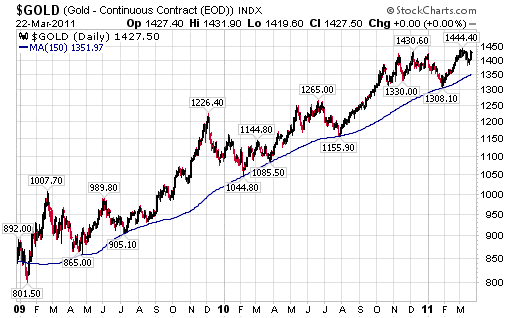
Yesterday was a banner day for the precious metals. Gold closed at an all-time high in terms of dollars. Silver moved into the 37 dollar zone for the first time since the precious metal bull market of the 1970s (today it's above 38 dollars an ounce!).
But there's a big difference between the current precious metals bull market and the bull market of the 1970s. The 1970 bull market drew tremendous interest (I was there). Everybody I knew (even the gold haters) were watching that bull market with keen interest, particularly during the wild "blow off" days of the late 1970s, when silver was rocketing higher -- rising every day by "limit up."
In comparison, today's huge precious metal bull market is greeted with yawns, that is, if it is greeted at all. I've been calling the current gold/silver market the "great stealth bull market." Ask the average man or woman on the street what's happening to precious metals, and they'll give you a blank stare and maybe a "Duh." Ask them if they own any gold or silver, and they'll give you a sheepish "Nah."
Gold (April) closed on March 2 at 1437.40, a record high. On March 9 silver closed at 36.04, highest since 1981. Yesterday both marks were bettered. Where's the excitement, where's the interest, where are the articles in the newspapers?
Time to study the chart below. As I've been saying, gold in its advance has periodically tested its 150-day moving average over the past few years (150-day MA is shown as the blue line on the chart). Note that on the most recent "correction," gold didn't even test its 150-day MA. When I saw this, I realized how powerful the forces under gold were.


Gold is now "out in the open" with no overhead resistance and no overhead supply. So far the bull market advance since 1999 has been steady, quiet, and orderly. Except for its spectacular slow and relentless climb, there's been no excitement in the gold bull market.
I don't think this is going to continue. Somewhere ahead the precious metals bull market is going to turn wild and speculative. Only one phenomenon will serve to create this excitement. That phenomenon is HIGHER PRICES. The public can resist anything in markets except steadily rising prices.
As for steady higher prices and excitement, I suspect that silver is about there. As for gold, maybe not yet. But somewhere ahead gold is going to catch fire. That will be the time when the great American public will decide that they have to have some gold, maybe just a coin or two, or maybe just a few shares of GLD -- but that time is coming.

Question -- As a new subscriber what should I do?
Answer -- Buy a position in GLD or SGOL or SLV. Assume a conservative position, one that you can sit with.

Question -- "What about older subscribers? What should we do?"
Answer -- Never mind timing this bull market. It can't be done, even by Goldman. You can add to your gold position. If possible, buy some one-ounce gold coins. One advantage of coins is that you're probably not going to trade them in and out. Sit tight with your coins, Put them in a place that's difficult to get at; in that way it will be a nuisance to sell them, even if you're tempted to.

***
Richard Russell

Labels: , , ,

Aug 29, 2010

Richard Russell: my take on gold

Here's a short extract from from Richard Russell's Dow Theory Letters reiterating his position and strong commitment in gold's generational bull market:

August 25, 2010 -- Dennis Gartman is an experienced commodity trader. Dennis has been very cautious about gold; he “sort of “ likes gold, so he calls himself a “gold agnostic.” For this reason it’s most interesting to read what Dennis says about gold in today’s report.

“Turning, then to gold and other metals, prices turned sharply for the better yesterday as the world rushed out of equities and looked for any safe harbors that were available. Certainly the rush to the Swiss franc was obvious, as noted above, and so too the rush into sovereign debt securities. But frankly, the rush was on to gold once again. We remain long what we have referred to as an ‘insurance’ position in gold, but we own it in terms of EUROs and /or of British pounds sterling, otherwise we remain an agnostic. To assuage our friends who are gold-bug-leaners, we shall not be short of gold. Nothing likely shall ever turn us manifestly bearish of it. But for the moment we are simply hard upon the sidelines, owning only this small ‘insurance’ position and comfortably in that position.
“Might we be enticed back to the bullish side of the market eventually? Of course we might. If the situation in the global equities markets became dire, we might move from agnosticism to ‘faith.” If we were to see the monetary authorities throwing caution to the wind and massively explode their balance sheets, we might be enticed away from our agnosticism to ‘faith.’ If the political situation were to become untoward, and patently uncomfortable, we’ll throw our agnosticism into a heap and join the gold market faithful. But until then, agnosticism works for us.”

Russell response — I can understand Gartman’s caution. Dennis is an old-time trader, and he’s seen a lot of traders get killed by taking huge and wrong positions.
My own position is that gold is in a clear and obvious primary bull market. These situations come along maybe two or three times in a lifetime. I was convinced back in 1999 that the bear market in gold had ended with gold selling at 256. In the year 2000 they were literally giving gold mining shares away. At that time gold shares were so ridiculously cheap that I told subscribers that they should buy these stocks (many selling for just a few dollars a share) and hold them as perpetual warrants.
At the same time I told my subscribers to start buying bullion one-ounce coins and “put ‘em away.” I’ve suggested that my subscribers do the same thing ever since.
I know bull markets, and I’ve never seen or experienced a primary bull market that didn’t end with a third speculative phase—this is the time when a bull market “blows its top”. I feel certain that the current huge bull market in gold will do the same.
But I have other reasons for being bullish about gold. Gold is the only real Constitutional money. The fiat paper that we’ve been using as money is only money because our government says “it’s money.” If the US government told you that printed paper was real money and legal for the payments of all debts, would you believe them. Well, you already have believed your government.
But I maintain that the truth will out, and that fiat paper is a fraud that will be found out. When that happens and people realize that they have been hoodwinked by their government, there will be such a rush (including both fear and greed) for gold that it will make the recent tech mania look like conservative investing.

As I write at midday, Dec. gold is up over nine dollars. Gold has been up 8 out of the last 10 days. As the months go by, we are pressing ever-closer to the speculative phase of the gold bull market. That will be something and even terrifying to see.

I am pleased to say that many of my older subscribers are now in the process of getting rich on their gold holdings. I’ve said over and over that one of the most difficult things to do in investing is to get in early on a primary bull market and ride the bull through to the latter part of its final speculative third phase.

The market seldom gives you the chance to get rich. This gold market has defied the odds and allowed its early followers and believers to get rich.
Anyway, that’s my take on gold and why you should own it and why you should follow my advice.

Richard Russell

Labels: ,

May 19, 2010

Richard Russell: Sell Everything Liquid, You Won't Recognize America By The End Of The Year

Here's the last bell ring from the old sage of the markets, the venerable Richard Russell:

"..Do your friends a favor. Tell them to "batten down the hatches" because there's a HARD RAIN coming. Tell them to get out of debt and sell anything they can sell (and don't need) in order to get liquid. Tell them that Richard Russell says that by the end of this year they won't recognize the country. They'll retort, "How the dickens does Russell know -- who told him?" Tell them the stock market told him. That's pretty intense!

Update: By popular demand, here's more on what he sees in the market. The gist is that the markets recent gyrations are telling him that the economy is in trouble:

And I ask myself, "Am I seeing things? The April 26 high for the Dow was 11205.03. The Dow is selling as write at 10557 down 648 points from its April high. If business is even better than expected, then why is the Dow down over 600 points? And why, if there were 674 new highs on the NYSE on April 26, were there only 20 new highs on Friday, May 14? And if my PTI was 6133 on April 26, why is it down 17 points since its April high?

The fact is that I've been seeing deterioration in the stock market ever since early-April, and this in the face of improving business news. The D-J Industrial Average is composed of 30 internationally known top-quality blue-chip stocks. These are 30 of "America's biggest companies." If Barron's is so bullish on the future of America's biggest companies, then why isn't the Dow advancing to new highs?

Clearly something is wrong. But what could it be? Much as I love Barron's, I trust the stock market more. If I read the stock market correctly, it's telling me that there is a surprise ahead. And that surprise will be a reversal to the downside for the economy, plus a collection of other troubles ahead.

About Dow Theory -- First, we saw the recent April highs in the Averages. Then we saw a plunge in both Averages to their May 7 lows -- Industrials to 10380.43, Transports to 4298.12, next a short rally. If ahead, the two Averages turn down and violate their May 7 lows, that would be the clincher. Such action would signal the certain resumption of the primary bear market.

Just as for years I asked, cajoled, insisted, threatened, demanded, that my subscribers buy gold, I am now insisting, demanding, begging my subscribers to get OUT of stocks (including C and BYD, but not including golds) and get into cash or gold (bullion if possible). If the two Averages violate their May 7 lows, I see a major crash as the outcome.
Pul - leeze, get out of stocks now, and I don't give a damn whether you have paper losses or paper profits!.."
....what more is there to say?

Labels: , ,

Sep 11, 2009

Richard Russell: Fed will do anything to keep gold down

By Richard Russell
Dow Theory Letters
Wednesday, September 9, 2009

As the great Bob Dylan song goes, "There's a battle outside, and it's raging, it will soon shake your windows and rattle your walls, for the times are a'changin'."

The battle is obvious -- it's the primary forces of overproduction and deflation vs. the Fed's obsession ("whatever it takes") to fight deflation and to produce asset inflation.

The one signal for rising inflation that the world understands is rising gold. The central banks do not want to see the gold signal, which tells the world that inflation is in command.

What the Fed really wants is asset inflation in housing. Housing is collateral for almost everything in the nation, and the Fed and Treasury are frantic to get housing prices heading higher.

Yesterday most assets got the message. Oil was higher, the base metals were higher, the stock market was higher, but gold (pressured by forces we know not from where) failed to close at the highly significant number of $1,000 an ounce or better. Incredibly, after being as high as $1,009 during yesterday's session, gold closed at $999.80 -- just 20 cents below $1,000.

Coincidence? Mistake? Random chance?

Hardly. To me it was obvious that the Fed did not want to see the following headline in the newspapers: "Gold closes above $1,000."

Whatever it takes, it seems, will be utilized to hold the only constitutional money down.

When a can is placed on a stove burner, the pressure builds up inside the can. At some point, we know not exactly when, the can will explode and the pressure will be released. That, I believe, is where gold is.

You can threaten gold with forthcoming central bank sales. You can sell gold in quantity. You can smother gold with short sales. But the primary trend of gold will win out. It will be expressed today, in a month, or in 2010. The trick for us is to hold onto our position -- don't trade it, don't move in and out with it, don't hold so much of it that you get the heebie jeebies every time it dips $10.

The primary trend of gold is up. We're riding the bull. The bull will try to shake us off his back. We'll hang on.

The word is that China wants to load up on gold while diversifying out of its huge position in dollar-denominated securities (T-bonds). China's problem is how to accumulate gold secretly without driving the price up. This has led to what is now called "the China gold put." Every time gold backs off, China is in there to scoop up what is offered.

On top of that, China is urging its over-1 billion population to buy gold and silver.

Finally, China is now the world's biggest miner of gold. China, in its patient way, is preparing for the future. The future that China sees is a world without fiat currency or a world in which its own renminbi is the world's reserve currency.

* * *

Chrys N.B. ... got Gold..?

Labels: , ,

Dec 3, 2008

Richard Russell: the "fun days" of 1929 redux?

A snippet from Richard Russell's Dow Theory Letters remarks:


Richard Russel
December 2, 2008 - The Bernanke-Paulson team is doing everything in its power to hold back the forces of deflation. The first indication that they're succeeding will be the stock market ceasing to deflate.

A trillion is the new billion. The government has thrown tens of billions at the face of various deflating entities in a desperate attempt at halting deflation. It hasn't worked. The stock market's opinion, so far, is that "it's not going to work." You can't cure the disease with more of the same "medicine" that caused the disease. The only cure for a crashing stock market is exhaustion, and it is probably the same for the US economy. The bear market in stocks has an economic equivalent - a severe recession, better known as a depression.

There is an inflection point somewhere ahead that will mark the death of deflation and the base for forthcoming inflation. We have not reached that inflection point yet. The stock market continues to deflate and the treasury bond market continues to discount deflation. If Bernanke and Paulson fail to halt deflation, we will be facing a deflationary disaster ahead. It will wipe out all the leveraging and inflation built into the US economy since World War II. For years I've been writing that ultimately we will face the choice - "inflate or die." Depression and deflation are the economic equivalent of death. I saw it once, and I never want to see it again - which is what today's site is all about.

Maybe wealthy La Jolla isn't a fair test, but I walk around La Jolla, and life appears to go on as usual. No real changes except that I see more "Sale" signs on the retail shops, and I see more "For Lease" signs posted in the windows of various blacked-out store fronts. People are shopping, couples sit in the sun at outdoor restaurants chewing on hamburgers or sipping coffee. Nothing much has changed in dreamy La Jolla - it will.

What is changing is the stock market and the Treasury bond market. Treasury bonds are hitting new highs, as the conservative bond market crowd pours money into the Treasury market on the thesis that come what may, they'll always get their money back if they buy Treasuries (that is, unless the dollar tanks, I think to myself).

Meanwhile, yesterday, the Dow was down over 679 points or 7.7% - so much for the five-day rally that served to get the bulls' hopes up.

My mind goes back to mid-1929. My parents are still giving cocktail parties for their friends (in those days, parties at restaurants were rare and unusual). My dad has just bought a Buick touring car, and we are preparing to take a ride to nearby Stamford, Connecticut. My sister and I are both going to private schools, and my mom is dreaming of getting out of the West Side and moving to the more "acceptable East Side." Dad is looking over the stock tables in The New York Times, and he wonders why he has not been more adventurous - Dad will only buy two stocks, American Telephone with its famous $9 dividend and "recession-proof Woolworth," which he terms "the poor man's stock."

During September through November of 1929, the market crashes. My uncle Irving jumps out of the tenth story window of a midtown Manhattan hotel. Irving commits suicide because his department store stock cuts its dividend in half (Irving lives on that dividend). After the great crash of '29, nothing in Manhattan seems very different. I can still ride the subway to school, all the way to Riverdale for a nickel. And a good sandwich at the Automat still costs only 15 cents. I'm given 35 cents for lunch every day. I usually buy a sandwich or a plate of cheese macaroni for 15 cents and a piece of pie for a dime at the Automat.

One year later everything has changed. Men are out of work. The lines outside the employment offices are growing longer - some wind around the block. Tired men in patched clothes sit on the sidewalk with outstretched metal cups and signs that read,"Veteran, God bless you." The mood in the city is changing, and you can sense the fear in the air. My parents' friends are calling the house and discussing how much money they have lost in the stock market. Some have lost their jobs. My father has a grim look on his face, he seems worried day and night.

In the year 1939 my father loses his job. He suffers a nervous breakdown. My mom doesn't want me to see it, and they send me on a youth hostel bicycle trip to California. On that trip I see the "Grapes of Wrath" up close and personal. California is filled with Okies and their beat-up trucks (people from Oklahoma who had fled the Dust Bowl and are looking for any kind of work in the Golden State). The California sheriffs and highway patrols are busy sending the poor Okies back home. "You want to work in California,bud? Forget it, we don't have enough jobs for our own." I'm stopped on my bike (I'm 16 years old) by the local sheriffs three times.

"Watcha doin' here kid? Lookin' for a job? Because if you are, I'm puttin' you on a box car and sending you back to wherever the hell you came from."

"No sir, I'm with a Youth Hostel group. We're just sight-seeing."

"Well you're not going to like the sights around here. And don't let me catch you lookin' for a job, kid. OK, get back on your bike - you can go."

Those were the fun days. I remember them well.

And now I'm wondering whether we're headed for another round of "fun days." The crashing stock market tells me it could happen. I don't want to see the days of 1939 again.

Richard Russell


...lots more follows for subscribers

***


Labels: ,

Sep 19, 2008

Richard Russell: Hold your gold coins!

Extracted from the Sep 16, 2008 edition of Richard Russell's Remarks:

"The great tragedy unfolds phase by phase. This is the way I see it.
The first phase was the giant edifice of inflated home prices topping out and rolling over. The second phase was the collapse of the great Wall Street houses, the third phase was the stock market sinking day after day.
The path of the stock market directly affects public sentiment. And I'm very much afraid that the next phase is going to be a pull back in spending, particularly discretionary spending, by the US public. Jobs will be difficult to find, the word will spread, if you've lost your job, you're not going to find another one at the same level of pay (if you find one at all). This will have an impact on retail sales, and US imports (which will have international implications for the exports of foreign companies, remember, the US is buyer to the world).
In this atmosphere, the big money, as I see it, will be made by wealthy speculators who will buy up foreclosed housings at bargain prices, often below the cost of replacement. Everything now depends on people being able to finance what they own, and this takes income and cash.
The two rarest items around will be just that -- cash and income. The great danger as I look ahead is that the bearish trends will feed on themselves.
Frightened people dump their stocks for cash, the result is a sinking stock market. A sinking stock market further frightens people and pushes them to sell ("get me out at any cost"). When I tell people that the correct posture now should be cash and gold coins, they look at me as though I was crazy. That reaction makes me worry.

One advantage of gold coins is that you're not tempted to trade them (it's too difficult). As my buddy, old-timer Sir Harry Schultz puts it, "The last man standing is he who owns gold." Hold your gold coins."

...to read R. Russell's snippet on 321Gold, please click HERE

Labels: , ,

Nov 23, 2007

Richard Russell: A Primary Bear Market

A Primary Bear Market

Richard Russell Dow Theory Letters
Extracted from the Nov 21, 2007 edition of Richard's Remarks

It was a noble battle, it was a battle that seemed almost endless. But today the great battle ended. Today the D-J Industrial Average closed below its August 16 low of 12845.78, thereby confirming the prior violation of the Transportation Average. In so doing, the stock market and the Dow Theory have spoken -- they have confirmed the existence of a primary bear market.

One of the precepts of the Dow Theory is that neither the duration nor the extent of the primary trend can be predicted in advance. I have absolutely no idea whether this is fated to be a mild bear market or a severe one.

Well, there is one hope and one hint. The most authoritative bull or bear signal comes when both Averages, Industrials and Transports, break through critical levels simultaneously. That is not what happened in the current instance.

The Transports broke under their August 16 low of 4672.35 back on November 7. Today the Industrials finally confirmed, so the bear signal was not given simultaneously. If there is even a hint that this bear market will be "kind," this is the hint, but I'll admit that this line of reasoning may be far-fetched. The fact that we must operate on is that the primary trend of the stock market is now definitely bearish. The great primary trend of the market is pointing down.

I've done my best to prepare my subscribers for this possibility. True, I did continue to "hope" that the Dow could stave off a break below 12845.78. The Dow did resist that situation for week after week. Alas, today the support gave way, and the Dow succumbed.

What to do now? I don't have any magic formula. Prudence dictates that we be light, very light, in our holdings of common stocks. Those subscribers who are holding top-grade dividend-paying equities may decide to sit tight. Those subscribers in the "compounding business" with large reserve funds may decide to weather the storm, collect the dividends, and continue to compound, buying additional shares at whatever price the market may offer at the time.

Those with large stock holdings may simply decide to cut back. After all, a lot can be said for the luxury of a good night's sleep. Personally, I've chosen what I call the "way of the sleeper." I'm very low on common stocks, in fact the only common stocks I now hold is a limited position in GDX, the exchange traded fund for precious metal shares.

Thought -- the market was oversold or actually severely oversold as of yesterday's close. A big break today renders the stock market oversold to the extreme. This could lead to a rally very shortly, and such rallies often take the Averages back to test their initial breakdown levels. If we do get such a rally, it would provide subscribers with a second chance to lighten up.

Note that the S&P and the Wilshire have NOT confirmed the Dow. In one of the strangest situations I've ever dealt with, neither the S&P 500 or the Wilshire 5000 have confirmed the Dow in that neither the S&P nor the Wilshire have violated their August 16 lows. What is the meaning of this absolutely weird situation? I don't know -- honestly I really don't know. But it is certainly something to think about.

Does the superior action of the S&P and the Wilshire cast doubt on the Dow Theory bear signal? I don't know. I've never in fifty years of watching market action seen this type of situation.

There isn't a lot more that I can say that is worth saying. The market has told its story. The scene has changed. I've lived through these changes before, and so have my subscribers. A few of my subscribers have been with me for almost 50 years. We've survived and done pretty well over those 50 years. We will continue to survive, regardless of the mildness or ferocity of this bear market.

click for magnification
charts courtesy of stockcharts.com

This is an adage that I dreamed up many years ago, but I'm afraid that it's just as true today --

"In a bear market, everyone loses, and the winner is the one who loses the least."

lots more follows for subscribers...

Nov 21, 2007
Richard Russell
website: Dow Theory Letters
email: Dow Theory Letters
Russell
Archives
© Copyright 1958-2007 Dow Theory Letters, Inc.

Richard Russell began publishing Dow Theory Letters in 1958, and he has been writing the Letters ever since (never once having skipped a Letter). Dow Theory Letters is the oldest service continuously written by one person in the business.

He offers a TRIAL (two consecutive up-to-date issues) for $1.00 (same price that was originally charged in 1958). Trials, please one time only. Mail your $1.00 check to: Dow Theory Letters, PO Box 1759, La Jolla, CA 92038 (annual cost of a subscription is $250, tax deductible if ordered through your business).

Labels: ,

Aug 8, 2007

Michael Nystrom: The Secret World of Central Banks

The Secret World of Central Banks
by M.A. Nystrom
Editor www.bullnotbull.com
        www.dailypaul.com


Today, all eyes were on the Federal Reserve: How it would respond to the recent turmoil in global financial markets? Would it lower rates, and if so, would it do any good?

By the time you read this, the Fed's decision - made in secret - will have already been announced. Hundreds of news articles and blogs will argue over its wording and meaning. Was it dovish or hawkish? Discussed ad nauseam will be: what the policy statement does or does not clarify, what it leaves room for in the future, what it means for the economy, housing, jobs, and the prospects for recession or recovery.

What will not be discussed is the powerful role played by central banks themselves.

Central Banks = Centralized Economic Planning
If you thought that centralized economic planning disappeared with the fall of the Berlin wall in 1989, think again. Eight times each year, a group of twelve men meet to make secret decisions that have a profound impact on the US and global economies. None of these men are elected. Their meetings are closed to the public. Even members of the US Congress and the Senate Banking and Finance Committees are barred from attending, or even knowing what is discussed. No detailed account of arguments or discussions is ever made public. Listen to Congressman Ron Paul on the secrecy of the Fed:


In some parts of the world, this might be called a cabal. Here it is called the Federal Reserve Open Market Committee (FOMC). Regardless of what you call it, it is profoundly unfair to the majority of Americans. Eight of the representatives at today's meeting - the Chairman and the Board of Governors - are political appointees of the President. All twelve men are bankers. Their secret decisions - made eight times each year - affect whether or not you can get a loan, what your payment will be, whether the economy booms or sinks into recession, and therefore whether or not you'll have a job.

What the Fed says and what it does are two different things. Today, with the Fed's stated "focus on inflation," I am reminded of Richard Russell's January 4, 2007 edition of his Dow Theory Letters, in which he had a short analysis of central banks. Mr. Russell 83 is years old and has been watching the market for well over fifty (50!) years. He's one wise & curious dude (the last two his own words) who's been writing non-stop since 1958.

This is what Russell has to say about central banks in general:

CENTRAL BANKS - I get a kick out of all these central bank governors, both here and overseas, constantly warning us about the "terrible danger of inflation." What a bunch of snake-oil salesmen these guys are. It's the central banks themselves that are pumping out all that extra fiat money that is creating the inflation. It's like an AIDS carrier indulging in all the sex he can handle while simultaneously warning about the spread of the disease.

So what's it all about with these central bankers? Simple, they like their cushy jobs along with the perks, and the only thing they're worried about is that the world will get wise to the central bank/fiat money racket, and maybe kill the beast. In other words, the central banks are afraid that voters will finally get rid of the whole private money business along with its nonstop production of intrinsically worthless fiat money.

You see, a real headwind of inflation would anger the public, in which case a few intelligent journalists might start putting the blame where it belongs - on the central banks, not the least of which is our own Federal Reserve. No, too much inflation, surging inflation, would be dangerous - it might expose the Fed and the central bankers for what they are - engines of inflation. When you've got a great racket going, like taking control of a nation's money, you want to protect that racket.

So its no wonder that the governors of our Federal Reserve take turns "warning us" about inflation while simultaneously telling us that "they'll keep everything under control." It's enough to cause this editor to "throw up his cookies." The curse of the Fed - it keeps going on and on and on. These freebooters know how to protect their racket. Create inflation, hide the evidence (as they did when they hid the figures on the broad M-3 money supply) and bravely act as our "protectors and saviors." Where was Congress when the Federal Reserve was first approved in 1913? Answer - At the same place it was when Congress handed over to President Bush the power to make war. End of that Russell rant. Whew!


Richard Russell hits the nail right on the head. You won't hear about this in the mainstream media anytime soon. Unlike the MSM, Richard Russell is independent - beholden to no advertisers. He can say what he wants; he is free to speak the truth.

Will the public ever wake up to what is going on with our money supply, and "finally get rid of the whole private money business along with its nonstop production of intrinsically worthless fiat money?" The first step towards that goal is awareness.

Since the Fed is worried about excessive inflation - which it has been creating itself, perhaps it is time for it to create a little deflation, i.e. monetary destruction. By limiting the supply of credit, assets that rely on ever increasing amounts of credit creation begin to lose value or disappear altogether. For those of you who think that deflation is impossible, I direct you to one of the most profound comments ever to appear on Bull! Not bull:

I am fascinated by the common perception that the Federal Reserve is a proven non-stop inflation machine. Inherently, the Federal Reserve uses inflation and deflation to whipsaw the average bystander out of his savings. I don't see how one economic machination is more favored over the other when the goal is to ensure that the public's savings ends up in the accounts of the shareholders of the Federal Reserve System.

Think about it. And stay tuned.

Labels: , , , ,

Aug 6, 2007

Richard Russell still going strong at 83

By Peter Brimelow
MarketWatch.com
Sunday, August 5, 2007


The Sunday sun was still high above George's At the Cove restaurant, overlooking the Pacific in the idyllic California beach town of La Jolla. But Richard Russell, editor of Dow Theory Letters since 1958, was ready for dinner. He would be getting up at 3:15 a.m. Monday as always, preparing to write the several thousand words of commentary he posts every day that the market is open.

Russell and his elegant wife, Faye, are regulars at George's, which is owned by a son-in-law from a previous marriage. They just celebrated Russell's 83rd birthday there. But the waitress says he usually arrives early and leaves quickly. Deadlines, and markets, are always on his mind.

A particularly intense week was looming for Russell. The stock market had staggered in the wake of his recanting his tenaciously-held view that the post-2002 rally was a just a blip in a primary bear market, which seriously angered many of his subscribers.

The Dow Jones Industrial Average closed on Friday, July 27, just below its June low of 13,266.73; Russell's reaction: A Dow Jones Transportation Index close below its June low of 4994.82 will confirm a Dow Theory Sell Signal. But Russell's been overriding Dow Theory when he feels like it.

Juncture recognition is key to Russell's reputation. He was unrelentingly bearish after 1966, but dramatically called the 1974 bear market bottom.

He got out of stocks two months before the 1987 crash. And again he got out of stocks in late 1999, six months before the March 2000 blow-off. Russell remained stubbornly bearish right through the subsequent 2002 slump, when most advisers were faked into thinking that happy days were here again.

Of course, it's not a completely clean picture. After 1987, Russell didn't get back into stocks until 1989, when they were considerably higher than his exit level. Arguably, the same thing has happened now.

But the point is that Russell is not a stopped clock, as some of my Russellphobe readers, who focus only on this last decade, keep complaining. And by getting out before the big breaks, he has dramatically reduced risk for his subscribers. "In this business, it pays to hope for the best, but be prepared for the worst," he says. According to the Hulbert Financial Digest, Russell is tied for top place as a market timer on a risk-adjusted basis since 1980.

The HFD monitors only Russell's market timing, on the austere grounds that the rich smorgasbord of investment mutterings, musings and mentions that he serves up each day does not lend itself to systematic tracking. But these ideas are often cited gratefully by my equally numerous Russellphile readers.

Russell in his 84th year looks absolutely, extraordinarily wonderful. He's been in La Jolla since 1961 and adores it. He apparently never travels or takes vacations, and he rarely gives interviews. His 10-minute commute is a worthwhile disruption, Faye Russell says, because the office provides him with his only social life. Russell does admit to 20 minutes on the exercise cycle after the market closes. And this week he cut back his Wednesday comment, saying he plans to rest midweek in order to "keep doing this for the next 15 or 20 years."

It looks distinctly doable. Faye Russell, 32 years her husband's junior and a corporate lawyer who says she went back to school because she assumed she would be a young widow, now wryly predicts he will outlive her.

Russell comes from an old South Carolina Sephardic family. He says that his father, a civil engineer, was advised by the famed financier Bernard Baruch, a friend whose background was very similar, to lose his southern accent when he came to Manhattan, where Russell was born and raised.

Russell himself served in World War II as a bombardier in the U.S. Air Force, flying more than 20 missions, an experience that obviously marked him profoundly. Then Russell worked as a textile designer, studying the stock market in his spare time. Married three times, and still on remarkably good terms with his ex-wives, he has five children, plus grandchildren who are being raised Catholic.

Russell says he is not drawn to organized religion. A sister is retired in Greenwich, Conn. An actress daughter, Betsy, who according to Wikipedia "endeared herself to young men across the globe with some nude scenes in 1983's "Private School," has now resumed her career in fiancΓ© Mark Burg's hugely successful "Saw" series. Russell doesn't particularly like these movies, but appears impressed by their return on investment.

Although Russell has ruthlessly bugged his subscribers into getting online he says he has only 500 unreconstructed snail-mailers out of some 10,000 subscribers. He turns out to be still something of a print primitive. He reads several newspapers a day. He even eschews email on weekends.

What about the market?

With Russell, what you read is what you get, not surprising when you consider how much of his life is spent writing. But what you get is nuanced and Delphic, which I believe is an honest reflection of his subtle and sensitive intellect. And, importantly, his intuition.

I asked Russell directly: Is there a "Greenspan put"? Have the authorities been committed to maintaining the markets, risking ultimate collapse?

In his esoteric way, Russell has excited his readers, who tend to become devoted Russellologists, by hinting that he thinks equity markets in general and the gold market in particular are being manipulated in the interests of an inflationary boom.

But, needless to say, Russell didn't answer me directly.

He said he does read Lemetropolecafe.com, the leading proponent of the manipulation theory. But Russell's not about to endorse it. He pointedly says that his favorite columnist right now is Bloomberg.com's Caroline Baum, a vociferous critic of the view that official-sector intervention, in the form of the rumored "Plunge Protection Team," exists at all.

On the other hand, Russell says flatly that "the central banks won't let deflation happen." (Hmmm ... and how, exactly, will they do that?)

If there's a put, Russell quips, it's a "China put," the unprecedented demand unleashed by China's economic awakening.

But Russell instantly agrees when I challenge him with the argument that no one really knows what's happening in China.

Maybe my questions had an influence. Looking at the dramatic last-hour rally on Wednesday night, Russell wrote: "Amazing action but the session was not a total triumph for the bulls. Breadth was about even, and new highs rose to 492. I had the distinct feeling that near the close of today's session somebody or some group decided to 'save the day.' Who could that be? Who would have the power to buy, say, a few thousand S&P futures? It doesn't matter. The true and decisive direction of the market will become clear as we move along."

And on Thursday night: "The sudden buying, seemingly 'out of nowhere,' left me just a bit suspicious."

Russell really doesn't like this bull market. He has repeatedly said that it can't be justified in terms of fundamentals, such as price-earnings ratios.

He does respect the fact that it has happened anyway. As he said recently: "Join the TV cowboys and ride the bull."

But it's not a surprise that he's worried now.

Russell wrote during this last week: "Fundamentally, the big question is the action of U.S. consumers. Will they pull back on their buying and maybe even start to save? If they do, it will be bearish for the economy and the markets? And oh yes, thanks Alan Greenspan for loading America up with loans, credit and debt!"

As Russell often does, he posed a question to himself: "Question: Russell, do you think we're at the beginning of a primary bear market?"

"Answer" Of course, this is the most important question that can possibly be asked today. And my answer is, 'No, I don't believe we are in a primary bear market. But this is too important a question to be arrogant about. And that's the reason I bring up the 50% Principle (i.e. the primary trend is intact as long as stocks don't give up more than half their gains since the bull market began). The 50% Principle will tell us whether we are experiencing a correction a primary bull market or whether the bull has indeed died.'

"Of course, a major problem is that the 50% or halfway level of the entire rise from the 2002 comes in at Dow 10,643. Will we have to wait for a huge decline to Dow 10,643 to find out whether it's a bear market or not. All I can say is that 'I hope not.' There will be indications along the way."

Last word: After a wild week of routs and rallies, the stock market finally broke down badly late Friday. After the close, Russell wrote:

"This is turning into one mean-looking decline. The Dow and the Transports BOTH closed at new lows for the move today. From a Dow Theory standpoint, that an ugly picture and calls for defensive action on the part of investors."

Russellologists note that he hasn't actually proclaimed a Dow Theory signal, but if you go by his earlier comments, Friday's close was one.

Stocks are now right at or below the point at which Russell recanted his bearishness. Torturing thought: at this point in his brilliant career, could Russell have been a contrary indicator?

* * *

Labels:

Jun 14, 2007

Richard Russell: I'm an old-timer...

Richard Russell
Dow Theory Letters
Jun 14, 2007

Extracted from the Jun 13, 2007 edition of Richard's Remarks

June 13, 2007 -- On June 7 the national debt of the US was $8.85 trillion. The annual interest on this debt is $406 billion or over one billion dollars each and every day of the year. The debt is increasing at the rate of $1.38 billion a day. Thus, we see the magic of compounding, but unfortunately what we're seeing is compounding in reverse.

With the above in mind, you have to ask yourself, "How in the world is the US going to finance its rising and compounding debt?" And the answer rings loud and clear -- it will be financed through inflation. I've said it for years, and I'll say it again -- it's a case of "inflate or die," and the US has no intention of dying. So we'll inflate, it's simply a matter of how rapidly we inflate and how successful the government and the Fed are in keeping the American people in the dark about what's happening to their money.

I'm an old-timer which means that I have a real-time perspective on what's happening to the purchasing power of the dollar. I remember bread at a dime a loaf, I remember full-course dinners at neighborhood restaurants for 90 cents, I remember new Ford cars for $450, I remember a double-scoop ice cream cone for a nickel. I've watched the purchasing power of the dollar going down the drain all my life. Now the process seems to be accelerating.

More recently, I've watched David M. Walker, our brave Comptroller of the United States, as he tours the nation and evidently will continue to tour until the 2008 elections. Walker is talking to anyone who will listen about the recklessness of borrowing money from foreign lenders to pay for running the US government and about the "demographic tsunami" that will arrive when the baby-boom generation begins to retire.

All the above is why I suggest that my subscribers accumulate gold. Furthermore, I've suggested that subscribers think of their gold holdings in terms of the number of ounces held. As for the price of gold, the price will take care of itself as the dollar slowly (I hope slowly) slides into the dusky realms of fiat-history.

There's no way of gauging how long this whole inflation process will continue or how long the dollar will be able to withstand the pressure of negative compounding. I've said for years that the Achilles Heel of the US is the dollar. Our "prosperity-on-loan" depends on the willingness of our overseas "friends" to accept US dollars. International finance is a cut-throat business. Nations tend to do what's best for them. All nations hold various quantities of dollars, and all dollar-holders must know that the US has no alternative but to continue on the path of systematic inflation.

Furthermore, the major developing nations, and I'm talking about Russia and China, want to be on an economic and political par with the US. To do this, Russia wants a convertible ruble, and China will want a convertible renminbi. As for the euro which is already convertible, it was created in Europe to compete with the dollar.

So far, most of the commerce of the world is done in dollars. But I don't know how long that's going to continue. In due time (when it suits them) Russia will make the ruble convertible and China will make the renminbi convertible -- but as I said, they will do it when they're ready and in their own good time.

I've held all along that the next war will not be a military war. It will not be a matter of the major powers fighting each other. The coming war for power and world leadership will be an economic war. It will be fought with competitive currencies and the movement of gold and the potential threat of nuclear bombs.

As for the bombs, they will only be a threat. World leaders know that no nation today can win a nuclear war. Nuclear bombs are for defense. If you have nuclear capabilities, you own the ultimate instrument of retaliation. Nuclear is the ultimate threat and therefore the ultimate defense. In classic Zen terms, it's "winning without fighting."

A full-page article in the June 12 Financial Times carries the headline, "Dragon Fleet. China aims to end the US Navy's long Pacific dominance." China is building its Navy as it moves to become the dominant power in the Pacific. At the same time, Russia wants to be the dominant power in Europe, and it wants all Europe to depend on Russian oil and gas. Both China and Russia want to "neutralize" the US. The years ahead should be exciting, dramatic and filled with danger.

lots more follows for subscribers...

Labels: ,

Apr 18, 2007

Richard Russell: (Real) Cash is Beautiful!

Richard Russell"... Cash is beautiful. With it you can buy a luxurious Bentley car, an apartment house in New York, a McDonalds franchise in San Diego or a million acres of land in Argentina. But wait -- don't hold onto your cash too long. Because today's cash isn't the cash of the early 1900's. In those days, you could turn in your cash and receive gold for it. Your dollars had something behind them that was tangible and eternal. The item that was behind your dollars or more properly Federal Reserve Notes was real, undisputed money. That situation ended in 1933. No more gold for your dollars. Today your cash has buying power, but that buying power is based solely on government fiat. And sad to say, the longer you hold your cash, the less buying power your cash will command.

Below I show a monthly chart of gold, the eternal money. As the chart indicates, since 2001 it has required more and more of today's fiat paper to buy an ounce of gold. The chart shows gold rising relentlessly from a low of 254 back in 1999 to almost 700 today. The blue line is a 13-month moving average, and the red line is a 34-month moving average.

What's happening?

I believe what's happening is that big money, sophisticated money, is slowly but relentlessly moving out of all paper or fiat money into real money or gold. Why would they do that? Here's the reasoning behind their move. The Fed and the central banks of the world are set against any contraction in the US or in the world economies. Remember, there's a natural tendency for markets and economies to regress to the mean. Currently, the US economy is operating well above trend -- therefore, the natural tendency for the US economy is to correct -- or to regress to the mean.

But the act of regressing to the mean for the US economy would mean recession. The Fed is dead set against recession. The Fed fears recession because of the enormous amount of debts and deficits built into the US economy. The Fed fears recession because of the fragile state of the US housing. Any recession in the US would almost surely produce deflation. And once deflation digs its claws into a debt-laden economy, the situation can get very nasty. In fact, the situation can get quickly out-of-hand.

Feb Chairman Bernanke, a leading student of the Great Depression, has already warned about the dangers of deflation. Bernanke wants no part of deflation. In fact, you might say he's preempting deflation. Mainly, because of the housing slump, Bernanke is already preempting deflation. And he will continue to preempt deflation. How does he do that? He does it by expanding the money supply and by fostering sub-standard interest rates. In other words, inflation is now being "force-fed" into the US economy. It's not a matter of whether inflation -- it's a matter of how little or how much inflation.

One very obvious measure of inflation is the amount of fiat currency it takes to purchase one ounce of gold. The monthly chart of gold going to 1997 tells the story. And its an accelerating story. Note how gold is pulling away from its (red) 34-month moving average.


What about holding a leading stock average rather than holding gold? The monthly chart below is a relative strength chart showing the performance of gold compared with the Dow. Here again we see that consciously or unconsciously the market in its wisdom is choosing gold over one of the strongest segments of the US stock market.

In July of 1999 one share of the Dow would buy 43.85 ounces of gold. Today one share of the Dow will buy only 18.44 ounces of gold. That's a decline of 58.2%. Thus, the Dow is steadily losing strength against gold. The reason, of course, is that the Dow is denominated in depreciating dollars.


What about the technical position of gold at this time? The P&F chart below tells the story. The latest move by gold has just filled the 695 box, it's highest level since the bottom of the correction. This opens the way for an attack on the 730 box recorded in May 2006.

The most recent move on the chart was an uncorrected advance from 640 to 695. This is a "high pole." Obviously, I don't know whether some correction or consolidation will be needed now or whether gold will move directly higher. It really doesn't matter. The trend is bullish for gold, and the base continues to build. The bigger the base, the more strength in the ultimate move to new highs. All that's needed now (and this has been the case all along) is patience, more patience -- and an understanding of the fundamentals."


To read more from R.R.'s quintessential market wisdom consider subscribing to his unique daily resume: The Dow Theory Letters

Labels: , , , ,

Apr 5, 2007

The "R man" at it ...(again!)

Richard Russell"... Well, there is one other phenomena that I want to talk about, and we call them bull and bear markets. The thing about a big bull or a big bear market is that they both end in exhaustion. And to become exhausted, a trend has to overdue itself on both the upside or on the downside.

I'm thinking of the bull market in gold. Unfortunately, I can't tell you when, but somewhere ahead the gold bull market is going to get "crazy," it's going to "blow its top" and end in exhaustion. It's going to become so wild and speculative that you'll just shake your head and mumble that "I've never seen anything like this." Yes it's going to happen somewhere ahead -- it's going to happen sure as shootin', but damn it, I can't tell you when.

Since there are always bull markets operating somewhere in something, why do I choose gold as an example? I pick gold because gold is the most emotional of all items. The gold-bugs love gold. The honest money crowd loves gold. The anti-inflationists love gold. The government hates gold. The central bankers despise gold. The bankers and the inflationists abhor gold. The yellow metal is loved and it is hated. A gold bull market brings out elements of both fear and greed. The fiat money crowd is fearful when gold advances. The honest money bunch love it when gold advances. Gold brings out the emotions like no other tradeable item. When gold finally goes into its third speculative phase, there'll be nothing like it. It will be a spectacle to remember."

Labels: , ,

Mar 17, 2007

Gold: the Big Picture

So as not to loose sight of what we're talking about here, feast your eyes on this bird's-eye-view monthly chart of the gold bull market that started with the new millenium, and keeps nicely chugging on...
As Richard Russell writes: "..Gold's in good shape, as it has been for the last 5000 years. And oh yes, the gold bull market is still only in its early second phase."

click for larger version

Labels: , ,

Mar 14, 2007

Richard Russell: This Gold Bull Market is based on fear of the viability of the dollar and all fiat money.

"...There are four kinds of gold or non-gold people (1) They know nothing about gold and never even think to ask. (2) They know a little about gold, but can't afford to buy any. (3) They trade small amounts of gold, but as soon as gold moves up or down 5 dollars or more, they sell it or are stopped out. (4) the so-called "gold bugs," the small minority who understand gold and money and adhere to a policy of accumulating gold.

I'm in category number 4. But let me give you my reasons.

The great majority of investors don't understand bull markets or the concept of the primary trend. When the primary trend of an item turns up -- whether it be stocks, commodities, agriculturals, precious metals -- we call that a bull market. There are small, medium and large bull markets. Once the primary trend of a category turns bullish, there's no way of knowing beforehand, how big the coming bull market is fated to be -- nor exactly what path the bull market will take.

We do know that in major bull markets there are psychological or sentiment phases. The first phase of a bull market is the accumulation phase. This is the early phase where informed investors accumulate an item because they know the item is underpriced or that the item is underused or simply not understood.

The second phase of a bull market, usually the longest phase, sees the professionals, the funds, the big money, the smartest of the public, taking positions in the item. The second phase tends to be characterized by many reactions, corrections, adverse news events that cause the public to dump the item.

The third phase of a bull market is the speculative phase, Here we see rising volume, the wholesale entrance of the public, accompanied by news and endless hype by the Wall Street "experts." People who wouldn't touch the item during the first and second phases, are now enthusiastic buyers. The third phase sees systematic distribution by the early first phase buyers. Third phase buying can easily turn to hysteria and madness. Towards the end of the third phase, we see hints of the beginning of the next primary bear market.

Question -- Do all bull markets progress as described above?

Answer -- Almost all major bull markets do. It's a judgment as to whether an ongoing bull market is fated to become a major bull market or not. There's no definitive answer to that question.

Now I want to talk about the current bull market in gold. This is a bull market that began in August 1999 with gold priced at 252 an ounce. Gold is the most emotional of all items -- loved by much of mankind, hated by certain elements including governments and central banks. Because gold is real money, and because gold is collected, traded and accumulated by millions of people the world over, gold bull markets tend to be BIG bull markets.

The gold bull market that started in 1999 has already taken gold up 291% to a high of 734 recorded in May of 2006. But what's so interesting about the ongoing gold bull market is that neither the public nor the funds have entered the picture. In fact, most people really have no idea that gold is in a primary bull market, this despite that fact that since 1999 gold has consistently outperformed the Dow and the S&P.

I believe that the gold bull market is now in its very early second phase. Informed investors have already established healthy positions in gold. I think that a very minor sector of the investing public has now taken some kind of a position either in gold or gold stocks or a gold ETF or a gold fund. Nevertheless, it's still unusual today to find an individual who has any kind of a position in gold.

Gold has been in a corrective phase ever its May high of last year. This backing-and-filling has served to discourage many Johnny-come-lately and in-and-out traders. Meanwhile, gold remains in what I consider its "bargain phase" below 734. But what about the future?

This is important. Almost all BIG bull markets (and I believe gold is in one) ultimately move into a third speculative phase. I believe this phase lies ahead for gold, maybe a year or so, maybe three, four or five years out. It doesn't matter -- in my opinion, the longer the time elapsed prior to the entrance of the third phase, the bigger the third phase for gold is fated to be. But before entering the third phase, we have to complete the second phase. The second phase, from the looks of it, may has quite a while to go before it is completed. Question -- how many of your friends own any gold?

My thinking is that when gold finally moves into its third phase, we may see one of the most speculative third phases in history. I believe we will see gold in the thousands of dollars. I believe we will see one of the most emotional bull market third phases in history. People will look back on the year 2007 and wonder what the world was thinking about with gold selling for $650 US dollars, dollars that were created out of thin air, fiat dollars which could be created by central banks in any quantity in at any time.

At any rate, that's the way I see this sluggish, unexciting, slowly-moving gold bull market here in 2007. I lived through and profited during the gold bull market of the 1970's. That bull market was based on inflation fears. This bull market when it moves into its third phase will be based on fear of the viability of the dollar and all fiat money. This bull market is fated to be much bigger than the bull market of the 1970's. "

Labels: , , , ,

Mar 7, 2007

Richard Russell: "I'm convinced that gold is cheap here.."

"..I note that many gold "experts" are claiming that they saw the gold correction coming, and that it has even further to go. All sorts and varieties of proofs are offered. Personally, I'm not interested in their crystal balls. What I want to do and have been doing all along is accumulating gold in terms of ounces. I'm convinced that gold is cheap here -- dirt cheap compared with the oceans of fiat paper floating around the world

Looking at the chart of GLD (this is the ETF which I use as a proxy for gold) no real damage has been done. GLD has dropped five boxes to the 63 level, it is still above its ascending bullish trendline. Gold is simply a better buy now that it was a month ago. Those are my thoughts on the gold action. My other thought on gold is that my gold position is not for sale. I'm a systematic buyer, not a panic-stricken seller."

click to view larger version

Labels: ,

Feb 23, 2007

Richard Russell: "..gold, the metal, is timeless money"

R. Russell's market wisdom on gold, silver and mine shares:

"..You don't have to be a genius in order to read the chart below. This is GLD, the Exchange Traded Fund which serves as a proxy for gold. The breakout came this month when GLD filled the 65 box. Since then, GLD has rallied to the 67 box (670 in gold), and this gives us an upside gold "count" to 820.


Of course, the next real test is for GLD to reach the 72 box -- and then to surpass it. I believe that's going to happen. How it will happen and when -- ah, I wish I could tell you. But I can tell you this -- the great gold bull market is intact and right on course.

The next chart is SLV, the Exchange Traded Fund and a proxy for silver. Yesterday SLV filled the 142 box, signaling a bullish breakout. The count for SLV is now 184, which would take silver over 18 dollars an ounce. The immediate upside target for SLV is the 152 box. I think that high will be surpassed this year, possibly early this year. But hey, what's the hurry? It's a bull market, and it will progress at its own pace and in its own time.


Next, we have GDX which is the Exchange Traded Fund for the gold mines. This is an intelligent and easy way to be invested in assorted gold mines. GDX includes a good assortment of the best mines plus a number of smaller speculative mines. We're still waiting for an upside breakout in GDX, and this would entail GDX rising to 43. The mining shares at this time are lagging the metal, but as I've said so many times, the mines and the metals alternate in leadership.

However, it's important to remember this -- gold, the metal, is timeless money, it's the obvious base of the precious metals universe. The mines are always speculations, they have the leverage, but they also may have the problems. My personal preference would be to own two-thirds metals to one-third mine shares. Others may differ, but subscribers know me -- I'm conservative and I always have risk in mind. A gold coin in the hand represents pure intrinsic wealth in any nation at any time in history. A hundred shares of a gold mine is a speculation and the hope of a profit in the period ahead.

I occasionally mention the Commercials in relation to gold. I consider the gold Commercials to be basically the gold mines themselves and perhaps the gold banks, those few banks that make a market in gold. The gold mines often sell forward gold, thereby locking in the current price. In doing so, they are also short gold. Occasionally, for instance, now, the Commercials will assume a large short position in gold. If gold rises, the mines lose on their short positions, but they can then either wait for a correction, at which time they can cover. Or, if need be, they can cover their short positions by supplying the actual gold which they mine.

But once in a great while, the Commercials get caught. They have assumed a large short position, and the metal goes against them. They don't get the decline they need -- and instead the metal powers higher. It's possible that this is one of those times. Yesterday's 23 dollar surge in the face of the current large Commercial short position had me thinking that way. If, indeed, the Commercials are caught here, we should see a concerted surge to the upside with very little "give" on the downside. Remember, trading is thin in the after market, and this is the time when the Commercials will try to knock the price of gold down, as they seek to present a picture of weakness in gold.

I want to emphasize the part that China and India and probably various Arab states could now be playing in the gold picture. Unlike US citizens, the three just mentioned are well versed in the value and the power of gold. The Chinese, Indians and Arabs understand that gold is real money, that it represents wealth that cannot be destroyed by governments or central banks. Thus, I believe that our overseas friends will be playing an increasingly large part in the gold picture.

In both ancient and modern history, gold has always flowed towards the strongest nations. Financial and even military strength has always acted as a magnet for gold. Thus, it will be most important to watch the flow of gold towards nations in the years ahead. Interestingly, the nations mentioned are all actively encouraging their citizens to accumulate gold. This is particularly true, I believe, in the case of China.

By the way, over the last five years gold has outperformed the S&P. In case you missed it, this rundown below shows gold's progress in various currencies. In dollars, gold is up 6 % so far this year (chart borrowed from John Mauldin's recent article.)

..."

Labels: , , , , , ,

Feb 19, 2007

Richard Russell agrees with GATA: Central banks rig gold

This is from yesterday's GATA newsletter:

"Dear Friend of GATA and Gold,

Nine years after LeMetropoleCafe.com proprietor Bill Murphy, soon to start the Gold Anti-Trust Action Committee, started screaming that the price of gold was being suppressed by collusion on the commodities exchanges, the king of technical analysis of the markets and the most venerable of U.S. financial letter writers, Richard Russell, has fully concurred.

In an unusual weekend letter distributed yesterday, Russell told subscribers to his Dow Theory Letters:

"Let's start with this vital and rather shocking piece of information, courtesy of Stephan Roach, chief economist at Morgan Stanley: 'Net foreign inflows into longer-term U.S. securities fell to just $15.6 billion in December 2006. This is the weakest reading in nearly five years. This stands in sharp contrast to America's enormous external financing needs -- about $3.5 billion of foreign capital inflow each and every business day is required to fund a current account deficit that was running at close to an $875 billion rate in the first three quarters of 2006.'

"What does this mean? It means that the squeeze is beginning.

"Normally, the U.S. reaction to the 'shortfall' would be a recession in order to cut way back on U.S. spending. Or it could be raising rates in order to make it more attractive to accumulate and hold U.S. securities. But raising rates would impact on the fragile U.S. housing situation. If the negative current account deficit trend continues, I don't know how it will be resolved.

"One result should be a weaker dollar and rising gold. If the shortfall continues, we can be sure of one thing -- something has got to give.

"Meanwhile, the central banks of the world are on a tear. I guess you could call it 'deflation-phobia.' At any rate, check out these statistics:

"In Australia, the M-3 money supply is running 13 percent over last year. In the Euro-zone, M-3 is up 9.3 percent. In Britain, M-4 is up 13 percent. In Korea, M-3 up 10.3 percent. In China, M-2 is up a whopping 16 percent. Russia shows M-2 up 45 percent. In the United States M-3 has been reconstructed to show that it's up 10.7 percent. As one wag put it, the central banks have instituted a campaign of 'whip deflation now!'

"I've described the situation previously as 'money gone wild.' It's a blizzard of fiat paper and credit beyond anything ever seen before in world history.

"The mystery is that gold isn't higher, much higher.

"My thinking is that central banks and others have, so far, held gold back with derivatives and massive short sales. I doubt that this can continue."

Yes, Mr. Russell, if gold had held its traditional ratio to money supplies and the prices of commodities, its price would be in the thousands of dollars by now. So much for the last decade of technical analysis of the gold market, which hasn't been able to figure out what has been going on.

No analysis of the gold market is worth anything if it fails to account for both open and surreptitious intervention by the central banks and their agents, the bullion banks, and by the mining company that, in U.S. District Court in New Orleans, claimed immunity to suit by declaring itself the agent of the central banks in the gold market, Barrick Gold.

This intervention has been too much lately even for technical analyst Dennis Gartman of The Gartman Letter, who now acknowledges that a government just might be behind the recent and most blatant efforts to suppress the gold price. Other technical analysts, like Clive Maund, still don't want to hear anything about it and get indigant and unresponsive when challenged. But give them a little more time. They probably will not want to be the last to acknowledge what has become obvious to everyone else, and what, in fact, is already on the public record in a half-dozen places technical analysts never look, since reality would get in the way of their beloved formulas and charts.

CHRIS POWELL, Secretary/Treasurer
Gold Anti-Trust Action Committee Inc.
...."

* * *

Labels: , , , , , ,