May 19, 2010

Richard Russell: Sell Everything Liquid, You Won't Recognize America By The End Of The Year

Here's the last bell ring from the old sage of the markets, the venerable Richard Russell:

"..Do your friends a favor. Tell them to "batten down the hatches" because there's a HARD RAIN coming. Tell them to get out of debt and sell anything they can sell (and don't need) in order to get liquid. Tell them that Richard Russell says that by the end of this year they won't recognize the country. They'll retort, "How the dickens does Russell know -- who told him?" Tell them the stock market told him. That's pretty intense!

Update: By popular demand, here's more on what he sees in the market. The gist is that the markets recent gyrations are telling him that the economy is in trouble:

And I ask myself, "Am I seeing things? The April 26 high for the Dow was 11205.03. The Dow is selling as write at 10557 down 648 points from its April high. If business is even better than expected, then why is the Dow down over 600 points? And why, if there were 674 new highs on the NYSE on April 26, were there only 20 new highs on Friday, May 14? And if my PTI was 6133 on April 26, why is it down 17 points since its April high?

The fact is that I've been seeing deterioration in the stock market ever since early-April, and this in the face of improving business news. The D-J Industrial Average is composed of 30 internationally known top-quality blue-chip stocks. These are 30 of "America's biggest companies." If Barron's is so bullish on the future of America's biggest companies, then why isn't the Dow advancing to new highs?

Clearly something is wrong. But what could it be? Much as I love Barron's, I trust the stock market more. If I read the stock market correctly, it's telling me that there is a surprise ahead. And that surprise will be a reversal to the downside for the economy, plus a collection of other troubles ahead.

About Dow Theory -- First, we saw the recent April highs in the Averages. Then we saw a plunge in both Averages to their May 7 lows -- Industrials to 10380.43, Transports to 4298.12, next a short rally. If ahead, the two Averages turn down and violate their May 7 lows, that would be the clincher. Such action would signal the certain resumption of the primary bear market.

Just as for years I asked, cajoled, insisted, threatened, demanded, that my subscribers buy gold, I am now insisting, demanding, begging my subscribers to get OUT of stocks (including C and BYD, but not including golds) and get into cash or gold (bullion if possible). If the two Averages violate their May 7 lows, I see a major crash as the outcome.
Pul - leeze, get out of stocks now, and I don't give a damn whether you have paper losses or paper profits!.."
....what more is there to say?

Labels: , ,

Dec 2, 2009

Anthony Deden: «Reflections on the Role of Gold in Investment Practice»

If Bob Landis's address to the Nov. 17, Zurich Gold Conference (appended two posts down) has whetted your appetite for more sane economic approaches to true capital preservation and solid investment practices, then you will certainly enjoy Tony Deden's sage musings:

"Reflections on the Role of Gold in Investment Practice":

Tony Deden

"..Despite of what the program says, I do not see myself as an expert. This is why I have added the word «Reflections» to the title. What I will share with you in the next twenty minutes are merely my own ideas on the subject – each of them, in fact, significant enough to demand far more discourse. Finally, I will also try to summarize my own recent practice with respect to gold and the reasoning that it entails.

First, let us define the terms. By the word «gold», I do not mean gold futures contracts, or a structured note, or a warrant, or a gold certificate. I do not mean gold mining stocks or most gold ETFs. By the word «gold» I mean just that – the old-fashioned kind that shines.

Secondly, let us define «investment practice». Forget the dictionary for a moment. In a city like Zurich, you have bankers, private bankers, asset managers, wealth managers, fund managers, portfolio managers, and the assorted variety of investment types. They are all investors. For the purposes of this talk, let us put them into two broad categories:

  • Those who work with other people’s money, savings, pensions and are obsessed with the idea of achieving results, money and fame on the basis of how markets do, others do or what the expectations of their customers are.
  • Those who look after money and capital that belongs to people they love (i.e. themselves, a father, an uncle, a grandmother, an old neighbor and so on) and who can not afford to lose it. These people are responsible for irreplaceable money.

On the surface, the jobs sound similar. But this is where the similarities end. If you are in the first category, most of my talk tonight may seem trivial and perhaps even irrelevant. If you are in the second category, welcome home.


«What matters is not securities prices, but what your 1975 savings can purchase in today’s world.»

For the last 25 years, I have found myself in the second category of investors and have focused exclusively in a rather unpopular segment: Capital preservation. For some of the audience here, capital preservation means low correlation to market. For others, it may mean bonds and other fixed income instruments. For others it may mean cash under the mattress. And yet for others it may mean gold in the vault. All of the answers are wrong.

Unfortunately, it is not so simple.

Suppose you were a successful businessman who sold his business in 1975 for 2 million francs. Or suppose you were just a simple man who managed to save (yes, save) some of his earnings, on retirement, in 1975, say 100’000 francs. Both of these sums were quite substantial back then. What matters is not securities prices, but what your 1975 savings can purchase in today’s world. Nearly 35 years later, in Swiss franc terms, you must have more than doubled your savings just to keep pace with the prices at Migros. In the end, what matters is the preservation of such capital – in the minimum.

These two imaginary men are witnesses to the fact that the job of capital preservation has nothing to do with alpha or beta or correlations or modern risk management. After all, we do not measure our health on the basis of an index of the collective health of others, but on an absolute basis. Absolute means – purchasing power. But what is absolute? We all end up measuring results in terms of a changing – depreciating money unit. There was a time when our man would put his savings in a bank and could count on the interest he received to meet his needs in retirement. But that was when money had substance. And it was a long time ago.


«I see my job in capital preservation much differently than you would imagine.»

In capital preservation, the problem we face is that we own a fixed amount of money capital – while the central bank produces, at virtually no cost, increasing amounts of the same thing, and in so doing, it reduces the value of what we have saved. On a compounded basis, after only a short period of time, we become impoverished.

I see my job in capital preservation much differently than you would imagine. You may be surprised to know that in 25 years of practice, in different times and for different reasons, I have been a value investor, a fixed income investor, a contrarian, a growth investor, a cash investor, top-down, bottom-up and so on. Starting only in 1998, very slowly, I have also employed gold and gold components in my portfolio, for reasons I will explain in a few moments. What seems to be lack of focus, or perhaps «style drift», is nothing more than a result of the absolute necessity in adapting to the changing circumstances that define both opportunities and risks – those known, those unknown, as well as the risks that come from not knowing what we do not know.

So far, in money terms, I have been more than successful in the pursuit of this mandate and have accomplished the goal to which I have aimed. There have been long periods during which I have owned a preponderance of common stocks, other periods during which I have held as much as 90% of assets in cash, yet others during which I have bought all the long-term government bonds I could, and finally, other periods during which I have held gold. I have accomplished the goal of capital preservation by owning at different times, some lengthy and some short, such diverse assets, as oil royalties, shares in Swatch, Straumann, Microsoft and so on, government bonds, and gold.


«Knowing that the source of all wealth is entrepreneurial activity.»

Starting with the elementary idea of scarcity and choice – and knowing that the source of all wealth is entrepreneurial activity, the general principle of my pursuit has been motivated by an understanding of value. I do not mean value in the sense of a lower P/E ratio or some Graham & Dodd formula or other comparative measure, even if all such notions are helpful. I describe value in its proper definition of being subjective and subject to personal interpretation. Overall, in so doing, I have sought to avoid large errors and have sought to identify significant trends. I have also sought to avoid the considerable errors that are generated by looking at prices rather than causes as a determining factor.

Let me explain – if the money price of an asset rises or falls substantially, one is tempted to look at this price and rationalize it in terms of where the price used to be, where other similar prices may be and so on. But that is really inadequate and misleading. The presence of a «bubble» or a bargain cannot be concluded until one understands the factors that have contributed in the rise or fall of prices.

So, if uncertainty is part of life and since we cannot forecast the future, how are we to be successful over a long period of time? In my view, we need two important possessions: firstly, the agility of an entrepreneur in avoiding errors that would put him out of business, while embracing opportunism and the understanding of value. Moreover, we also need certain intellectual ingredients – considerable knowledge, interest, wisdom and learning on four topics:

1. The nature of money – its history, its significance in financial and economic matters and its role in investment issues.

2. The nature of wealth and capital – how it is generated, how it is destroyed, what risks it confronts and how to value it – subjectively but deliberately. For example, I do not believe that wealth is made in the stock market—which, at best, is a reflection of wealth – and generally, prices of common stocks, like money, are also a function of confidence rather than inherent value. The standard of living of a nation or a family does not depend on the quantity of money, but on the productive capital it possesses.

3. The nature of business cycles – in solid economic theory that makes sense and passes the smell-test of history. I speak of theory as in the Austrian School theory in contrast to the gobbledygook – the confidence cum consumption game that passes for mainstream economics today.

4. Finally, knowledge of oneself is a critical subject as well.


«There is nothing magic about gold.»

Armed with such understanding, an intelligent person is able to make a start in looking after such irreplaceable money.

There is nothing magic about gold. In and of itself, it has no value. There is no one in history that made a fortune by investing in it. Its history is a matter of public record. Up until 15 August 1971, the price of gold was irrelevant for investment purposes. Then came this 10-year period that brought this extraordinary rise—from $35 per ounce to a record of $850 – only to be followed by a brutal 20-year decline from $850 to $257 in 2001. For 20 years, it was the world’s most rotten investment idea. Silver was even worse: It went from $50 to $4 per ounce. And yet, all this while a steady monetary inflation pushed consumer prices in dollar terms by 100%. Contemplate this for a moment.

Instead of looking at an ounce of gold in money price – start thinking in terms of the value of money you hold. This is not about gold, but about money. And this is a simple observation that is impossibly difficult to understand. We live in a world where money defines everything – it is hardly possible to ask ourselves: What is our money worth?

Despite a long rise in price since 2001, gold is actually quite unknown, misunderstood and feared. From the pension fund consultant and trustee to the man on the street, gold remains a relic of a bygone era. The rise of the finance economy in the last 30 years, the inflationary impact on asset prices that have masqueraded as capital gains and the general intellectual impoverishment of modern man have all contributed to our society having lost the skills we once had in detecting the devices and schemes designed to defraud – fraud and theft being the very evil nature of central banking.


«I saw gold ownership increasingly as insurance rather than as an investment.»

In my own practice, since 1998, the role of gold in portfolio construction has taken different forms.

Between 1998 and 2001 – I came to conclude that it was mispriced and that the capital of those companies engaged in the sector was also wildly mispriced. I saw it at that time as either an enormous bargain of gigantic proportions, or as a business about to go extinct. I bet on the former. And so, for the years 1998 to 2001, I viewed gold purely as an investment.

The situation continued to change. Over the ensuing years, in the aftermath of the great Greenspan liquidity of the Y2K scam and the momentous money creation that followed 9/11, it became clear that

  • (a) the dollar, as a reserve currency would eventually have to be re-examined,
  • (b) the financial situation in the US would deteriorate rapidly,
  • (c) the gap between mine supply and traditional demand was growing and
  • (d) central banks had become large speculators in the gold markets via the leasing mechanism.

It was only appropriate to re-consider my ownership in gold, not merely as an investment, but also as an insurance policy against a monetary collapse, a crisis in the payment system or a geopolitical conflict. I saw gold ownership increasingly as insurance rather than as an investment.

This continued until more recent times. On reflection, it became evident that a global currency debasement was being orchestrated – in fact, one of unprecedented magnitude and scope. I became convinced that governments would not allow a free market solution to the crisis (i.e. a cleansing), but would pursue what is politically expedient. Further additions to our portfolio coupled with the need to maintain large cash balances, were the basis for a completely new view. I now view gold not merely as insurance, but indeed as cash substitute. More than 45% of our net assets are in precious metals. Holding paper cash subjects me to credit risk, counterparty risk, foreign exchange risk, political and inflation risk. I can avoid most, if not all these, by substituting with gold. It simply means that I trust nominal money less and less.


«Can you point me to any honest money anywhere in the world?»

We are being told that gold is not a productive resource and has no industrial use. What a brilliant thought. I agree, of course. But how much greater is really the economic value of holding government bonds or cash? Or, what sort of industrial uses can be made out of treasury bills? Or structured products?

We are also told that gold is merely a great hedge against a lower dollar. It is true, but not completely. Can you point me to any honest money anywhere in the world? It escapes the superficial observer, but gold is, without doubt, a hedge against the real risk – perhaps a certainty – that none of our ancestors would even imagine – a monetary system at the brink of collapse.

There is much to read about the correlation of gold with commodities indices, oil and so forth. These comparisons may result in clues, but not in wisdom. Yes, when the Chinese money bubble finally breaks, as it will, all hell will break loose for commodities and even for gold. The dollar will rise. But just ask yourself «then what?» and «for how long?».

Finally, there is this common advice that «for insurance purposes, a 5% to 10% exposure to gold would be sufficient». Firstly, these back-of-the-napkin asset allocation models are complete bunk. Secondly, if we are indeed to speak of insurance, prior to making a deal with the insurer, we have to assess the risk. So, what sort of risks are we speaking of? Earlier, I gave you my own list of such risks. None of which seems even close to solution.


«If cheaper currency is the source of wealth, where has Bangladesh gone wrong?»

The price of this metal in money prices has outperformed all other classes for many years in a row. It is understandable that people would want to explain it in hindsight, and it is also quite reasonable among honest men to have differences of opinion. But by asking about gold in terms of price, we miss the greater lesson to be learned in this whole period of crisis.

Frankly, we now have two generations of economic agents who are entirely ignorant about the nature of money. We welcome rising prices and see them as wealth even as they are merely the result of inflation. We demand more cash to save the system, instead of allowing those who fail to go bankrupt, so that more efficient competitors can emerge. We have tolerated the Swiss National Bank sale of our gold reserves in exchange for American paper money and promises.

We demand cheaper currency to stay competitive because we do not know the true nature of competitiveness. If cheaper currency is the source of wealth, where has Bangladesh gone wrong? If cheaper money means economic prosperity, why not just print as much as we can and give it out to everyone? We have become fools. The customers know nothing and the advisers know even less. And then we have the idiot economists—the neo-classical, Keynesian variety with solutions to problems they did not even anticipate; solutions that have, in fact, long been discredited. And so we lurch from crisis to crisis—eating our meager capital in the hopes of becoming rich in money. It’s a pity.


«I see gold as a tool in the same manner I see common stocks, bonds, or just any other type of asset.»

To be an investor in our times without an understanding of history, classic economic theory or the common sense of our grandfathers is a recipe for disaster. And there is more disaster to come.

Here is my summary: In pursuing my goals in capital preservation, I am interested in tangible assets – not promises, not claims, not contracts, not confidence and not hope. I will continue to pursue wealth creation by participating in the capital of the few remaining outstanding entrepreneurs. And I will continue holding cash for a while, expecting to find opportunities to use the latter to purchase more of the former. I do not really trust the money issued by governments. And so, I see gold as a tool in the same manner I see common stocks, bonds, or just any other type of asset.

Let me be very blunt: the discovery of value and/or wise speculation becomes extremely difficult, if not impossible, in an irrational and dysfunctional economic system.

And so, at different times, for different reasons, in different amounts and for different purposes, none of which are suited for a simple explanation or a model—I seek to have such a mixture so as to pursue a noble cause in the economic life of those I serve—capital owners and savers—that of seeking to protect their savings from the rent-seekers, the fools, thieves and assorted charlatans that clutter our world.

Thank you.


A speech from the 1st Gold Conference in Zurich, presented by finews.ch


Tony Deden, born 1957 in Athens, Greece, was educated in Mathematics and Chemistry, University of California but has remained a lifelong student of history, economics and political economy.

Since 1985, at the age of 28, he has been in private practice as investment counselor to families, and since 2001, the manager of Bermuda-registered Edelweiss Fund whose intellectual and practical purpose is the preservation of capital and whose record of total return since inception is at the 99,6th percentile of all unleveraged and diversified investment companies. He serves as Chairman and Chief Investment Officer of Sage Capital Zürich.

Labels: , , ,

Jul 2, 2009

Free Bernie Madoff..!


Mises Daily by Jeffrey A. Tucker
Posted on 7/2/2009

Bernie Madoff stole billions from the customers of his phony investment funds, running a racket rather than a financial service. People who aren't even his victims are furious, and nearly everyone enjoyed a 10-minute sense of vengeance when the judge threw him behind bars for 150 years.
Let me weigh in with a contrary view. Free Bernie Madoff, I say.

His life is already ruined. He is a pauper. He will never again do business. >From the innovative genius whose information technology in the 1960s became the basis of NASDAQ, he rose to the heights and fell to the depths where he will stay this way until death. He won't be able to be seen in public for the rest of his life without encountering scorn and derision from everyone around him.

Maybe the idea of jail is punishment. I don't see how it can be a worse punishment than he would face on the outside.

Maybe the idea is to impose on him a feeling of remorse. But does he not already feel regret, even deep sorrow? This man who was widely considered to be a historic phenom is now disgraced, forever. We all have one life to live, and his is now a complete wreck, going down in history as the worst financial criminal of all time.

What, then, precisely, is the point of jailing him? He is no direct threat to anyone. Society would not be safer because he is in the slammer. He is not going to rob people or beat people up. He might write a book and donate the funds to charity or make some restitution to his victims. I, for one, would like to read that book.

Instead, taxpayers will be forced to pick up the tab for his living expenses. Victims get nothing. That's not justice. That's inhumane for both sides of the transaction: Bernie and us.

Will jail "rehabilitate" him? It's ridiculous. His rehabilitation, if there can be one, is probably already complete. Consider the dilemma in which he found himself. It began small, a simple scheme that anyone can play. His problem was that it worked better than most.

Once his scam began, he probably hoped the markets would turn around and he would become honest again. It didn't turn out that way. Then he couldn't dig his way out of it, no matter how much he hated his life. That it lasted decades instead of days is a testament to his marketing savvy, but that's not to say that he loved his life. Spending the rest of his life in the pokey won't rehabilitate him any more intensely than life on the outside.

The problem with prisoners is not that you are treated like an animal. Would that they had it so good! At the zoo, the animals are fed and groomed and cared for. They have value because they elicit affection from paying customers. Even slaves are in a better position, for at least they are valued to some small degree by their masters.

Prisoners, on the other hand, face a kind of metaphysical transformation. They go from being valued members of society to being treated like blobs of flesh taking up space. Their wardens see them as objects. They are abused by fellow inmates and live in a state of incredible degradation everyday.

All prisoners are therefore living amidst a kind of torture. It isn't modern. It isn't even medieval. It is contrary to all principles of civilization. Perhaps we should allow it for the most violent members of society, pending some other solution. But that doesn't apply to Madoff, and it doesn't apply to some ¾ of all the prison population.

But still, we are all supposed to feel some kind of joy at his captivity. For decades we've been told by sociologists that the real criminals in society are not muggers and murderers and rapists but rather "white-collars criminals" who are capitalists sneakily stealing money using fancy finance. They are the ones who should be in jail.
And so now, those educated by the sociologists, forever soft on real crime but oddly tough on financial crime, have their way, as the bourgeoisie cries out for vengeance against a guy whose sole victims were the rich people who were his own customers.

So let us ask the unaskable: Just how unusually evil were Madoff's actions? Not that unusual. In fact, the whole notion of paying off past investors with the funds of present investors is at the very core of the Social Security system. At least Madoff sought the consent of his investors who let him care for their money based on their own volition. And at least he didn't attempt to defend himself with the claim that he was conducting wise public policy.

Labels:

Feb 3, 2009

Eric Sprott: we have a Global Economic Catastrophe...

Eric Sprott of Sprott Asset Management is (as always) no word mincer in his January missive "Markets at a Glance" when he writes:

"The problem isn’t just the banking system anymore. The problem is the banking system and everything else. This year, the financial crisis of yesteryear is morphing into an altogether different animal. It’s morphing into a financial crisis that has an economic crisis layered on top of it. In fact, to call the current environment an economic crisis is likely understating the situation. What we really have is a global economic catastrophe. One where weakness only begets more weakness, causing a vicious circle that is proving nigh impossible to reverse in spite of all the world’s financial, economic, and political brain trust throwing everything they have, including the kitchen sink, at the problem."

To read his report "So You Think 2008 Was Bad?..Welcome to 2009" in full technicolor pdf format please click HERE

Labels: , , ,

Nov 21, 2008

Orlandini: more than ever gold bullish!

Below is an extract from Enrico Orlandini's latest dispatch from "Dow Theory Analysis S.A.C.":

"...Now with respect to gold, I must admit that I am extremely bullish the yellow metal at this point in time. More so than I have been in a long, long time and I do not think my enthusiasm is misplaced. I have been following gold for nine years and buying gold since early 2002. I do so, not out of any emotional attachment, but rather because my technical analysis tells me that gold is going to rally up to US $3,000 by 2012 or 2013. I have expounded that belief for six years, as most of you are painfully aware. The funny thing is that as gold goes higher, the harder it is to convince anyone that it should be bought. Everyone loves to call a top to the bull market in gold and yet the top is not even close to materializing.


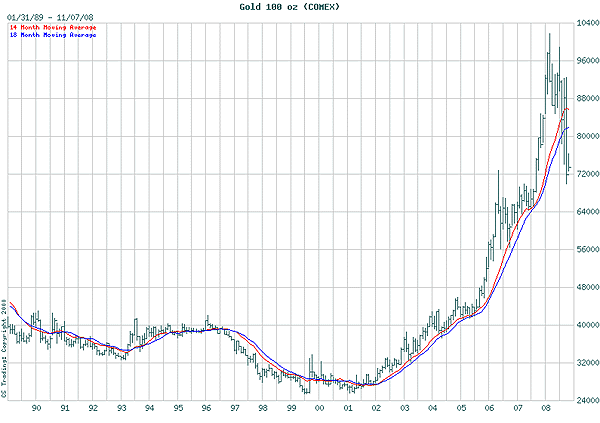
Until March of this year, the ride had been relatively smooth as we rallied from the 2001 low of US $252.50 to the March 2008 high of US $1,033.90. You can see the move up in gold's historical chart posted above. The biggest correction was a measly 25% and that made investors greedy and complacent, a deadly combination when placing money in any market. In March the markets took it upon itself to humble investors and remind them just who was boss.

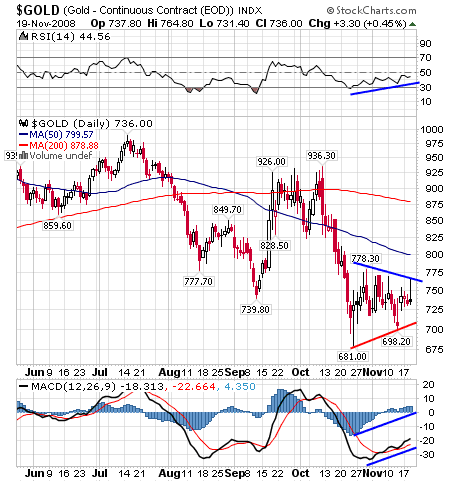
Then comes the inevitable correction. Gold fell from the 1,033.90 high, all the way down to the 681.00 low posted just last month, and that is a 45% retracement of the entire bull market. A significant correction to say the least! Immediately after the 681.00 bottom was posted the gold price moved back up over 700.00 and began to build a base, most of which has occurred close to the 38.1% retracement level at 735.80. As you can see below in the daily chart, a range has been established that reaches from the 720.20 support on up to the 760.60 resistance.


You can also see that price is being compressed into a tighter and tighter trading range and in a bull market the odds favor an upside breakout.

Currently the December gold futures contract is moving toward the top of the range trading up 13.70 at 749.70. It is rallying in spite of a good rally in the dollar and bond market, and in spite of the fact that almost all other commodities are down in negative territory. I am looking for a move and a close above the important 772.70 level.


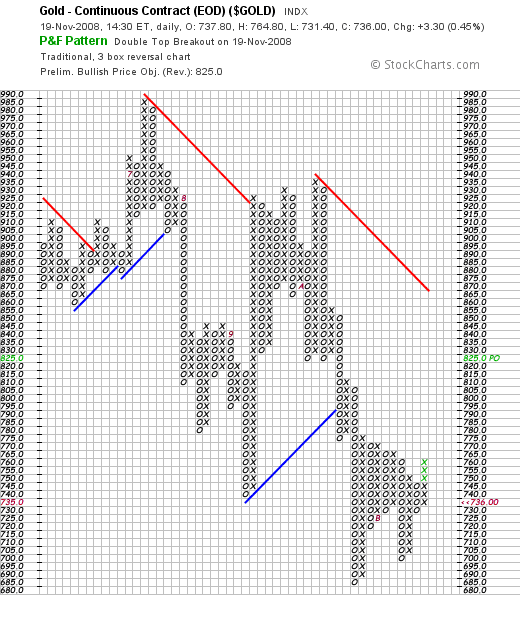
Once that happens then I think gold will move back up to tackle the old all-time high at 850.00 yet again. For the first time in a long time the P & F chart for gold has a bullish price target of 825 and although it may not seem like much, it is a step in the right direction.

In conclusion,

we are suffering from significant deflationary pressures where everything loses value. When that happens, folks tend to search out a real store of value and that would be gold. The yellow metal is the world's oldest store of value. Other countries have a long history of this and Americans will follow suit. I have no doubt that the US government will try to outlaw gold at some point in time, just like they did back in 1932. They will also implement other measures in an effort to pacify Americans, but sooner or later they'll catch on and that is when the real trouble begins. Social unrest and civil disobedience will come to the surface as people look for their rights, they so carelessly gave up. A struggle for power will ensue."


Labels: , ,

Oct 5, 2008

Eric Sprott: The Financial System Is A Farce

Excerpt from the latest Sprott Asset Management's "Markets at a Glance" installment:

"Clearly, derivatives failed to avoid the monumental crisis in the financial system today – quite the contrary. They’ve increased the likelihood that if one financial institution goes down, they all go down, just like the house of cards it was all built on. As we wrote last year: “We believe if banks were allowed to go bankrupt, and their assets liquidated, then the true extent of the ruse would be revealed.”
Indeed, as predicted, there came a day when the ruse was revealed. This has resulted in an unprecedented intervention on the part of the Treasury and the Federal Reserve, taking the role of buyers of last resort for just about any and all paper assets in an effort to ‘save’ the financial system. Lest market-based adjustments prove too onerous for the economy to endure, government is now taking over the functioning of the free markets to a disturbingly great extent.
Unfortunately, this only exposes the other half of the ruse; namely, the erroneous belief that central banks can ‘solve’ financial crises with the same ‘solution’ that caused the crisis in the first place: throwing money at the problem. Alas, contrary to what Wall Street would have us believe, the road to riches does not lie through central bank actions of this sort."

Please click HERE for the whole three page analysis document in Adobe Acrobat .pdf

Labels: , , ,

Sep 29, 2008

Bailout: here's the deal

US politicians have announced a $700bn deal to rescue America's financial system and end the credit crunch.

The move, backed by both Republican and Democratic leaders, allows the Treasury to spend up to $700bn (£380bn) buying bad debts from ailing banks in the US.

President George W Bush urged lawmakers to support the bill, which needs approval by both houses of Congress.

Some Republicans have voiced objections to massive state intervention in the financial sector.

The deal was announced after days of high-level wrangling between Republicans and Democrats in Congress over the content of the bill.

Both parties had vigorous objections to a proposal submitted last week by Treasury Secretary Henry Paulson that would have given him sweeping powers over how the money was spent.

To read the entire Emergency Economic Stabilisation Act draft, please click HERE

Labels: , ,

Sep 18, 2008

Ambrose Evans-Pritchard: Market votes no confidence in Fed

Global Credit System Suffers Cardiac Arrest on U.S. Crash


By Ambrose Evans-Pritchard
The Telegraph, London
Thursday, September 18, 2008


The global credit system came close to total seizure yesterday. Key parts of the derivatives market shut down and a panic flight to safety depressed the yield on three-month US Treasury bills to almost zero for the first since the Great Depression in 1934.

The closely-watched TED-spread measuring stress in the interbanking lending market rocketed to 238 as the share prices of Morgan Stanley, Goldman Sachs, Citigroup, Wachovia, and Bank of America all went into a tailspin yesterday.

The collapse in investor confidence is a harsh verdict on the judgment of the US Federal Reserve, which chose to ignore market pleas for a rate cut to halt what amounts to a modern-era run on the banking system. Almost none of the current Fed governors have market experience. Most are academic theorists.

The Fed had hoped that a targeted $85 billion (L47 billion) bailout for insurance giant AIG -- on onerous terms -- would be enough to stabilize the banks after the weekend failure of Lehman Brothers. Instead it set off a cardiac arrest at the heart of the credit system.

Bernard Connolly, global strategist at Banque AIG, said the Fed and the Treasury were doing too little, too late, to stave off disaster. Interest rates need to be cut immediately and dramatically, while Washington must prepare for a wholesale takeover of large parts of the lending system along the lines of the Scandinavian bank rescues in the early 1990s.

"Unless there is a very rapid change of mind, depression -- with all its horrors and consequences -- will be inevitable. The judgment that letting Lehman's go would not create systemic risk depended, if it was ever going to be anything other than ludicrous, on very rapid action to shore up the financial system. Instead, Hank Paulson seems to be adding to the risk in the system," he said.

"We fear that a virtual nationalisation of the financial system will now be necessary," he said.

America's Reserve Primary Fund suspended withdrawals after shareholders pulled out almost $40 billion in two days on news of its heavy exposure to Lehman's debt. The move came as the fallout from Lehman's collapse spread worldwide. Japan's Nikkei wire said Japanese banks would suffer almost $2 billion of losses on Lehman's bond defaults.

Russia suspended trading the Moscow bourse after the Micex index crashed 24 percent in two days. Officials promised $44 billion to support the banking system.

As Washington bails out one financial institution after another, investors have begun to doubt the long-term credit-worthiness of the US itself.

The cost of insuring against default on 10-year US Treasuries jumped to an all-time high of 30 basis points yesterday, as measured by the credit default swaps (CDS) on the derivatives markets. Germany is at 13, and France is 20.

"This is historically significant because we have never seen anything like it before," Daniel Pfaender, sovereign credit strategist at Dresdner Kleinwort.

"What we don't know yet is whether this a liquidity issue or whether it reflects the credibility of the US financial system."

The Treasury's rescue of the mortgage giants Fannie Mae and Freddie Mac has added $5.3 trillion in liabilities to the US government. It almost doubles the national debt (under IMF definitions), at least on paper.

The Fed has now added a further $85 billion in debt for AIG. While the sums are manageable so far, what worries investors is the likely avalanche of insolvencies yet to come.

The Federal Deposit Insurance Corporation has already exhausted half its capital cleaning up after the collapse of IndyMac. It may need half a trillion dollars of fresh money to cope with the 120-odd lenders on its sick list. Professor Nouriel Roubini from New York University warns that several hundred banks will go under before this hurricane has exhausted its fury.

John Chambers, head of sovereign ratings at Standard & Poor's, said America's AAA grade is safe for now. The Fannie/Freddie bailout is not comparable to ordinary state debt. It is backed by housing collateral, mostly based on prime mortgages.

"In the worst-case scenario, the losses from Fannie and Freddie will be 2.5 percent of GDP. This is not to belittle the unprecedented actions of the last two weeks.

"For the US to lose its AAA we would have to see the sort of financial distress that occurred in the Nordic countries. It could get that bad. There's no God-given gift of a AAA rating. The US has to earn it like everyone else," he said.

Charles Dumas from Lombard Street Research said America's dependence on foreign money would carry a high price. "The ultimate test will be whether this seriously jeopardizes the reserve currency role of the US dollar. China finances the US government. So as long as the Chinese are willing to accept an annual loss of 15 percent on their holdings of US bonds in real yuan terms, this can go on, but the decision lies in Beijing. What is clear is that it will take the US decades to pay this off," he said.

Hans Redeker, currency chief at BNP Paribas, says the US debt scare is vastly overblown. America's total government debt is 48 percent of GDP on IMF measures, compared to 57 percent for Germany, 94 percent for Japan, and 108 percent for Italy.

"The debt levels are nothing compared to Europe, even after Fannie and Freddie. America still has great leeway," he said.

"We think the next phase of this crisis is going to be a repatriation story as American investors bring their money back from frontier markets. The US broker dealers were 60 times leveraged and now they need to take assets back onto dollar balance sheets."

Albert Edwards, global strategist at Societe Generale, said Washington's serial bailouts are the inevitable result of the credit bubble of preceding years. "This was all baked in the cake long ago. What we have seen so far is just a dress rehearsal for the deep recession that is coming. America is going to be losing 500,000 jobs a month. That is when we will see interest rates go to zero. The deficit will be covered with printed money as it was in Japan. The endgame will be helicopters full of cash dropped by Ben Bernanke," he said.

* *

Labels: , ,

Aug 22, 2008

Richard J. Greene: Amateur hour in the precious metals markets

Richard J. Greene of Thunder Capital Management strikes some brutal but well-deserved blows against all the bad guys in his new essay, "Amateur Hour in the Precious Metals Markets". Greene writes:

"You do not get a $200 move down in gold and $7 move down in silver in a month, because they were supposedly in a bubble, and then after everyone and his mother is selling you find it almost impossible to find any actual gold or silver to buy at major dealers across the country. Hundred-ounce bars on eBay are changing hands at $17 per ounce, more than $4 above the spot price. That is a heck of a lot closer to the market price than $12.68 spot, which is what the screen says right now but where you can not buy a single ounce of physical silver. After this display anyone who uses the paper markets to invest in gold and silver is just a dummy and deserves what he will eventually get -- nothing. How speculators can continually line up leveraged positions against bullion banks with unlimited cash backing which in turn repeatedly smack down the markets is a mystery."

You can find Greene's essay at GoldSeek HERE

Labels: , ,

Aug 21, 2008

Monty Guild: Fortune Favours the Brave

Below is the recent market commentary by Monty Guild and Tony Danaher of Guild Investment Management Inc.

Posted On: Wednesday, August 20, 2008
Author: Monty Guild & Tony Danaher


“FORTUNE FAVORS THE BRAVE”

FERTILIZERS, GRAINS AND PRECIOUS METALS


As you know, we are fundamental analysts, not technicians. We take an investment view on stocks and commodities, not a trading view. That being said, we believe that much of the panic and the savage price decline in food related investments and in precious metals is behind us. We are adding to our positions in these two areas.

We do not know if the correction caused by technical momentum traders is over. What we do know is that the emerging world is very strong economically, and these countries are large and growing consumers of high protein foods. Thus, a recession in Europe, Japan and the U.S. will not deter them from upgrading their diets. This will require the production of more grains and an increase in demand for fertilizers and other food production inputs. We own fertilizer stocks and we have recently been adding to our positions.

The world banking system is broken and badly needs to be re capitalized. How will they get new capital from investors? We doubt that the banks will be able to get many investors to buy into their optimism and buy their stock. In our opinion, the only long term solution is that governments print more money to re-capitalize and re-liquefy the banking system. The season for increased gold demand is upon us as India starts to buy more for the wedding season. Gold coins are in short supply at many coin dealers in the U.S. Stagflation, inflation, and deflation threaten the world in different parts of the globe. All of these events are bullish for gold and we are adding to our gold positions.

As we said earlier we are not technicians, or momentum players (the two groups that seem to have had control of commodity prices during the last few weeks). We are fundamentalists, and the fundamentals argue that food and precious metals are getting into attractive buy areas.

We do not know if this is the ultimate bottom in precious metals. We do know that we want to own gold during periods when the world banking system is flirting with collapse and the only solution is governmental takeovers and subsequent large money printing exercises, by governments in Europe, Japan and the U.S.

There has been no fundamental decrease in the value of gold as a hedge against both inflation and strong deflation. Clearly, many commentators believe that one or the other may be the long-term outcome. We believe it is still too early to call…but that inflation has the upper hand at this time. Historically, gold has fared well in both inflationary and strong deflationary periods. We will write more on this later.

Thanks for listening.

Labels: , ,

Aug 4, 2008

From RBC Capital Markets' report and outlook on gold

"The numbers in the markets indicate that gold exchange traded funds (ETFs), along with gold royalty companies such as Franco-Nevada, have outperformed practically all listed gold - and other resources - stocks over the past two months, a time when global resources stocks have been mercilessly hammered. Gold ETFs, representing a proxy investment in gold bullion itself, have been outperformed over the period by silver ETFs, which traditionally display a higher "beta" than gold bullion prices during times of crisis or stress, currently seen in global investment markets.

Specialist analysts at RBC Capital Markets have sought to look forward, and in a report out to clients this week, recommend that it's time to buy listed gold stocks, not least on seasonal factors. RBCCM analysts argue that the macro outlook remains constructive, on a combination of a US dollar "that shows no clear leadership as a global reserve currency", and, second, that "central banks continuing to aggressively reflate the economy will likely maintain pressure on currencies relative to gold and other hard assets. This backdrop is complemented by emerging market countries that are facing energy and agriculture inflation which is expected to be positive for gold". RBCCM's analysts see a positive outlook for the back half of 2008: "the seasonal slowdown for physical gold demand is nearly behind us, and we expect increased demand looking ahead to August, September, and October. With the US Federal Reserve rate cycle on hold for the time being, the US dollar drifting and inflation pressures growing around the world, particularly in the emerging market economies, we believe the timing is right for investors to be buying gold and gold equities".

As observed over the past 12 months, the RBCCM analysts anticipate that larger capitalisation listed gold stocks "with established production bases and higher share liquidity" will continue to outperform smaller capitalisation names. From a fundamental perspective, the analysts continue to favour gold companies with improving production and cost profiles, gold reserve upside, active exploration programs and strong management teams.

RBCCM analysts identify several positive factors for gold bullion prices:

  • Non-European Central Bank announcements regarding gold purchases (Russia, UAE, Qatar)
  • Chinese foreign exchange reserves topping $1.4 trillion, dominated by holdings of US treasury securities. The Chinese central bank continues to comment on the need to diversify foreign exchange reserves
  • Firm demand for gold ETFs, near an all-time high of 29.8m ounces
  • Gold equities pricing in gold bullion at $850-$875/oz long-term
  • Expectations of a US Federal Reserve rate pause, and no rate hike expected, and
  • Mine supply flat in 2008, with a decline expected in 2010.
  • Potentially negative factors affecting gold bullion prices are identified as:
  • Jewellery demand showing strong elasticity in India and the Far East
  • Switzerland deciding to sell 200 tonnes over two years, replacing Germany in the ECB gold sales agreement, and
  • The potential for IMF gold sales as part of the ECB gold sales agreement.

RBCCM analysts point also to the ratio of the spot dollar gold price to the Philadelphia Gold & Silver Index (XAU), given that the analysts believe that the ratio is an important indicator for identifying periods when gold stocks are relatively cheap or expensive, compared to gold bullion. The current ratio is around 5.4 times, and has averaged five times over the past few months. According to the RBCCM analysts, when the ratio is above five times, the average one-year holding period return for the XAU has historically been 40%; when the ratio is between 4.5 and 4.75 times, the average return has been 27%.

The RBCCM analysts also note that the net speculative long gold futures position on COMEX has coincided with the run in the price of gold. On 19 February 2008, the net long position in futures reached an all-time high of 25.3m ounces; with the recent selloff in gold, the RBCCM analysts expect a further decline from the 25 July level of 23.7m ounces. The analysts look for the "positive correlation between gold and the speculative futures position to continue, and look for the long position to remain strong as gold consolidates and makes another run at $1,000 an ounce in September-October 2008".

The RBCCM analysts also argue that seasonality provides a compelling argument for investment: "Over the past 28 years, gold has typically outperformed on a monthly basis in the months of April and May. This is usually followed by a seasonal slowdown in the [Northern Hemisphere] summer months, and an upsurge in the early fall. With this in mind, investors may be able to exploit near-term weakness in gold and gold equities before a positive run in the late summer, early fall period".

Finally, the analysts note that over the past couple of years, ETF gold products "have emerged as a meaningful component of gold demand, accounting for 7% of total demand in 2007. Following a slowdown in mid-2007, the five primary ETFs have added almost nine million ounces, coincident with the gold price rally". During the recent rally in the gold price from its low of around $850 an ounce in early May to around the $970 an ounce level in early July, ETF ounces under management bounced back from 25.9m to a record 29.8m ounces (and are currently 28.8m as of July 25). This overhauls the previous all time high set in March when gold bullion hit its record of $1,033 an ounce. "We believe", conclude the analyst, "that investors continue to use this product not only for short-term trading opportunities but also for long-term or strategic investment purposes".

Labels: , ,

Jul 14, 2008

Peter Brimelow: What if gold gave a party and everyone came?

By Peter Brimelow
MarketWatch.com
Monday, July 14, 2008


NEW YORK -- Gold surges, but sentiment is soggy. The goldbugs smell a breakout, and this time they may have generalist backers.

Gold's performance last week was remarkable. Losing $10.30 on Comex in the first two days, it then turned round to add $27 on the week and $46 from Tuesday's intraday low, closing at $960.60 an ounce. Volume was extremely heavy. SPDR Gold Trust (GLD) added 45.99 metric tons of gold to its holdings on Friday, possibly its biggest daily increase, taking it to a record level.

Sentiment started the week low and apprehensive. LeMetropole Cafe's Bill Murphy remarked early on Friday: "It is remarkable to me how the Cafe Sentiment Indicator, a barometer of interest in gold and silver by the general public, continues to be a predictor of upwards precious metals price action. Tuesday, Wednesday, and Thursday of this week were collectively the worst three days in the last 10 years for that indicator. ... How typical, with that sort of terrible bullish sentiment, that this morning we are walking in to the most buoyant Comex pre-market upward gold price action that I can recall."

Murphy's Cafe Sentiment Indicator is proprietary, but it is believed to be heavily weighted to how many sign-ups this subscription site gets.

Despite the strong week, sentiment did not much improve. MarketVane's Bullish Consensus for gold rose only 4 points, to 82%. (In February-March it spent 19 business days in the 90s, peaking at 95%.)

And neither the Philadelphia Gold and Silver Index (XAU)nor Amex Gold Bugs Index (HUI) recovered to the level they were at on July 1, when Comex gold closed at $944.50.

Nevertheless, the more sophisticated gold bugs are excited. Dan Norcini, the respected technical commentator who posts on gold daily on Jim Sinclair's MineSet Website, pointed on Friday to "the importance of today's technical breakout. ... This is occurring against a backdrop of normal seasonal weakness which makes the move all the more impressive. ... Most noteworthy today was the action of the bond market ... with bonds tanking alongside equities as safe haven flows made their way into gold."

Australia's The Privateer noticed the same thing: "Normally, in times of fear of incipient financial meltdown, U.S. investors stampede into Treasuries as a 'safe haven.' That didn't happen on Friday, July 11. In fact, the opposite took place. ... The 10-year paper, for example, saw its yield increase by 17 basis points -- the biggest one-day jump since March 24."

The Privateer's paramount $US 5x3 point and figure chart looks extremely handsome. As its proprietor says, "We now have a 'breakaway gap' on this chart":

http://www.the-privateer.com/chart/gold-pf.html

As one of Le Metropole's contributors wrote, "Gold's friends are spoiled for choice, with excellent geopolitical, financial structure, and monetary arguments for a strong metal price."

Unfortunately for me, I remember the 1970s. Not just the late '70s, but the 1973-4 equity bear market, in real terms as bad as the 1929-1933 crash.

In late 1974, gold shares had a huge run -- in fact, by some measures the biggest ever proportionately. The standard explanation was that shares were being bid up ahead of the legalization of American ownership of gold, banned since the 1930s, which became effective Jan. 1, 1975.

But perhaps as important was the desperation of generalist managers to find something on the long side that worked. Something similar applied in 1979, although the market precursor then was stagnation rather than decline.

What happens if profit-starved generalists and momentum players wake up and take notice?

* * *

Labels: , ,

Jul 5, 2008

Gold: the precious laggard that will hit $2,000

Gold: the precious laggard that will hit $2,000

By Ian Williams, Charteris Treasury Portfolio Managers
Last Updated: 4:25pm BST 04/07/2008


In 1999 when oil was $10 a barrel, I suggested that the price would ride fivefold to $50 a barrel in real terms over the next few years. This forecast was dismissed with incredulity at the time. Almost 10 years later with the price over $130 a barrel, my original forecast turned out to be rather timid - with mainstream commentators now forecasting $200 a barrel.

My forecast was based on an analysis of long term future supply-demand trends, combined with a study of ultra-long term commodity cycles.

What is striking about ultra-long term commodity cycles is how seemingly unrelated commodities appear to rise and fall together.

Price data shows that around 1999-2000, virtually every single commodity hit a significant low before turning up sharply. Nickel hit a low before proceeding to rise ten-fold in the period up to April 2007. Similarly copper also bottomed around this time before an eight-fold rise up to May 2006. Copper is once again challenging its all-time high and looks set to move into new high ground.

The reasons for this stellar performance are now well-trodden - the emergence of China, India and Russia - as major consumers of scarce and in some cases increasingly finite resources.

This commodity super-cycle phenomenon shows no signs of abating. But to profit from it, investors need an understanding of the leads and lags within the commodity family to avoid being caught buying a particular commodity at a short-term peak in its price. I would be very wary about buying oil assets at present - simply because the price of oil in relationship to other raw materials is becoming very stretched....CLICK FOR MORE

Labels: , ,

Jun 3, 2008

Junior Mining summer shopping spree?

According to Financial Journalist Peter J. Cooper writing from Dubai, this coming summer may be just hot enough to ignite an aquisitions rush for promising and undervalued junior miners.
You can read P.J. Cooper's post called "Stalking the best gold and silver juniors a profitable summer sport" at his blog HERE

Labels: , , ,

Apr 5, 2008

Prices of Gold and Silver Set to Rise!

Prices of Gold and Silver Set to Rise!
by Julian D. W. Phillips

The focus in the gold market has always been on the $ price of gold and yet we have ample evidence of why we should not price gold in the US$, just as the oil price should not be priced in the US$. The fall of the $ has clouded the state of the global economy, its monetary system, as well as most of its markets. The gold and silver price has moved fairly closely with the € in the opposite direction to the $. But should it be attached so faithfully to the €?
Please click HERE to read the article

Labels: ,

Mar 28, 2008

John Embry: Don't let gold's volatility bother you

In new commentary for Investor's Digest of Canada, Sprott Asset Management's chief investment strategist, John Embry, takes note of GATA's full-page advertisement in The Wall Street Journal and urges precious metals investors to ride out the market's short-term hairpin reversals. Embry's commentary is headlined "Sit Tight -- Don't Let Gold's Volatility Bother You" and you can find it at the Sprott site HERE

Labels: , ,

Mar 3, 2008

Gold probing towards the $1000 mark

Peter Brimelow from MarketWatch.com sniffs the precious metals air and finds it charged with anticipation from gold bugs everywhere....

"NEW YORK -- Gold finishes a fabulous February, and the gold bugs' attention is turning to gold shares, and silver.

When I last wrote about gold, with the pleasingly prescient headline "Gold's path to $1,000 now clear?," bullion had just staged a three day-bounce back after a terrible beating received on Feb 1st.

Since then, as Australia's The Privateer put it recently: "The last two weeks have been absolutely stellar for gold, as it has moved three-quarters of the way between $U.S. 900 and the big $U.S. 1,000 over that period."

The Privateer's $U.S. 5x3 point-and-figure gold chart is designed to respond glacially to gold price changes. Now it has been struck with scalding global warming: It has changed 18 times in February and now looks spectacular:

http://www.the-privateer.com/chart/gold-pf.html

The questions now interesting the gold bug investment letters are:

-- Can gold go much further, percentage-wise?

-- What does this mean for silver?

-- Why aren't the wretched gold shares moving?

Silver leaped a stunning 9.7% in the past week, with Comex May silver closing up $1.767 at $19.915. The Privateer was a little dismissive: "For many of those who are dipping their toes into the precious metals markets, gold is simply seen as being too expensive. That is why silver ('the poor man's gold') has outperformed gold so far this year."

But other observers were more excited. At Le Metropole Cafe, Bill Murphy, who has followed gold closely for years, was motivated to put out a special Sunday alert: "To say that silver has been trading differently the past couple of months is an understatement. ... As a veteran commodities trader, I could see, on a daily basis, somebody quietly accumulating silver on price dips ... never pushing the envelope, but buying silver at times when it normally would get trashed."

At Jim Sinclair's MineSet, Dan Norcini plunged into the technical entrails of silver futures trading -- the "commitments of traders" supplied by the Commodity Futures Trading Commission -- and pulled out an unusual augury: "The funds have not been reducing their net long position. ... The funds continue to buy. Guess who is doing the selling -- the small specs! Apparently, some of the public is trying to pick a top in the silver market. They have built up the largest outright short position in two years. Talk about a bullish signal. The most undercapitalized traders on the planet are adding new silver shorts as the market breaks into a 28-year high."

Norcini adds: "Remember, it is a new calendar month on Monday and that often means new allocations of fund money to the markets. If that occurs, the silver shorts are in serious, serious trouble as the longs will show them not one ounce of mercy. Blood in the water draws sharks and the silver shorts are not only bleeding, they are hemorrhaging massively."

But gold shares, of course, continue to break their owners' hearts. GoldMoney's James Turk, in this weekend's FreeMarket Gold & Money Report, shows with a 20-year chart that the ratio of gold to the Philadelphia Gold and Silver Index has only been meaningfully lower briefly once -- right before the gold upswing began in 2001.

Perhaps the answer to the question if the shares will notice $975 gold is the same as that provided by The Privateer, discussing the general lack of attention paid by the public to the gold surge: In "the early 1980s, when the Dow Jones Industrial Average was challenging the all-time highs it had set in 1969 and slightly exceeded in 1972-73. ... It took quite a while, until mid-late 1985, in fact, for the majority of people to finally be satisfied that the Dow wasn't going to fail at the 1,000-1,100 level as it had done for the previous 15 years. Once that happened, the markets took off. ..."

Privateer's prediction: "That is what is in store for gold, as and when it exceeds $1,000 for the first time."

* * *

Labels: , , ,

Dec 30, 2007

Louis James: Why the Big Gold and Silver Spike Will Be Even Bigger This Time

This interview from Seeking Alpha
Part I of a two-part interview with Louis James, Senior Editor with Casey Research. James talks about the gold and silver markets, and shares his views on several interesting companies. In Part II, to be published next week, Louis discusses five more gold and silver companies he likes and why.


TGR: Where do you think gold is headed over the next 12 months?

JAMES: There are two different ways of looking at the gold market. One has to do with the fundamentals of supply and demand. The other has to do with the speculative value of gold. Regarding the first view, the supply side is easier to grasp. And right now, there are very clear signs of difficulties ahead on the supply side. Newmont Mining Corp. (NYSE: NEM) has already announced that production is going to decline by many millions of ounces. Demand is a little trickier to forecast. Silver and the base metals have industrial uses, so industry drives demand. However, the value of gold is based largely on perception — what people feel and what they fear, as opposed to what manufacturers need.

The turmoil of the last year has made it very clear that there are good reasons to hold onto gold because it has a long and established history of solid value. While weak supply and recent market turmoil may not justify the current price of gold, they certainly explain it. And those factors were not assuaged by the Fed's little rate tweak last week. I have to believe that despite some short-term fluctuations, the fundamentals of supply and demand — such as they are — are very bullish for gold, at least over the next year or two.

So that’s one side of the story. The other side has to do with the speculative value of gold. What happens when people start fearing for the value of their paper assets and their fiat currencies? It’s a totally different question than which way is gold heading, and what happens if this project or that project is successful. At Casey Research, we think that the conditions are almost, but not quite, approaching those of the late 1970’s. We think the government vastly understates inflation, and we see the kind of economic forces that drove gold prices to record highs in the 1980s converging again. They’re not obvious yet — average people on the street are not worrying too much about the value of the dollar yet, but we think it won’t be long before they start.

The average man in the street is not yet worrying about the US dollar and the economy as much as he perhaps should be. But when that happens, as it did in the late '70s, when everybody and their cousin was worried about hyperinflation, when your bartender was telling you about the gold coins he just bought, and so on—when the average person was getting into the picture— that’s when we had the real mania stage. That’s when you have a spike in gold. So far, we haven’t seen anything like this. It’s just the basics of supply and demand for gold in the current context. But the second part of the story is that we believe that big spike is still ahead, and it will be even bigger than the last time because the stakes are even higher now.

TGR: Do you want to venture a guess what that spike will be? I understand $850 price spike in 1980, adjusted for inflation, would be about $2,200 now.

JAMES: That’s about right.

TGR: Do we see a spike going beyond that?

JAMES: Actually, I am not sure we will see quite the spike we saw in 1980. It’s interesting that back then gold held over $800 for only four days, and two of those days were weekend days. I don’t actually see a spike quite like that. Things will fall apart more gradually this time. I think this time we will see more of a gathering surge that will take the price quite high. There will be a spike somewhere—who knows where? But that spike won’t be as important as the tidal surge that will easily take gold over $2,000. And if you use the shadow government’s inflation figures for what that $850 would be worth in 2007 dollars, it’s over $4,000 to even match that 1980 spike.

When will that happen? I think it’s a fool’s errand to try to call that exactly. I’m confident enough that it will be within a year or two, max three, that it makes sense to me to buy gold now. I am not at all worried about gold being close to record highs now. Not just because in inflation terms, it’s cheap, but because of where I think that surge will take the gold price. I think gold is still cheap, even in the $800 range.

TGR: Let’s talk about some companies, starting with Bravo Venture Group Inc. [TSX.V: BVG].

JAMES: One of the things to remember about Bravo it that has a management team that has done it all before. From the boardroom to the people in the field, the people are experienced. And Bravo has multiple kicks in the can. The company generated a lot of excitement over a project in Nevada that ultimately didn’t work out, which sometimes happens. Exploration is never a sure thing. But the company is pursuing the generative model very well. It has projects in different jurisdictions, different metals even, but it’s mostly focused on gold.

TGR: What do you mean by a generative model?

JAMES: It means the company generates projects that it either advances or sells. Bravo identifies a project in its early stages, then maybe polishes it up, or develops it a little before handing it off to another mining company. And the classic structure for this model is the joint venture [JV] —using other people’s money to take on the high-risk, exploration stage, which makes a lot of sense to us.

If you look at the simple odds of finding an economic gold deposit out of a prospect— I believe these are on the order of 1 in 300— it just makes sense to shift that risk onto someone else. When it comes to the big finds, I can’t think of many instances where the first company that stumbled on the scene hit it big. Most of the big projects have been owned by several companies before the big discovery was made. Even the current darling of the market, Aurelian Resources Inc. [TSX: ARU], with its big find at Fruta del Norte, didn’t know what it was looking for. That was a blind find that occurred while the company was exploring off the edges of another deposit.

Frankly, for a small company, even if the interest in the project were diluted down to 30 percent, or a major took the project all the way into production, leaving the smaller company with only 10 or 20 percent— that 10 or 20 percent of a project that is big enough to interest a major is a lot of value for a junior. The cash flow generated by that project will pay for the junior to produce all sorts of shareholder value in the future.

TGR: Does Bravo have any interesting projects right now?

JAMES: I really like the company’s Homestake Ridge project in British Columbia. It’s a very interesting project with high-grade results—the better part of a million ounces now. We also like the Woewodski Island project in Alaska, which involves a lot of very high-grade surface work. There’s no tonnage yet; there’s no ore deposit until you actually have drill holes outlining volume of rock, and that’s what’s happening now. Sure, it's speculation but it’s in a company that already has some successful projects and plenty of blue sky in other areas.

TGR: What about Eaglecrest Explorations Ltd. [EEL-TSX Venture]?

JAMES: We are not formally recommending Eaglecrest; however, I’m comfortable talking about it. I’ve visited the site, I know the people and I have gone over the technical details with them. The main concern with Eaglecrest is, of course, the politics in Bolivia. The government just formally passed, and the judiciary just put the kiss of approval upon, a new tax measure. On the one hand, it’s positive because it puts an end to all of the questions about whether Bolivia is going to be anti-mining or not. The fact that they’re putting in this tax regime shows that they do want the mining revenue. On the other hand, it's a tax increase. Although the government gives tax credits on royalties, the net result is that mining is now more expensive in Bolivia. If I were a mining company or an exploration company looking for more minerals right now, I would probably not choose Bolivia. That’s why I’m hesitant to recommend Eaglecrest right now.

That said, Eaglecrest has title to a very interesting prospect. . .I also like Eaglecrest's technical people. And that’s paramount to me. The rocks don’t excite me if I don’t think good people are working on them. Eaglecrest’s new team has persuaded me that their interpretation of the geology of this project is perhaps better than the previous interpretation. And that lends new life to the deposit.

TGR: What about the recent no-confidence vote in Venezuela?

JAMES: I like Venezuela, which like Bolivia, is very interesting geologically. But Chavez is still president and he can still rock the boat. Just look at the deal he did with the petroleum companies—50 percent, take it or leave it. And of course, the oil companies have all that infrastructure in place. If they have a choice between 50 percent and zero, they’ll take the 50 percent naturally. But a guy who can do that is not really a guy who inspires a lot of confidence. So, we’re still leery of Venezuela, but, boy, there’s a lot of geologically interesting terrain there. And it sure would be nice to see that open up more.

TGR: In some ways, Venezuela under Chavez and Bolivia under Morales are alike, aren’t they?

JAMES: That’s true. When we were in Bolivia, we spoke with people in the opposition, which controls the Senate. We spoke with people from industrial concerns, and they control the four major provinces that produce most of the revenue in the country. And, of course, Morales ticked off the judiciary, too. So, there is significant opposition; it is quite possible that the guy could be out soon. If you just look at the history of Bolivia, the average term of a president lasts only a year or two. So odds are that Morales will be out soon. But as an investor, a speculator, I am not looking for change. I’m not looking for turmoil; I’m looking for stability. I want to know there’s a working mining environment and that it’s going to stay that way. The fact that there may be a change for the better is potentially good, but it tells me I don’t want to invest now. I want to wait and see if the change is good, and then see if it’s stable, and then maybe that’s the time to start taking a financial risk.

TGR: Any thoughts on Exeter Resource Corp.(AMEX:XRA)?

JAMES: I like Exeter a lot. We’ve had an interesting history with the company. We sold it when their former flagship project, Don Sixto, in Mendoza province, ran into political trouble there. We did it a bit early, when rumors about potential trouble were just starting. The rumors proved true and we were happy to be out. However, ultimately the company did an absolutely remarkable job of recovering and bringing forward its Plan B and Plan C projects, and D, E, and F, actually.

What I really like about Exeter is it has two very highly prospective projects right now. One is the super high grade Cerro Moro project in mine-friendly Santa Cruz province, southern Patagonia. The company was very focused on a small area of that project, but there are a lot more of those high-grade showings in the area. In a recent press release, Exeter announced fresh results from a new target area at Cerro Moro that appears to be just as high grade, just as exciting. So, the hypothesis is that this one area that the company has concentrated on is just the beginning.

Then there’s Caspiche, a project in Chile. In preliminary drilling, Exeter punched a 300-meter hole with 0.9 g/t gold. All of a sudden, there’s more potential. There are a few holes in this area that were all shallow. Several of them hit good bulk tonnage grades, maybe 0.7 g/t gold or so, over a very large width. Pretty good. It isn’t a slam-dunk, but it has the hallmarks. It has the alteration area; it has a few holes; and it has one really good hole that suggests that this could be one of those really big gold targets.

Exeter is not particularly cheap right now, but if either of these two speculations works out, it will be really, really good for the company. Plus, the company has a pipeline full of other projects. And who knows? The company may even get Don Sixto, its former flagship project, back. Mendoza has a new pro-mining governor.

So, I like Exeter a lot, but I have to stress that it is highly speculative; it doesn’t have a 43-101-compliant resource right now. It will have resources soon, but the market has already given the company a lot of credit for that. If either of those two exciting projects disappoints, it would be easy to get hurt on that stock. That said, the upside potential is very good based on outstanding results so far.

TGR: Let’s move on to First Majestic Silver Corp.(FRMSF.PK).

JAMES: I like this company also. I like the people involved — the technical people on the ground in Mexico are very experienced. Keith Neumeyer, the CEO, made his name with First Quantum Minerals (FM.TO), so he has a bit of a pedigree. Of course, he wasn’t the only one behind First Quantum’s huge success. But he was part of the management team, so he’s worth risking a bet on.

First Majestic raised high expectations from the get-go about how quickly it would be able to outline a lot of ounces of silver, and how quickly it would be profitable. The company didn’t deliver as quickly as it had intended to, but it is doing what it promised, and that’s important. It’s taken them longer than we hoped on many fronts, and it hasn’t done a great job of letting the public know when it’s reached milestones. One of those milestones was the addition of a zinc circuit to its flagship mine, La Parrilla. It’s taken a while, but the company is getting the costs down to where they need to be so that hopefully this coming quarter the numbers will be quite a bit improved.

So, that base of value is starting to solidify, and First Majestic Silver does have plenty of exploration potential. The stock got whacked pretty hard a couple of years ago, when one of the company’s major exploration projects delivered some really disappointing drill results. The market gave them a 50 percent haircut.

TGR: Wasn’t that a little severe?

JAMES: Exactly. We started buying the stock with both hands because it was clear that even though this was a serious and material disappointment, it was not worth 50 percent of the company. We issued a strong buy on that low, and within two months our subscribers who followed our advice had a 100 percent return on their investment.

TGR: What about going forward?

JAMES: First Majestic has a solid base of production now that finally seems to be coming into its own. There’s still plenty of blue sky, lots of projects still to explore. I think the company has prospects for reaching its 200 million ounces of silver equivalent potential this coming year.

TGR: In general terms, how would you characterize the silver market in Mexico?

JAMES: I think the whole subsector is ripe for consolidation. And First Majestic is well positioned. It has the resources, the connections in Toronto and elsewhere to raise the funds to be a consolidator. However, if the company gets gobbled up instead, it will be at a premium for existing shareholders. So either way, there’s also an M&A

TGR: What are your thoughts on Goldcorp Inc. (GG:NYSE)?

JAMES: That’s an interesting question. For a while, Goldcorp was regarded as not the best among the majors because it was doing such a good job. It was so profitable that it didn’t have much leverage to the rising gold price. However, with recent changes in costs for major projects and the perception of profitability after the great Galore Creek fiasco (Barrick/NovaGold), a lot of people are thinking that maybe a more profitable company like Goldcorp isn’t such a bad idea after all.

TGR: So you have a favorable opinion on Goldcorp?

JAMES: Absolutely.

Labels: , , ,

Dec 9, 2007

Aden Sisters: Soaring Markets...

"..Normally, for instance, you'll see the so-called smart money go into a developing bull market first. This includes investors who understand the markets and the big picture, some professionals and so on.

As prices rise, more gold bugs will move in, usually followed by some early-bird Wall Street types.

This is basically where we are now, in the second phase. But as New Orleans illustrated, this bull market rise is still lacking investor and Wall Street enthusiasm. That's still to come and we think that'll probably happen once gold hits a new record high above $850.

During the third phase of a bull market, the public jumps in. The public is usually late to the party and in their collective excitement, they'll drive prices up to extreme levels. The most recent example of this happened in the late 1990s when tech stocks were all the rage. Everyone was "into high tech" and these stocks were going to keep rising in the "new era," but of course they didn't.

As for gold, the public is barely aware of gold's ongoing rise and they're not in the market. The reason that's good is because the longer gold goes without attracting much attention, the higher it will ultimately go once the public starts moving in.

This suggests that the gold price could literally skyrocket at some point to levels far higher than most people are expecting. And with world tensions increasing on several fronts, it's providing plenty of fuel for the markets..."

To read the article please click HERE

Labels: , , ,

Nov 28, 2007

Mineweb: Volatile gold tracking backwards through $800

The recent gold price surge has been shortlived again as a dollar rise has led to a fall back to below the $800 level and may move lower. The gold price thus continues to be very volatile moving up and down on dollar strength perceptions.

Author: Lawrence Williams
Posted: Wednesday , 28 Nov 2007
LONDON -

If you want to take a view on gold and where the price is going you have to first take a view on the US dollar. Gold moved sharply upwards on a falling dollar last week, but this week, as some strength has been seen in the US currency, the gold price has rapidly tracked back downwards through the $800 mark - and if the dollar stays where it is, or shows even the smallest sign of strength - however temporary - we could see a return to the mid to high $700s over the next few days.

But, if the dollar starts to move lower again against the major currencies, gold will almost certainly bounce back upwards, and whether it achieves the $850 all time high in the near future will depend almost entirely on the weakness, or perceived weakness in the greenback in the next few months.

If US interest rates move down another quarter point, as many feel likely, then the dollar value against the basket of currencies will probably move down again too and gold will likely move up. If the Fed decides against cutting the rate, then this could be seen as a positive sign for the dollar and gold could slip back as a result to the mid $750s.

The dollar weakness is also being curtailed as non-US economies may also consider cutting their own interest rates to try to ward off any business downturn as a result of a static or contracting US economy, and their own industries becoming less competitive internationally against US output as the dollar declines.

But, gold production worldwide is, at best, flat and probably falling, and with the cancellation of major projects like Galore Creek, coupled with a credit crunch which could see more marginal or risky projects struggle to raise development funding, the decline may be greater over the next few years than analysts have been estimating.

There is also an impression that the rate of Central Bank gold sales may be declining in the face of higher prices and there are indications that some banks may even be buyers in the market to increase the size of their foreign reserves.

The pattern makes for increasing gold price volatility, such as we have been seeing over the past few weeks with recent short term peaks and troughs in the gold price being up and down as much as $70 an ounce - perfect for smart traders to move in and out of the metal and make good profits if they judge the market right - which in turn increases the volatility quotient.

Overall, though, not withstanding worldwide currency manipulation and the impact of various Central Bank policies, the trend in the dollar value remains downwards for the moment, and the gold supply situation is not likely to improve. There is additional offtake from the market through ETFs, although of course this can be divested more easily too. So, gold price fundamentals remain good, dollar fundamentals remain weak and thus the medium term gold price outlook should be very much a positive one.

If there are any serious shocks ahead for the US economy - which is certainly a possibility - and the dollar moves back down again, the gold price will rise and re-test recent peaks. It will be the strength or otherwise of such a dollar decline which will determine whether gold will at last breach the $850 level, but the general consensus of market followers is that this will happen sooner or later, but exactly when few are prepared to define.

Analysts also cite the oil price as being a driver for gold, but it seems more likely that dollar strength or weakness is both the driver of the oil price and the gold price, as both are traded in US dollars. Oil, though, is more open to market manipulation by the producing nations which can increase or reduce supplies at very short notice - an option not really open to gold miners.

Labels: , ,