Jul 15, 2011

The Gold Standard Institute journal

The July edition of the journal of the Gold Standard Institute leads off with an essay by financial writer Louis Boulanger, who argues that while people may ignore reality, they do so at great peril, as there is no guarantee that reality will ignore them. 
Boulanger concludes that the Internet revolution is moving sovereignty away from the state and back toward individuals -- which is, of course, the moral claim for ensuring that the precious metals trade freely as independent currencies. May it come to pass in our time. 
You can find the July edition at the Gold Standard Institute's Internet site HERE

Labels: , ,

May 24, 2011

Gold standard back?


Labels: , ,

Nov 10, 2010

Harry Schultz: 8 of November, a Day to Remember

Yesterday, Nov 8, 2010, was a day I've awaited for 40years, since President Nixon shut down the last vestiges of the gold standard. Yesterday, at last, a respected member of the ruling classes called for a discussion to readopt a modified global gold standard as a lynchpin for the monetary system. Robert Zoellick, World Bank President and a former US Treasury official, says a new system is needed (as called for in HSL for 20 years), using 5 main currencies, with gold as the international reference point for future currency values. He wondrously said "Although textbooks may view gold as the old money, markets are using gold as an alternative monetary asset today." I couldn't have put it better and in fact I have put it in those exact words, as has Jim Sinclair and a number of free market analysts.

RZ said "The development of a monetary system to succeed Bretton Wood II launched in 1971, will take time. But we need to begin." Amen, Mr Z and thank you! Also, thanks to the Financial Times for making this the leading page one headline story, despite their traditional aversion to gold. Ethics won! This story broke in the early AM Nov 8th and halted a correction that began in the gold price, after which gold rose to a new high. The story freaked out ruling politicians around the world who despise gold because it acts as a governor on government spending. After Nixon closed the gold window, government spending and deficits rocketed, as the data charts prove, from that exact moment. Germany, the US Fed, and Trichet of ECB all patted Mr. Z on the head, but said it's not practical.

What would you expect them to say dear reader? They will fight a gold-linked system, but in the end they will give in, because the system is dying, fast, as the gold price reflects. How good a new system will be, whether it will have only a symbolic link or a strong one, can't be guessed today, nor how soon. The gold price will tell us. My prediction on Bloomberg TV in Paris a few years ago was that "Gold will force a system change when gold hits $1,650, but that it might need $2,000 to bring a change." That may still come true, because, as you see in the press today, most political leaders tried to discount Mr Z's brave, but wise recommendation.

I shall frame this FT front page and hang it on a wall. It was a watershed day.

Harry Schultz

Labels: , ,

Oct 30, 2010

Professor Fekete: Is There Life After Sudden Death of the International Banking System?

Is There Life After Sudden Death of the International Banking System?


Dr. Antal Fekete
The debate on the Real Bills Doctrine (RBD) within the sound money movement is important because the international banking system, financing world trade as well as domestic trade, is facing its greatest challenge in all history. Indeed, it may succumb to the sudden death syndrome, and all efforts to resuscitate it may fail. Worse still, banks have by now acquired such a bad name, and they have earned such a universal hatred for their role in the global destruction of capital and of individual savings, that any new financial institution in whose name the word "bank" figures may be rejected out of hand by the people, should anyone try to make a fresh start in the banking business after the collapse.

Banking systems have been wiped out before under both deflationary and hyper-inflationary conditions. But there were always at least some banks that survived the cataclysm, namely, banks of countries that have stayed the course of financial rectitude and did not listen to the siren song of zero interest and perpetual debt. Countries that continued to observe the sanctity of contracts anchored in gold. Today the entire world entrusted its fortunes to the dinghy of global fiat money. If the dinghy is smashed to pieces on the reefs, not a single bank will survive.

Under these circumstances detractors of the RBD will discover that the singing the praise of "100 percent reserve" will bring no comfort. It will not save the skin of their pet banks. They will not be trusted any more than the fractional reserve banks, so called, will. The RBD, nothing less, will have to come to the rescue and make the survival of people possible.

I have never been able to persuade my detractors to debate my theory on the sole reasonable premise that the merits or demerits of the RBD can only be assessed in a context where banks are completely absent. Ludwig von Mises described such a scenario prevailing in Lancashire before the Bank of England opened its branch office in the city of Manchester. The absence of banks did not frustrate the growth and flourishing of the wool trade, the staple industry of the region at the time. Weaver-on-clothier bills, spinner-on-weaver bills, woolman-on-spinner bills circulated as cash in the local economy. The absence of banks could hardly be a handicap in any vibrant community eager to make most of its endowment and potential. It wasn't in Lancashire.

I have lived in Newfoundland for forty years and had the opportunity to study the monetary conditions in the "outports", as the isolated small fishing villages scattered along the rugged coastline are known where boats carrying fresh supplies and buying up the catch call only a couple of times a year. People in the outports had no use for the word "bank": they have never heard of, much less seen one. Pre-confederation Newfoundland was a dominion of Britain (same as Canada) with its gold and silver coinage. Among others, they had the distinctive $2 gold and 5¢ silver piece. There was a perennial shortage of coins. The shortage did not rule out trade. People wanted to eat, get clad, shod, and keep themselves warm in winter. Coin circulation was substituted by real bill circulation. Unlike on the continent, in the outports real bills were of small denomination. They were not called real bills either. They were called "chits" drawn by the fishermen on the local fish processor when they delivered their catch on the wharf. Chits would circulate from hand to hand. You could buy supplies from the local store against payment in chits. You could pay for the repair of your nets, and the lumberman was happy to supply you with firewood if you offered him chits in payment. Maturity date on the chits was dove-tailed with the arrival of the next cargo boat bringing in fresh supplies. The captain of the boat would pay in gold and silver coins for the catch, so the fish processor could meet the demand for coins when redeeming his chits.

My detractors theorize that prices would be lower in the absence of real bills circulation. They conclude that clearing devices are inflationary as they "reduce the demand for gold". This theorizing is just as idle as trying to find out how much carting would cost if the carter shunned the cart and started carrying heavy loads on his own back once more. Guess what: this question could never be answered. No carter would undertake carting on his own back after the wheel has been invented! Likewise, real bills would step into the shoes of money whenever gold coins were in short supply. Like it or hate it: the wheel has been invented.
The debate on the RBD is dismally lowbrow. It uses terms totally inappropriate in the present situation, such as supply of and demand for gold, the equilibrium price of gold, and the like. Participants of the debate are utterly unprepared for the event when all offers to sell gold against irredeemable paper currency are abruptly and simultaneously withdrawn. To deal with the present financial crisis and its aftermath we have to develop the prerequisite linguistic tools. In this effort Carl Menger's work is the only help we have. Menger had no use for the language of equilibrium analysis. According to him what makes gold special among marketable goods is its unsurpassed liquidity. This means that the spread between the asked and bid price of gold increases more slowly than that of any other marketable good, as ever larger quantities are thrown on the market. This is the property that makes gold superbly qualified to play the role of the ultimate extinguisher of debt: the asset into which all credit instruments must mature if the credit system is to last.

In a sense credit can still be said to mature into gold, albeit at a variable price. But if the gold basis goes negative and stays negative, in other words permanent backwardation of gold strikes, it will herald the advent of Armageddon. The overwhelming majority of working economists don't see that gold still plays an indispensable role in the credit system. The U.S. Treasury bond market has a sine qua non adjunct in the gold futures market. Without it bonds would be irredeemable: they would be promises maturing into more promises. But once permanent gold backwardation strikes, the prop of gold futures is removed, and the U.S. Treasury bond market will succumb to the sudden death syndrome. For the time being it is supported by speculative demand, but the demise of the gold futures market will make the bond speculators scurry for cover.

As long as confidence in the monetary system is unimpaired, gold will be widely available and the credit system will work properly. Increasing unavailability of gold indicates the threat of a breakdown of the credit system. Gold is going into hiding. Watch for the day when it will not be for sale at any price. When this happens, the credit system and along with it trade will collapse. It is not a matter of equilibrium or the lack of it. It is a matter of life or sudden death.

Detractors of the RBD do a great disservice to society when they try to force their narrow parochial and cultist viewpoint, the quantity theory of money and the supply/demand equilibrium theory of price, on everybody at a time when the problem is the relentless drying-up of liquidity. What we need is a theory of hoarding to supplement the theory of marketability. The theory of interest describes how gold is exempted in part from serving as a medium for saving. There is a complementary theory: that of discount, describing how gold is exempted in part from serving as a medium of exchange. That economy is best where gold is hoarded least. In such an economy gold is not needed in the cash balances of traders and, for that reason, is widely available to serve as the ultimate extinguisher of debt.

Time has long since passed when bickering about the number of angels that can simultaneously dance on the point of a needle has added anything material to our knowledge. Fractional reserve banking is a red herring. Tinkering at the edges with 100 percent reserve requirements leads nowhere. You will never understand RBD if you try to approach it through abuses of banks. What needs to be explained is why real bills can circulate on their own wings and under their own steam — banks or no banks.
Real bill circulation will start spontaneously after the total prostration of the world's banking system. Yes, there is life after the sudden death of the banking system. People are not going to commit collective suicide at the altar of fiat currencies. People want to live. They will use whatever little gold is available to them to trade by drawing real bills against the production and distribution of goods they want to consume. It will be a repetition of the miracle at the end of the Middle Ages, when the bill of exchange was invented in Italian city-states such as Florence, Venice and Genoa. It will happen again. The world will do very well with real bills and without banks, thank you very much.

When contract law will once again reach the level of highest respect, and promises to pay gold can once again be believed, banks may once again be in vogue. When that day dawns, the best earning assets of the new banks will be real bills drawn on consumer goods in most urgent demand maturing into gold coins. The criterion by which banks are judged is not going to be the prohibition against less than 100 percent gold reserves. It will be the prohibition against borrowing short in order to lend long.

Source: "The Daily Bell"

Labels: , ,

Sep 7, 2010

Egon Von Greyerz: Gold Entering a Virtuous Circle

GOLD ENTERING A VIRTUOUS CIRCLE

By Egon von Greyerz
September 7, 2010

Fundamental and technical factors for gold are now in total harmony and gold is entering a virtuous circle that will drive the price up at its fastest pace since this bull market started in 1999.

  • It is a fact that gold in US dollars (and many other currencies) has gone up 400% in eleven years or 16% per annum annualised.
  • It is a fact that the US dollar has declined 80% in value against gold since 1999.
  • It is a fact that the dollar and most other currencies have gone down 98-99% against gold since 1913 when the Federal Reserve Bank of New York was created.
  • It is also a fact that the Dow Jones (and many world stock markets) has declined over 80% against gold since 1999.
  • It is a fact that gold has made a new all time monthly closing high in dollars in August 2010.

Gold trend

We expect gold to start a substantial rise now which will continue for 5-10 months before any major correction. Gold’s technical picture is extremely strong with a continuous rising pattern of higher highs and higher lows with the steepness of the curve increasing. From much higher levels we are likely to see a correction that could last up to a year before the next rise which will last several years before we see a significant peak. Once gold has topped we do not expect the same kind of decline as after the 1980 peak since gold is likely to become part of a future reserve currency. At that point gold will be a solid but unexciting investment with very little upside potential. But that is likely to be a few years away.
For the full article please click the following link: GoldSwitzerland Market Update

September 2010
Egon von Greyerz

Labels: , , ,

Jul 18, 2010

Darryl Schoon: The End-Game and The Illusory Gold Bubble

The End-Game and The Illusory Gold Bubble

Darryl Robert Schoon
When the end-game began, gold was $35 per ounce. Today, gold is $1200. When the end-game is over, gold will be far higher.
Midway through 2010 we are approaching the end of the end-game, the resolution of the monetary imbalances that began in 1971. For more than 2500 years, gold was money: but, in 1971 that changed. After 1971, money was no longer connected to gold. For the first time in history, money had no intrinsic value.
After the Bretton Woods Agreement in 1945 until 1971, the world’s currencies were anchored to the US dollar which was convertible to gold. Thus, directly or indirectly, all currencies could be exchanged for gold; but on August 15,1971 the US cut the ties between the US dollar and gold; and all currencies became fiat.
It was as if someone removed a pin from the axle of international commerce when the US dollar was no longer convertible to gold. Previously, the US dollar was linked to gold, and other currencies were linked to the dollar. Everything was stable. It is no longer so. Once the pin connecting gold and paper money was removed, everything changed. The axle of international commerce began to vibrate and lately it’s been getting much worse. The fear is that the wheels are now about to come off.
- Page 9, How to Survive the Crisis and Prosper in the Process

THE BEGINNING OF THE END-GAME
The cutting of ties between money and gold set in motion the extreme monetary instability that was to characterize the 1970s. In 1960, the US prime rate was 5 %. At the end of the decade, the rate was 6.75 %. But when money became fiat in 1971, US rates became extremely volatile, vacillating between 4.50 % and 21.50 % during the next ten years.
In my article America at the Crossroads and the War on Gold, I pointed out the role of former Fed chairman Paul Volcker in destabilizing the monetary system. Believed by most to be a “hard-money hero”, Volcker was, in fact, the very opposite.
Volcker, as under-secretary of the Treasury in 1971, played a critical - and largely unknown role - in the removal of gold from the international monetary system and is therefore responsible for much of the monetary chaos which has since ensued:
From 1969 to 1974 Mr. Volcker served as under-secretary of the Treasury for international monetary affairs. He played an important role in the decisions leading to the U.S. suspension of gold convertibility in 1971, which resulted in the collapse of the Bretton Woods system. read here.
Appointed as Chairman of the Federal Reserve by President Carter in 1979, Volcker was at the helm when inflationary forces he had earlier unleashed almost destroyed the US economy in 1979-1981.
Volcker’s draconian raising of interests rates in 1980 was necessary to quell the inflationary fires he had lit in 1971; and although successful, Volcker’s role is not dissimilar from others who put out fires they themselves start.

THE END-GAME ACCELERATES
While it was Paul Volcker who set the end-game in motion, it was Alan Greenspan, his successor at the Fed, who would greatly accelerate the process by putting US financial markets beyond the reach of government regulators.
Volcker was replaced by Greenspan as Fed Chairman because Volcker wouldn’t dismantle existing financial regulations as desired by the Reagan White House and Wall Street investment banks. As Nobel Prize winner Joseph Stiglitz later explained:
Paul Volcker, the previous Fed Chairman known for keeping inflation under control, was fired because the Reagan administration didn't believe he was an adequate de-regulator.
In Alan Greenspan, Wall Street got the Fed chairman they wanted, someone who would provide them with an unending flow of central bank credit and who would turn a blind eye as to what they would do with it. Alan Greenspan was Wall Street’s wet dream come true.
During his 19 year tenure as Fed Chairman, Alan Greenspan ushered in an era of loose credit producing massive profits for Wall Street along with two of the largest bubbles in history, the US dot.com and US real estate bubbles.
Greenspan with consummate political timing resigned as Fed Chairman just before his extraordinary credit bubble collapsed. However, a third, even larger bubble which Greenspan nurtured, still has yet to burst. This is the government bond bubble, by far now the largest bubble in history
The enormous government bond bubble was “Fed” by the excessive issuance of credit made possible by the removal of gold from the monetary system, thereby allowing governments to freely borrow what they had just printed.
Once Volcker controlled the fires of runaway inflation in 1980/1981, the issuance of government credit and debt exploded upwards under Greenspan’s tenured aegis at the Federal Reserve.

This soon-to-be fatal rise in US debt would not have been possible had the US dollar been tied to gold. This is why both bankers and governments who profit and live by debt oppose a return to the gold standard or any attempt to again tie their currencies to gold.
…a gold standard and a redeemable currency…enables a people to keep the government and banks in check. It prevents currency expansion from getting ever farther out of bounds until it becomes worthless…
Professor Walter E. Spahr, Chairman of the Department of Economics, NYU, 1927-1956
Banker John Exter, present when Volcker cut the ties between the US dollar and gold, later commented on the consequences of Volcker’s historic decision: The final link between the dollar and gold was broken. The dollar became nothing more than a fiat currency and the Fed [and especially the banks] were then free to continue monetary expansion at will. The result..was a massive explosion of debt
Today, the debt is due and owing and repayment is increasingly in doubt. Economics isn’t rocket science. It’s cause and effect and since the introduction of debt-based money, the primary cause of economic expansion has been credit.
The consequence of credit is its deadly effluvia, debt; and when the issuance of credit can no longer service or roll-over constantly compounding debt, parcus nex, economic death, otherwise known as the end game, ensues.
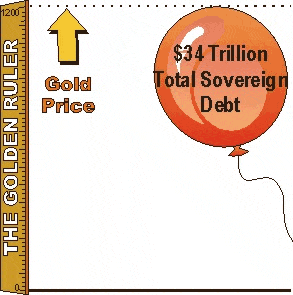
The enormous amount of government debt - total sovereign debt now totals $34 trillion dollars - can never be repaid. The end of the end-game will come when investors collectively realize this is so. That realization has not yet happened. When it does, for most it will be too late.

THE ILLUSORY GOLD BUBBLE
Some believe gold is a bubble. It is not. The price of gold, however, tracks a bubble and that is why it is mistaken for one.

WHICH ONE’S THE BUBBLE?
THE RULER OR THE BUBBLE?

The real bubble is government debt, not gold. Government debt is a bubble that hasn’t yet burst; one that has grown even more rapidly in the last two years as almost all nations went far deeper into debt after the 2007/2008 global collapse.
..sovereign debts grew by almost 30% in just two years. Sovereigns became the majority of worldwide debt. Several countries doubled their debts from 2007 to 2009 (BIS data) read here.
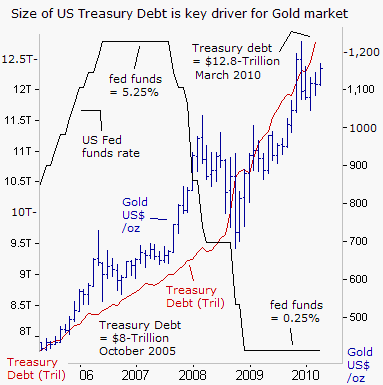
This recent meteoric rise in government debt has been matched by a corresponding rise in the price of gold. When government borrowing rose after 2007, the price of gold also rose, from $700 to $1200 per ounce, almost precisely tracking the rise in government debt.

(Click on image to enlarge)

the ballooning size of the US Treasury’s debt, which hit a record $12.8-trillion last month, has been a steady linchpin supporting the historic rally in the gold market over the past decade. As a general rule of thumb, every $1- trillion of fresh debt issued by the Treasury equates with a $125 /ounce increase in the price of gold. As long as the Fed and G-20 central banks continue to peg ultra-low interest rates, - and G-20 governments continue to flood the debt markets with huge quantities of IOU’s, - it translates into monetization, and the trajectory for the gold market would stay bullish. www.sirchartsalot.com
When the government debt bubble bursts - and it will - gold will not collapse as will bonds and other paper IOUs. When it happens, the collateral damage to the US dollar and fiat currencies may well be fatal and the price of gold - the only safe haven in such times - will explode upwards.
The recently revealed Bank of International Settlement 382 ton gold swap is evidence of gold’s value in such times. Hinted at by Julian D.W. Phillips in his insightful article, Gold Is Back As Money, Michael J. Kosares connected the dots in his post, BIS Swap Signifies A Threat To Europe, Not To Gold, by pointing out that the swap was probably conducted with Portugal.
Portugal, whose gold reserves equal (or rather equaled) 382 tons, badly needs to refinance its debt and when investors no longer trust sovereign bonds, gold is far more preferable as collateral than a government’s promise to repay.
Note: In the swap, the BIS most likely used commercial banks as intermediaries in order to disguise central bank use of gold as financial collateral.
The European debt crisis marks the beginning of the end of the government debt bubble. Only a false sense of confidence is now supporting sovereign bond markets. In the spring of 2010 that confidence was shaken; and, someday, it will disappear entirely.
We live in interesting times. We are in the end-game.
Buy gold, buy silver, have faith.


Labels: ,

Jun 21, 2010

Ambrose Evans-Pritchard: Gold reclaims currency status as global system unravels

By Ambrose Evans-Pritchard
The Telegraph, London
Sunday, June 20, 2010

We already know that the eurozone money markets seized up violently in early May as incipient bank runs spread from Greece to Portugal and Spain, threatening the first big sovereign default of our era. Jean-ClaudeTrichet, the president of the European Central Bank (ECB), talked days later of "the most difficult situation since the Second World War, and perhaps the First."

The ECB's latest monthly bulletin gives us some startling details. It reveals that the bank's "systemic risk indicator" surged suddenly to an all-time high on May 7 as measured by EURIBOR derivatives and stress in the EONIA swaps market, exceeding the strains at the height of the Lehman Brothers crisis in September 2008. "The probability of a simultaneous default of two or more euro-area large and complex banking groups rose sharply," it said.

This is a unsettling admission. Which two "large and complex banking groups" were on the brink of collapse? We may find out in late July when the stress test results are published, a move described by Deutsche Bank chief Josef Ackermann as "very, very dangerous."
And are we any safer now that the EU has failed to restore full confidence with its E750 billion (L505 billion) "shock and awe" shield -- that is to say after throwing everything it can credibly muster under the political constraints of monetary union? This is the deep angst that lies behind last week's surge in gold to an all-time high of $1,258 an ounce.

The World Gold Council said on Friday that the central banks of Russia, the Philippines, Kazakhstan, and Venezuela have been buying gold, and Saudi Arabia's monetary authority has "restated" its reserves upwards from 143 to 323 tonnes. If there is any theme to the bullion rush, it is fear that the global currency system is unravelling. Or, put another way, gold itself is reclaiming its historic role as the ultimate safe haven and benchmark currency.

It is certainly not inflation as such that is worrying big investors, though inflation may be the default response before this is all over. Core CPI in the US has fallen to the lowest level since the mid-1960s. Unlike the blow-off gold spike of the Nixon-Carter era, this rally has echoes of the 1930s. It is a harbinger of deflation stress.

Capital Economics calculates that the M3 money supply in the US has been contracting over the past three months at an annual rate of 7.6 percent. The yield on two-year Treasury notes is 0.71 percent. This is an economy in the grip of debt destruction.

Albert Edwards from Societe Generale says the Atlantic region is one accident away from outright deflation -- that ninth Circle of Hell, "abandon all hope, ye who enter." Such an accident may be coming. The ECRI leading indicator for the US economy has fallen at the most precipitous rate for half a century, dropping to a 45-week low. The latest reading is -5.70, the level it reached in late-2007 just as Wall Street began to roll over and crash. Neither the Fed nor the US Treasury were then aware that the US economy was already in recession. The official growth models were wildly wrong.

David Rosenberg from Gluskin Sheff said analysts are once again "asleep at the wheel" as the Baltic Dry Index measuring freight rate for bulk goods breaks down after a classic triple top. The recovery in US railroad car loadings appears to have stalled, with volume still down 10.5 percent from June 2008.

The National Association of Home Builders' index of "future sales" fell in May to the lowest since the depths of slump in early 2009. RealtyTrac said home repossessions have reached a fresh record. A further 323,000 families were hit with foreclosure notices last month. "We' re nowhere near out of the woods," said the firm.

It is an academic question whether the US slips into a double-dip recession or merely grinds along for the next 12 months in a "growth slump." For Europe, nothing short of a sustained global boom can lift the eurozone out of the deflationary quicksand already swallowing up the South.

Spain had to pay a near-record spread of 220 basis points over German Bunds last week to clear away an auction of 10-year bonds, roughly what Greece was paying in March. Leaked transcripts of a closed-door briefing to the Cortes by a central bank official revealed that Spanish companies have been shut out of the capital markets since Easter. Given that the Spanish state, juntas, banks, and firms have together built up foreign debts of E1.5 trillion, or 147 percent of GDP, and must roll over E600 billion of these debts this year, this is a crisis unlikely to cure itself.

By their actions, investors show that they do believe the EU can be relied upon to back its rescue rhetoric with hard money, and for good reason. Germany's coalition risks breaking up at any moment, fatally damaged by popular fury over the Greek bailout. Far-right populist Geert Wilders is suddenly the second force in the Dutch parliament. Flemish separatists have just won the Belgian elections in Flanders. The likelihood that an ever-reduced group of German-bloc creditors facing disorder and budget cuts at home will keep footing the bill for an ever-widening group of Latin-bloc debtors in distress is diminishing by the day.

Fitch Ratings said it will take "hundreds of billions" of bond purchases by the ECB to stop the crisis escalating. Since Bundesbank chief Axel Weber has already deemed the first tranche of purchases to be a "threat to stability," it is a safe bet that Germany will fight tooth and nail to prevent such a move to full-blown quantitative easing. The bloodletting along the fault-line between Teutonic and Latin Europe will go on, as the crisis festers.

Yet the markets are already moving on in any case. They doubt whether the EU's strategy of imposing of wage cuts on half of Europe without offsetting monetary and exchange stimulus can work. Such a policy crushes tax revenues and risks tipping states into a debt-deflation spiral, as if everbody had forgotten the lesson of the 1930s.

Greece's public debt will rise from 120 percent to 150 percent of GDP under the IMF-EU plan. There is a futile cruelty to this. As Russia's finance minister Alexei Kudrin acknowledges, a Greek "mini-default" has become inevitable.

EU president Herman Van Rompuy confessed that EMU lured countries into a fatal trap. "It was like some kind of sleeping pill, some kind of drug. We weren't aware of the underlying problems," he said.

What he has yet to admit is that the north-south imbalances built up since the euro was launched -- indeed, because the euro was launched -- cannot be corrected by further loans from the north or by pushing the south into depression. The political fuse will run out before this reactionary and self-defeating policy is tested to destruction.

* * *

Labels: , , , ,

May 19, 2010

Egon von Greyerz: Alea Iacta Est (the die is cast)


ALEA IACTA EST

by Egon von Greyerz – Matterhorn Asset Management
Yes this is it! We have crossed the Rubicon and events in the world economy are now likely to unfold in a totally uncontrollable fashion. Clueless governments still don’t understand that it is their ruinous actions that have created a credit infested and bankrupt world. They will continue to prescribe the same remedy that caused the problem in the first place, namely more credit and more printed money. The consequences are clear; we will have hyperinflation, economic and human misery as well as social unrest.
When will the world finally begin to understand that we have reached the point of no return and that “the voyage of their life is bound in shallows and in miseries” (Shakespeare, Julius Caesar).  Sadly, we are probably not very far from that point. It is already starting to happen in many countries.
The latest EU and IMF package of $ 1 TRILLION (Euro 750 billion) is yet another futile attempt by governments to abolish poverty by printing paper. Let’s be absolutely clear, this money does not exist and the EU governments are hoping by declaring such a large amount that they can con the Wolfpack speculators. At this point the EU has just picked a large round figure of out the air. But when their bluff is called by the Wolfpack and the next attack happens, EU governments will after initial huffing and puffing start printing unlimited amounts of paper.
So the world is now on its road to ruin and there is no action, no leader and no new amount of printed money that can save the world or prevent a hyperinflationary depression.
Never in history has the world been in a situation when virtually all industrialised countries are bankrupt. Therefore there is no precedent for what will happen in the next few years. What we can be quite certain about is that events will happen in a seemingly random pattern and that it will be impossible to forecast where the next crises will start.
But although we will not be able to predict in what order events will take place, we can expect much of what is outlined below to happen.

Wolfpack attacks

Already back in 2007 we warned about the very high risk of the CDS (credit default swap) market. This is now one of the primary instruments used by the Wolfpack (expression coined by the Swedish Finance Minister Borg). The Wolfpack, speculators with enormous fire power such as hedge funds and investment banks, use the CDS market to attack any weak financial sector, be it a country, a bank or a company. The combination of the leverage of the CDSs and the massive capital available to the Wolfpack makes it possible for them to bring down or badly maul whatever they attack. It was not the Wolfpack that caused the problem in for example Greece but they can bring down a weak victim quickly and profit immensely and immorally from it.
There are so many weak potential victims that the Wolfpack can attack and they will start with the most vulnerable ones like, Portugal, Spain and Ireland etc. But when the time is right they will also attack the US and the UK.
So in the coming year we will see country after country coming under attack from the Wolfback which will lead to acceleration in money printing and higher interest rates.

Iceland – Ireland – Greece – Who is next?

The EU support package of $ 1 trillion is supposed to be sufficient to protect the rest of Europe from another Greek tragedy. The dilemma with such a massive EU commitment is that no government expects to have to pay the money out. If they did the voters in the respective EU countries would throw out their government. Why should the German people, who are also having hard times, pay for the Greeks, Portuguese or the Spaniards, especially since these loans will never be paid back.
Greece is bankrupt but is still taking on additional EU loans of € 140 billion. In addition, their austerity measures are supposed to bring the deficit down from 12% of GDP today to 3% in a few years time. But who can be so stupid as to lend to a bankrupt nation which will sink into the Ionian and Aegean Seas in the next few years. With massive cuts in government expenditure, with major falls in output, with unemployment rising fast, with tax revenues collapsing how can Greece possibly be expected to improve the economy and pay a high interest rate on their exploding debt?  In addition, as long as they have the Euro they will be totally uncompetitive. So if they couldn’t manage their economy in the so called good times, it is absolutely guaranteed that they have no chance of surviving in bad times. So Greece will default and so will Portugal, Spain, Italy, France, the UK, the US and many more. But before that there will be the most colossal worldwide money printing exercise which would have used up most of the trees in the world but for electronic fiat money.
So, if virtually bankrupt nations don’t cut their deficits, they will definitively go under and if they try to cut, they will also go under due to collapsing output and tax revenues and colossal debts. Thus whatever actions governments take or don’t take, they are damned.
The table below shows debt as a percentage of GDP for various OECD countries. The official debts (in red) are massive and unlikely to ever be repaid in real money. Total debts (grey bars) include unfunded liabilities such as pensions and health care. Spain has the lowest total debt to GDP of 250%. Germany and the UK have around 400%, the US over 500% and Greece over 800% debt to GDP. These figures are absolutely astronomical and prove that most governments in the world will be totally incapable of repaying their debts or funding the pensions or medical care which they have committed to. It doesn’t matter however much governments cut expenditure or raise taxes, all these countries are insolvent and nothing can save them.
 [1]

The world must permanently readjust

Most governments still believe that deficit spending and money printing is the solution to all their problems. Because the world economy’s expansion in the last 100 years and particularly in the last 40 years has been primarily based on credit and not real growth, governments live under the false impression that money printing will work this time too. But we have reached the point when investors will no longer buy worthless government debt that will never be repaid with real money. We will first go through a period when governments issue and buy their own debt thus monetising the debt or print money.  This will be the hyperinflationary phase. Thereafter the world will realise that none of the government debt and very little of the bank debt will ever be repaid. Credit will then implode and so will also the assets financed by credit. Eventually there will be a new monetary and financial system and the world will start afresh. The adjustment period will be very long and will involve economic and human misery, leading to social unrest and major political change. It will be a horrible experience for the world during this extended period of adjustment. But it will be like a forest fire that clears out the deadwood and creates the conditions for  strong new growth. Once the new era starts it will therefore be from a very much lower level and individuals will be rewarded for hard work with  little or no social security safety net. Credit will only be granted for sound capital investment projects, not for consumption or speculation. Ethical and moral values will return and the golden calf will not be worshipped. But before that, the period of readjustment will be very long and extremely difficult for the whole world.

Hyperinflation

For several years we have predicted that hyperinflation is the most likely outcome of the economic predicament that the world is in. But it is unlikely to be a straightforward hyperinflationary period. Precious metals will be the primary beneficiaries of hyperinflation. Certain commodities, especially food and energy, will also go up in price.  But most assets that have been financed by the credit boom will go down in real terms. This includes property, stocks and bonds. In hyperinflationary money these assets could still go up in price. If someone who earned $ 50,000 per annum in real money now earns $ 5 million in newly printed money, his house will probably also go up in nominal terms. But in real terms property prices will decline massively. There will be no credit available and interest rates will be very high, probably at least 15-20% so very few people will be able to buy a house.
Hyperinflation will destroy many currencies so paper money will definitely reach its intrinsic value which is zero. Gold and silver will virtually be the only assets that will protect investors fully against the destruction of money.
 [2]

The next leg of the debt crisis is here

In our February newsletter “Sovereign Alchemy will Fail” we discussed the Sovereign Time Bomb and we are now experiencing the initial small explosions with Greece as the first victim. The $1 trillion EU/IMF rescue package was never intended to be more than a headline figure. EU governments were hoping that this would frighten the Wolfpack away. But so far this has failed. The Euro went up 4 cents when the package was announced but is now down to new lows again. How can anyone take a massive rescue package seriously when most of the countries making the commitments are bankrupt themselves? Spain and Italy have committed tens of billions each. And they are the ones that will be attacked by the Wolfpack next.This is the bankrupt saving the bankrupt. The IMF has no money but is dependent on its members of which the US is the biggest contributor. And they are bankrupt too. The UK, which is not in the Euro Zone and which has a worse budget deficit than Greece, contributed £15 billion. The new UK government is planning to cut a massive £ 6 billion of costs out of its next year’s budget which will bring major hardship. But as a last act, the outgoing labour government committed £15 billion which if paid out will never be repaid. The whole thing is a total farce. Governments commit trillions to rescue banks and sovereign states but cannot even make budget cuts of a few billion in their own countries. This shows that the world economy and the world financial system is being run by morons who only have their own self interest in mind and do not understand the consequences of their ruinous actions.
When the $1 trillion EU rescue package was announced, the US simultaneously offered European banks dollar Swap facilities (dollar loans) of a minimum $500 billion but probably much more. In addition the US Fed also injected at least $500 billion into the US banking system. These actions make it clear the banking system is under tremendous strain similar to 2008. But this is just the beginning. Things will get a lot worse.

Gold

In 2002 we advised investors to put up to 50% of their liquid assets into gold when the price was $300. To us it was crystal clear that the mountain of debts and derivatives would never be repaid with normal money but would be inflated away by money printing and this is what is now happening. The media are now talking about a bubble in gold and comparing to the 1980 top at $850. Let us be very clear, although gold has gone up 5 times since the 1999 bottom at $250,  it is nowhere near its peak. Adjusted for real inflation (as per shadowstats.com) the 1980 gold peak in today’s prices corresponds to around $7,200 today. So gold could easily go up 6 times from the current price of $1,220 and still be within normal parameters.
 [3]
There are many factors that will contribute to gold’s rise from here (in addition to money printing):
  1. Gold production is going down.
  2. Neither Comex (the futures exchange), nor the bullion banks would be able to deliver more than a fraction of the physical gold for which they have outstanding commitments.
  3. Central banks and the IMF probably don’t hold even half of the 30,000 tons that they claim they have. Most likely, at least 15,000 tons (6 years gold production) have been sold to suppress the gold price.
  4. The precarious financial system will lead to a total distrust of paper gold including most of the ETFs which have no physical gold.
The four factors above will lead to the most massive surge in the gold price. There will be nowhere near sufficient gold to satisfy demand at current prices. We had been expecting gold to start its acceleration in March 2010 and this is exactly what is happening. We expect the move to be relentless during most of this year with very few major corrections but with high volatility. Moves of $100 in one day could easily happen.
So gold is likely to make a top in the next few years between $5,000 and $10,000. But if we get hyperinflation the price could go exponentially higher like in the Weimar Republic when gold reached DM 100 trillion per ounce in 1923. Will gold experience the same type of correction when is has peaked as happened after the 1980 peak? Probably not, because gold is likely to be a part of a new monetary system that will be created when the current one has collapsed.
The table below illustrates the total destruction of paper money against gold in the last 100 years and shows how many ounces of gold that $1,000 bought at various times. In 1910, $1,000 bought 40 oz of gold at $25 per oz. Today in 2010, $1,000 buys 0.80 oz of gold at $1,230 per oz. This is a massive decline of 98% in the value of the dollar measured in real terms in the last 100 years. The next significant year is 1971 when Nixon abolished the convertibility of dollars to gold. It was this disastrous decision that opened the floodgates for the credit and money creation that we are experiencing currently. The dollar is down 97% since then. But even if we take more recent years, the purchasing power of the dollar measured in gold has declined catastrophically. Since the 1999 gold low, the dollar has declined by 80% against gold and since 2002 (when Matterhorn Asset Management recommended major gold investments) by 76%.
 [4]
Virtually all currencies show similar declines in value against gold in the last 100 years. This is the clearest evidence of governments and central banks defrauding their people of their hard earned money. Where will it end? It will end when the dollar and many other currencies reach their intrinsic value of ZERO. That time is not far away.
Matterhorn Asset Management AG
Bahnhofstrasse 28a
CH 8001 ZURICH
Switzerland
+41 44 213 62 45 - Tel
+41 43 456 97 11 - Fax
matterhornassetmanagement.com

Labels: , , , , ,

May 14, 2010

Antal Fekete: The New Austrian School of Economics

What follows is tantamount to a historical manifesto that could signal a new era for world economics and modern society as a whole. It is Professor Fekete's proclamation of a truly viable way out of today's global economic impasse a.k.a. "The Greatest Depression".
Please read it carefully...


THE NEW AUSTRIAN SCHOOL OF ECONOMICS
Antal E. Fekete
aefekete@hotmail.com
**
The Hungarian Connection

The Austrian School of Economics dates its beginnings back to the publication in 1871 of a slender volume: The Principles of Economics (Grundsätze der Volkwirtschaftslehre) by Carl Menger. The adjective "Austrian" was meant to be derogatory, introduced by economists of German school of historicism to ridicule Menger's idea of basing economic science on axiomatic foundations, on the pattern of logic and mathematics. The root of the word "Austrian" is "East", so the connotation of "Austrian economics" is "oriental economics" - a kind of voodoo economics.
German economists could just as well have said "Austrian-Hungarian economics", since Hungary lies even further East than Austria, plus the fact that in 1871 Austria-Hungary was a dual monarchy, the two countries sharing not only a monarch but also many important political, economic, scientific, cultural institutions and traditions.
The Hungarian connection is dramatically revived by an unfortunate split in the rank and file of Austrian economists that took place in the 21st century. I have run conferences at the Martineum Academy in Szombathely, Hungary in the Austrian tradition and in the spirit of Carl Menger. I published course outlines under the aegis of the now defunct Gold Standard University on my website www.professorfekete.com. For my efforts I have been roundly denounced by parochial "American Austrians" at the Ludwig von Mises Institute in Auburn, Alabama. I consider this split most unfortunate at the most critical time, when the international monetary system shows signs of advanced senile dementia as well as of physical disintegration. This could have been a most opportune time for students of the gold standard to close ranks, join forces, and demand a return to the only monetary system that makes for economic stability, for peace and prosperity. They should have put their quibbles aside and offer a common platform and blueprint showing the world how it could be done. It was not meant to be.
Because of the urgency of the moment I have decided to make a fresh start and to establish a new school, proudly naming it the New Austrian School of Economics in Budapest, Hungary, where I live. My first act in doing so is to extend a sincere offer of cooperation to the American Austrians as soon as they are ready to look at Adam Smith's Real Bills Doctrine as a valid theory which is very much in the spirit of Menger.


The Quantity Theory of Money

It is a great pity that as a young man Ludwig von Mises embraced the Quantity Theory of Money, and has never during his long life been able to extricate himself from its clutches. For this reason he was alienated from Adam Smith's Real Bills Doctrine, the latter being an implicit refutation of the former. In spite of this flaw I still consider him the greatest economist of the 20th century. But the mortmain of Mises cannot be allowed to guide us in the 21st century when the Quantity Theory of Money is so spectacularly self-destructing, as witnessed by the Second Great Depression that started 80 years after the first, in 2009.


Cleansing of the Temple

The Real Bills Doctrine of Adam Smith states, in essence, that short-maturity bills of exchange drawn on goods in most urgent demand and moving fast enough to the ultimate gold-paying consumer, are capable of spontaneous monetary circulation, without any impetus or props from the governments or the banks. Indeed, bill circulation is possible in the absence of any banks at all. Such a system of financing production and trade sans banques could rise from the ashes of the regime of irredeemable currency before our very eyes. In the first decade of our century the governments and the banks have totally discredited themselves in the public's view as they have run the ship of the world's monetary system onto the rocks. Should the bankers have the temerity to show up after the shipwreck in order to set up shop, people will rise and chase them out - just as Jesus chased out the money changers in the famous scene "Cleansing of the Temple" (Mark 11:15-19; Matthew 21:12-17; Luke 19:45-48; John 2:12-25).
The scriptural teaching, confirmed by all four evangelists, is clear. Social cooperation is still possible in the absence of banks. It was a fatal mistake to ban the spontaneous circulation of bills maturing into gold from financing world trade - thereby promoting the bankers' dishonored promises to pay, and their never maturing but ever burgeoning debt, to the status of money.


Victors disallowing real bill circulation in 1918

The international gold standard did not collapse during the 1930's because of its inner contradictions - as schools inculcate the idea into all students. The truth is that the victorious powers inadvertently caused the collapse of the gold standard (with a 13-year lag) by disallowing its clearing system, the international bill market, to reopen for business after the cessation of hostilities in 1918.
The victors did not want to abolish the gold standard per se. After all, Britain returned to a gold bullion standard at the original parity of the pound sterling in 1925. The victorious allies acted vindictively. They just wanted to punish Germany over and above the provisions of the peace treaty. They forced the world into the straitjacket of bilateral trade, essentially a barter system that had evolved during the war. They refused to entertain Germany's post-war revival, given the benefits of multilateral world trade, epitomized by the international bill market as it operated before 1914. In effect, the victors wanted to perpetuate the wartime blockade of Germany in peacetime. Never mind that this also punished their own people. In their opinion it was a small price to pay for security. Little did the victorious powers realize that they were sounding the death knell for the gold standard. In a complex trading world such as that of the twentieth century the gold standard could hardly survive if it is castrated by cutting off its clearing system, bill circulation. The idea that the world could be coerced to embrace a system barring multilateral trade is akin to the idea that people could be forced back to barter by abolishing money.
History has borne out the truth of this observation. During a period of five years, from September 1, 1931, when Britain, to September 27, 1936, when Switzerland reneged on their domestic and international gold obligations, all other governments have similarly defaulted on their solemn promises to pay their creditors in the form of a fixed quantity and quality of gold. In some countries, so in the United States, draconian regulations were put into effect making the possession of gold a criminal offence in 1933. Such extreme measures had only one explanation: vindictiveness - even to the extent of hurting your own citizens and violating your own Constitution in the execution of an insane monetary policy. Government economists, university professors, financial writers and journalists have "forgotten" to raise the question whether such extreme and vindictive interference with the world's production and distribution of goods and services would ultimately have some untoward effects, even war, as a repercussion. Not one of them thought of suggesting that the legal tender status of bank notes should be declared unconstitutional through an international treaty - as the paramount measure to secure the preservation of world peace.


A Century of Legal Tender

The "forgotten questions" are belatedly being asked now. The present great financial crisis is not the outcome of some recent errors of commission or omission. Its ultimate cause goes back 100 years, to 1909. That was the year when France and Germany, in short succession after one another, enacted legal tender legislation making the note issue of the Bank of France and the Reichsbank legal tender in their respective jurisdictions. Without legal tender bank notes an all-out war could scarcely be fought. Members of the officer corps and procurers of munitions would demand remuneration in the gold coin of the realm. That could have put a speedy end to the war that started in 1914.
The real cause of the great financial crisis that started in 2009 is the inadvertent destruction of the gold standard a hundred years ago through the introduction of legal tender bank notes before World War I, and the vengeful decision to bar the international bill market after. It was these measures that have given rise to the corrosive regime of irredeemable currency, floating exchange rates, gyrating interest rates, and forever growing perpetual debt - a monetary arrangement never before globally embraced.


100 percent Gold Standard (so called)

I am an old man, two years shy of four score. I was looking forward to enjoying the quiet pleasures of retirement. However, the present world crisis calls me out of retirement. I feel it is my duty to do what I can to prevent a disaster, to wit, the establishment of the 100 percent gold standard (so called) and letting it run as the fall guy in a mission that is condemned to fail, as Britain's return to the gold standard was in 1925.
Britain's gold standard of 1925 failed because it did not have a clearing system and so it utterly lacked elasticity that only self-liquidating credit, embodied by real bill circulation could impart to the monetary system. It was doomed to failure from start. The 100 percent gold standard (so called) would repeat the mistake the British made in 1925. Another failure of the gold standard would set the world back another hundred years. In the meantime there would be trade wars, most likely leading to another world war. Our civilization would be put in harm's way.


The Theory of Discount

The 100 percent gold standard (so called) would also deprive the world of the benefits of the discount rate, this sophisticated and versatile instrument to regulate the economy. The economic triumph of the one hundred-year period from 1815 through 1914 is the triumph not only of the gold standard, but also of self-liquidating credit, the bill market, and the discount rate (as distinct from the rate of interest). During that triumphant period such economic maladies as chronic trade imbalance, structural unemployment, foreign exchange crises, unbridled increases in public and private debt were quite unknown. The world economy was on an even keel, delicately balanced by self-correction through the mechanism of the discount rate.
In the 19th century no sharp distinction could be made between "surplus" and "deficit" countries due to the self-correcting mechanism of the discount rate. It would have been unthinkable that balances of pound sterling would keep piling up in one country (as dollar balances do now in China), causing great disruptions in world trade, and leading to the dismantling of whole industries in the deficit countries.
Instead, surplus countries would experience an automatic fall, deficit countries an automatic rise in the discount rate. This would immediately induce a flow of short-term capital from the surplus countries to the deficit countries in the form of consumer goods in the most urgent demand. There is no better way, known to man, to satisfy the world's multifarious and fast-changing needs using the world's scarce resources most economically and efficiently, to the best advantage of all. This great mechanism of economic adjustment, capable of preventing structural unemployment and chronic imbalances in the world economy, the discount rate, was thoughtlessly thrown away by the victorious allies when they decided not to allow the reorganization of the international bill market for reasons of vindictiveness in 1918.


Open the Mint to Gold!

The secret of solution to the great financial crisis of our day is that governments should open the Mint to gold. This means restoring the individuals' right to convert their gold at the Mint, without limit, into the gold coin of the realm free of seigniorage charges. They should also have the right to melt down, hoard or export the gold coin of the realm as they see fit.
The significance of the opening of the Mint to gold is that it would convert idled gold into "gold on the go". Circulating gold coins would revive world trade as nothing else could. Gold locked up in government and private vaults is a curse putting the world economy in a bind (in addition to being a stupid economic waste of a unique scarce resource that has no substitute).


The Most Misunderstood of Metals

Gold is the most misunderstood metal in human history, because of the economists' failure to distinguish between its dynamic and static aspects in representing values. Economists have blithely assumed all along that the value of gold is the same whether it flows freely from one hand to the next, or whether the movement of gold is obstructed, in the worst case arrested, by the government (soon to be aped by banks and individuals). Yet the truth of the matter is that "gold on the go" is far more valuable than "gold locked up". Golden Ages of history were periods characterized by "gold on the go". Man trusted man, and men trusted their governments. Promises to pay gold were routinely made and kept. Gold was paid out without hesitation because men and governments were confident that they can get it back on the same terms any time of their own choosing. Above all, during the Golden Ages of history there was peace because goods and services could be more readily obtained through trade than through theft or conquest.
By contrast, under our present system wherein gold is concentrated in government and private hoards, there prevails a great distrust and widespread misery. Above all, there is perpetual war as goods and services could be more readily obtained through theft and conquest than through voluntary trade.
In rejecting gold our statesmen have rejected reason. Their guilty conscience is shown by their neurotic fear of an open debate on the gold question, and by the fact that they deny academic appointments to solid gold standard men, treating them as if they were cranks. Politicians are wont to erase the very thought of gold from the public consciousness.


The Best Unemployment Insurance Known to Man

The combination of a gold standard with bill trading would produce an economic miracle in the world far greater than the economic miracle of Ludwig Erhardt's Germany in 1949. The curse of trade deficits would disappear. Even if a country suffered a great natural disaster, say, the total loss of its annual crop, trade deficit would not necessarily follow. The discount rate would immediately shoot up in the stricken country. That country would be the best place in the world on which to draw bills. This would instantaneously generate a flow of short-term capital in the form of consumer goods in most urgent demand. No country would ever need to go to other governments begging for charity. Surplus countries would be prompted to expel gold in response to greater demand as demonstrated by the higher discount rate abroad.
Structural unemployment would disappear as it would be prevented before it became chronic by the higher discount rate in areas of falling employment. The higher local discount rate would generate an influx of finished and semi-finished goods from the surrounding areas. The processing and the distribution of these goods would create as many new jobs as necessary. The best "unemployment insurance" known to man is "gold standard plus bill trading". This is how the world economy worked before 1914; this is how it would have worked after 1918 had the victorious powers had the intelligence to allow multilateral trade and real bill circulation to make a comeback.


Hands-off Treasury Bills

All the government needs to do is to open the Mint to gold and to protect real bill trading against fraud. Funds raised through the bill market are public funds that must be protected against misuse just as other forms of public funds must. Let me mention just three types of misuse: (1) drawing more than one bill on the same consignment of merchandise; (2) drawing a new bill upon the expiry of the old on the same unsold merchandise; (3) financing stores of goods in the expectation of a rise in price by drawing bills.
Bills of exchange drawn on goods in most urgent demand and moving fast enough to the ultimate gold-paying consumer are capable of monetary circulation on their own wings and under their own steam, regardless whether or not banks are standing by, ready to monetize them. But if they are, legislation should prohibit banks from borrowing short in order to lend long. In practice this means that the banks would be prohibited from rolling over short term commercial credit at maturity. Commercial banks must also be prohibited from conspiring with the drawer of the bill. Withholding stocks from trade in expectation of a rise in price must be financed by an investment bank, never by a commercial bank. The two types of banks should be strictly separated by law. Commercial banks must also be prohibited from investing in brick and mortar. In practice this means that mortgages are "hands-off ".
Treasury bills are also "hands-off", except on capital account. We know that people will want to eat and to keep themselves clad and shod tomorrow. That's what makes bills the safest earning asset. We also know that people will pay their taxes only after they have eaten, clad and shod themselves. That's why real bills as an earning asset are superior to Treasury bills.


The Curse of Senescence

The demand for gold has a component that is unknown to our generation, although it was ubiquitous a hundred years ago: the demand for yield on gold in gold. Gold used to wear two hats: if you wanted, gold was wealth; but if you wanted, gold was income. Moreover, the switch between the two was as simple as one-two-three, through the agency of the bill market. The possibility of making gold yield an income in gold is missing from the world today. The reason is the neurotic approach to gold promoted by the media and academia.
The discount earned by holding real bills to maturity is the safest way to generate an income in gold. Likewise, the safest way to convert that income back into gold is by selling real bills from portfolio.
But why is switching between gold as wealth and gold as income so important? Well, God created man and made him mortal. Also he made us subject to curse of senescence. Our capacity to generate an income is the lowest just when our need to rely on it is the greatest: when we grow old and frail. This seems unjust; but God has also given us a marvelous tool as a compensation: gold. The young man can hoard gold, maybe to adorn his wife with gold jewelry, thus converting income into wealth, so that they can turn this wealth back into income by dishoarding gold when he grows old and his surplus of income has turned into a deficit. Thus gold is man's tool to convert income into wealth and wealth into income safely. Gold is the catalyst in solving the problem of senescence. That indeed is gold's main excellence.


Exchanging income for wealth and wealth for income

The trouble is that hoarding and dishoarding gold is a laborious and time-consuming process, raising the problem of efficiency and safety. It is important for us to see that the efficiency of converting income into wealth and wealth into income can be greatly enhanced, and the time-consuming process can be telescoped into instant action, if we pass from direct to indirectconversion of income and wealth. That is to say, we pass from hoarding and dishoarding to the exchange of income for wealth and wealth for income.


The Theory of Interest

This leads us to the concept of interest. The interest rate is just the marginal efficiency of exchanging income and wealth (over the zero efficiency of direct conversion: hoarding and dishoarding). We can shape the theory of the origin of interest so as to describe the evolution of direct conversion of income into wealth or wealth into income through the agency of themost hoardable good, gold, resulting in the far more efficient indirect conversion: the exchange of wealth and income.
This closely follows Menger's familiar theory of the origin of money as the evolution of direct exchange (barter) resulting in the far more efficient indirect exchange through the agency of themost marketable good, gold.
Given the possibility of indirect conversion, that is, the exchange of income and wealth, the young man with a surplus of income but a deficit of wealth, who wants to go into business, no longer has to waste his best years to hoard gold in order to raise capital. He will seek out a congenial elderly man who has a surplus of wealth but a deficit of income. The two can go into partnership in exchanging the surplus income of the junior partner for the surplus wealth of the senior. But they can do it safely only if the God-ordained institution of the gold standard and the instrument of the gold bond have not been corrupted by do-gooder politicians, as they in fact have in inflicting the coercive regime of irredeemable currency upon the world.
Today no exchange of income and wealth is safe because we no longer have a reliable unit measuring value. This is a formidable obstruction in the way of forming new capital at a time when great capital destruction is taking place due to fluctuating interest rates. The problem of providing adequate capital for business cannot be solved satisfactorily while assuming the regime of irredeemable currency, under which the central bank can suppress the rate of interest all the way to zero - the main cause of capital destruction in the world today. It can be solved only under the regime of a gold standard, where the rate of interest is naturally stable, as shown by the stable price of the gold bond.
This is a new theory of interest that starts from the concept of the hoardability of gold and from the natural need of man to save for his old age. It enables us to see that old age security can be furnished far more efficiently through the voluntary efforts of individuals than through the coercive schemes of the government.


My Message to the Young

I have established the New Austrian School of Economics in order to spread these unorthodox ideas which are very much in the spirit of Carl Menger. Time has come to go beyond rehashing old truths: we must come up with new ideas on our own.
I hereby invite all young people who feel that regurgitating platitudes is not enough. Come to Budapest and enroll at the New School of Austrian Economics! Let's raise the torch and carry on the great work of enlightenment together! This is no time for cultism or for parochial quibblings. We must forge ahead past the stale criticism of the existing order. Armed with new ideas we are ready to act. I want to lead you and, then, I want you to lead the world!
There is no place anywhere else in the world where you can study the gold standard as it interacts with its clearing system, the bill market, and with the mechanism of the discount rate; where you can learn that legal tender legislation and the elimination of bill trading is invitation to war (first trade war, followed by shooting war); where you can learn that the starting point of the theory of interest must be gold, the most hordable commodity - except here, in Budapest, at the New School of Austrian Economics. The powers that be have expunged gold standard studies from the curriculum. As a consequence the charlatans of at our universities will never be able to come to grips with the theory of interest. There is no way to understand interest without understanding gold first. We shall recreate gold standard studies and advance it together.
See you in August when I shall deliver my first lecture series on the subject of Disorder and Coordination in Economics - Has the world reached the ultimate economic and monetary disorder?
May 12, 2010

***


Calendar of Events

European Bankers Symposium, 9-10 June 2010, Hall, Tyrol, Austria. Professor Fekete will be a keynote speaker on June 9, at 13:30. The title of his talk is: (Gold) Architecture for a New World Finance System. For more information, please see www.financetrainer.com.
ANNOUNCING THE ESTABLISHMENT OF THE AUSTRIAN SCHOOL OF ECONOMICS IN BUDAPEST. The first ten-day, 20-lecture course offered is entitled: Disorder and Coordination in Economics - Has the world reached the ultimate economic and monetary disorder? The lecturer is Professor Fekete, with the cooperation of Mr. Rudy Fritsch (Canada), Peter van Coppenolle (Belgium), and Mr. Sandeep Jaitly (United Kingdom). It will be held in Budapest, Hungary, from August 9-20, 2010. Participation is limited, early registration is advisable. For more information and registration, contact Dr. Judith Szepesvari, the wife of Prof. Fekete at: szepesvari17@gmail.com. Inexpensive dorm-type accommodation is available for students (shared bathroom, shared kitchen); a three-star hotel is next door. Extra-curricular consulting with Professor Fekete can be arranged for an extra fee.
The school is meant for all students (including beginners) interested in the Austrian theory of money, credit, and banking. Its program plans to cover the whole spectrum of Austrian economics, with special emphasis on developments that took place after the death of the greatest 20th century economist, Ludwig von Mises, including the Real Bills doctrine and social circulating capital; the theory of money, credit and banking; and the theory of interest and discount.
Completion of this course will earn participants one credit towards a four-course, four-credit program that has been submitted for accreditation to the Adult Education Accreditation Board of Hungary. Participants will receive a certificate signed by Professor Fekete. The follow-up credit courses will cover these areas:
Adam Smith's Real Bills Doctrine and Social Circulating Capital.
The Austrian Theory of Interest and Discount.
The Austrian Theory of Money, Credit, and Banking.
Some of the follow-up courses may be offered at Martineum Academy in Szombathely, Hungary, where we have had four successful conferences already in the past. A special cordial invitation is extended to all Martineum alumni and their family members and friends!
It is not well-known that Budapest is one of the foremost spas in Central Europe with a dozen or so medicinal thermal springs. Participants of the course could stay on afterwards and savor the superb spa and cultural offerings in the city. Make it a family holiday! Bring the children! Eating and shopping facilities, as well as a swimming pool are nearby. Spectacular excursions can be arranged in the surrounding hills, and boat trips on the River Danube.

Labels: , , , , , ,

Mar 17, 2010

Von Mises on The Gold Standard


This article is excerpted from chapter 17 of Human Action: The Scholar's Edition , by Ludwig Von Mises, and is read by Jeff Riggenbach.

Men have chosen the precious metals gold and silver for the money service on account of their mineralogical, physical, and chemical features. The use of money in a market economy is a praxeologically necessary fact. That gold — and not something else — is used as money is merely a historical fact and as such cannot be conceived by catallactics. In monetary history too, as in all other branches of history, one must resort to historical understanding. If one takes pleasure in calling the gold standard a "barbarous relic,"[1] one cannot object to the application of the same term to every historically determined institution. Then the fact that the British speak English — and not Danish, German, or French — is a barbarous relic too, and every Briton who opposes the substitution of Esperanto for English is no less dogmatic and orthodox than those who do not wax rapturous about the plans for a managed currency.
The demonetization of silver and the establishment of gold monometallism was the outcome of deliberate government interference with monetary matters. It is pointless to raise the question concerning what would have happened in the absence of these policies. But it must not be forgotten that it was not the intention of the governments to establish the gold standard. What the governments aimed at was the double standard. They wanted to substitute a rigid, government-decreed exchange ratio between gold and silver for the fluctuating market ratios between the independently coexistent gold and silver coins. The monetary doctrines underlying these endeavors misconstrued the market phenomena in that complete way in which only bureaucrats can misconstrue them. The attempts to create a double standard of both metals, gold and silver, failed lamentably. It was this failure that generated the gold standard. The emergence of the gold standard was the manifestation of a crushing defeat of the governments and their cherished doctrines.
In the 17th century, the rates at which the English government tariffed the coins overvalued the guinea with regard to silver and thus made the silver coins disappear. Only those silver coins that were much worn by usage or in any other way defaced or reduced in weight remained in current use; it did not pay to export and to sell them on the bullion market. Thus England got the gold standard against the intention of its government. Only much later the laws made the de facto gold standard a de jurestandard. The government abandoned further fruitless attempts to pump silver standard coins into the market and minted silver only as subsidiary coins with a limited legal tender power. These subsidiary coins were not money, but money-substitutes. Their exchange value depended not on their silver content, but on the fact that they could be exchanged at every instant, without delay and without cost, at their full face value against gold. They were de facto silver printed notes, claims against a definite amount of gold.
Later in the course of the 19th century, the double standard resulted in a similar way in France and in the other countries of the Latin Monetary Union in the emergence ofde facto gold monometallism. When the drop in the price of silver in the later 1870s would automatically have effected the replacement of the de facto gold standard by the de facto silver standard, these governments suspended the coinage of silver in order to preserve the gold standard. In the United States, the price structure on the bullion market had already, before the outbreak of the Civil War, transformed the legal bimetallism into de facto gold monometallism.
"If one takes pleasure in calling the gold standard a 'barbarous relic,' one cannot object to the application of the same term to every historically determined institution."
After the greenback period, there ensued a struggle between the friends of the gold standard on the one hand and those of silver on the other hand. The result was a victory for the gold standard. Once the economically most advanced nations had adopted the gold standard, all other nations followed suit. After the great inflationary adventures of the First World War, most countries hastened to return to the gold standard or the gold-exchange standard.
The gold standard was the world standard of the age of capitalism, increasing welfare, liberty, and democracy, both political and economic. In the eyes of the free traders its main eminence was precisely the fact that it was an international standard as required by international trade and the transactions of the international money and capital market.[2] It was the medium of exchange by means of which Western industrialism and Western capital had borne Western civilization into the remotest parts of the earth's surface, everywhere destroying the fetters of age-old prejudices and superstitions, sowing the seeds of new life and new well-being, freeing minds and souls, and creating riches unheard of before. It accompanied the triumphal unprecedented progress of Western liberalism ready to unite all nations into a community of free nations peacefully cooperating with one another.
It is easy to understand why people viewed the gold standard as the symbol of this greatest and most beneficial of all historical changes. All those intent upon sabotaging the evolution toward welfare, peace, freedom, and democracy loathed the gold standard, and not only on account of its economic significance. In their eyes the gold standard was the labarum, the symbol, of all those doctrines and policies they wanted to destroy. In the struggle against the gold standard, much more was at stake than commodity prices and foreign-exchange rates.
The nationalists are fighting the gold standard because they want to sever their countries from the world market and to establish national autarky as far as possible. Interventionist governments and pressure groups are fighting the gold standard because they consider it the most serious obstacle to their endeavors to manipulate prices and wage rates. But the most fanatical attacks against gold are made by those intent upon credit expansion. With them, credit expansion is the panacea for all economic ills. It could lower or even entirely abolish interest rates, raise wages and prices for the benefit of all except the parasitic capitalists and the exploiting employers, free the state from the necessity of balancing its budget — in short, make all decent people prosperous and happy. Only the gold standard, that devilish contrivance of the wicked and stupid "orthodox" economists, prevents mankind from attaining everlasting prosperity.
The gold standard is certainly not a perfect or ideal standard. There is no such thing as perfection in human things. But nobody is in a position to tell us how something more satisfactory could be put in place of the gold standard. The purchasing power of gold is not stable. But the very notions of stability and unchangeability of purchasing power are absurd. In a living and changing world there cannot be any such thing as stability of purchasing power. In the imaginary construction of an evenly rotating economy there is no room left for a medium of exchange. It is an essential feature of money that its purchasing power is changing. In fact, the adversaries of the gold standard do not want to make money's purchasing power stable. They want rather to give to the governments the power to manipulate purchasing power without being hindered by an "external" factor, namely, the money relation of the gold standard.
The main objection raised against the gold standard is that it makes operative in the determination of prices a factor that no government can control — the vicissitudes of gold production. Thus an "external" or "automatic" force restrains a national government's power to make its subjects as prosperous as it would like to make them. The international capitalists dictate and the nation's sovereignty becomes a sham.
However, the futility of interventionist policies has nothing at all to do with monetary matters. It will be shown later why all isolated measures of government interference with market phenomena must fail to attain the ends sought. If the interventionist government wants to remedy the shortcomings of its first interferences by going further and further, it finally converts its country's economic system into socialism of the German pattern. Then it abolishes the domestic market altogether, and with it money and all monetary problems, even though it may retain some of the terms and labels of the market economy.[3] In both cases it is not the gold standard that frustrates the good intentions of the benevolent authority.
The significance of the fact that the gold standard makes the increase in the supply of gold depend upon the profitability of producing gold is, of course, that it limits the government's power to resort to inflation. The gold standard makes the determination of money's purchasing power independent of the changing ambitions and doctrines of political parties and pressure groups. This is not a defect of the gold standard; it is its main excellence. Every method of manipulating purchasing power is by necessity arbitrary. All methods recommended for the discovery of an allegedly objective and "scientific" yardstick for monetary manipulation are based on the illusion that changes in purchasing power can be "measured." The gold standard removes the determination of cash-induced changes in purchasing power from the political arena. Its general acceptance requires the acknowledgment of the truth that one cannot make all people richer by printing money. The abhorrence of the gold standard is inspired by the superstition that omnipotent governments can create wealth out of little scraps of paper.
"People fight the gold standard because they want to substitute national autarky for free trade, war for peace, totalitarian government omnipotence for liberty."
It has been asserted that the gold standard too is a manipulated standard. The governments may influence the height of gold's purchasing power either by credit expansion — even if it is kept within the limits drawn by considerations of preserving the redeemability of the money-substitutes — or indirectly by furthering measures that induce people to restrict the size of their cash holdings. This is true. It cannot be denied that the rise in commodity prices that occurred between 1896 and 1914 was to a great extent provoked by such government policies. But the main thing is that the gold standard keeps all such endeavors toward lowering money's purchasing power within narrow limits. The inflationists are fighting the gold standard precisely because they consider these limits a serious obstacle to the realization of their plans.
What the expansionists call the defects of the gold standard are indeed its very eminence and usefulness. It checks large-scale inflationary ventures on the part of governments. The gold standard did not fail. The governments were eager to destroy it, because they were committed to the fallacies that credit expansion is an appropriate means of lowering the rate of interest and of "improving" the balance of trade.
No government is, however, powerful enough to abolish the gold standard. Gold is the money of international trade and of the supernational economic community of mankind. It cannot be affected by measures of governments whose sovereignty is limited to definite countries. As long as a country is not economically self-sufficient in the strict sense of the term, as long as there are still some loopholes left in the walls by which nationalistic governments try to isolate their countries from the rest of the world, gold is still used as money. It does not matter that governments confiscate the gold coins and bullion they can seize and punish those holding gold as felons. The language of bilateral clearing agreements by means of which governments are intent upon eliminating gold from international trade, avoids any reference to gold. But the turnovers performed on the ground of those agreements are calculated on gold prices. He who buys or sells on a foreign market calculates the advantages and disadvantages of such transactions in gold. In spite of the fact that a country has severed its local currency from any link with gold, its domestic structure of prices remains closely connected with gold and the gold prices of the world market. If a government wants to sever its domestic price structure from that of the world market, it must resort to other measures, such as prohibitive import and export duties and embargoes. Nationalization of foreign trade, whether effected openly or directly by foreign exchange control, does not eliminate gold. The governments qua traders are trading by the use of gold as a medium of exchange.
The struggle against gold, which is one of the main concerns of all contemporary governments, must not be looked upon as an isolated phenomenon. It is but one item in the gigantic process of destruction that is the mark of our time. People fight the gold standard because they want to substitute national autarky for free trade, war for peace, totalitarian government omnipotence for liberty.
It may happen one day that technology will discover a method of enlarging the supply of gold at such a low cost that gold will become useless for the monetary service. Then people will have to replace the gold standard by another standard. It is futile to bother today about the way in which this problem will be solved. We do not know anything about the conditions under which the decision will have to be made.

***

Ludwig von Mises was the acknowledged leader of the Austrian School of economic thought, a prodigious originator in economic theory, and a prolific author. Mises's writings and lectures encompassed economic theory, history, epistemology, government, and political philosophy. His contributions to economic theory include important clarifications on the quantity theory of money, the theory of the trade cycle, the integration of monetary theory with economic theory in general, and a demonstration that socialism must fail because it cannot solve the problem of economic calculation. Mises was the first scholar to recognize that economics is part of a larger science in human action, a science that Mises called "praxeology." 
See Ludwig von Mises's article archives.
This article is excerpted from chapter 17 of Human Action: The Scholar's Edition and is read by Jeff Riggenbach.
You can subscribe to future articles by Ludwig von Mises via this RSS feed.
Notes
[1] Lord Keynes in the speech delivered before the House of Lords, May 23. 1944.
[2] T.E. Gregory, The Gold Standard and Its Future (3d ed. London, 1934), pp. 22 ff.
[3] Cf. Human Action, chapters XXVII–XXXI.

Labels: , , ,